- Get Started
- Image & Video APIs overview
- Developer kickstart
- SDK quick starts
- Try it!
- MCP servers and LLM tools (Beta)
- VS Code Extension (Beta)
- Video tutorial library
- Programmatic asset management
- Programmatic upload
- Upload programmatically
- Create upload presets
- Auto upload
- Moderate images with AI
- Use AI to generate image captions
- Upload images in Flutter
- Upload images in Node.js
- Auto-tag images in Node.js
- Upload multiple files in Node.js
- Upload videos in Node.js
- Upload images in Python
- Auto-tag images in Python
- Upload videos in Python
- Upload images in PHP
- Upload images in Go
- Upload assets in a React app
- Upload assets in a Vue.js app
- Drag-and-drop uploads in React
- Upload assets in a Next.js app
- Upload assets with Server Actions
- Upload assets in Svelte
- Upload assets in a SvelteKit app
- Upload assets in a Remix app
- Upload images in Hono
- Use webhooks to remove backgrounds
- Upload images in Laravel
- Interaction with Cloudinary APIs
- Cloudinary SDKs
- Find your credentials
- Configure the JavaScript SDK
- Configure the React SDK
- Configure the Angular SDK
- Configure the Flutter SDK
- Configure Svelte Cloudinary
- Configure the Javascript SDK in Svelte
- Getting started with Cloudinary in Node.js
- Configure the Node.js SDK
- Configure the Python SDK
- Configure the PHP SDK
- Configure the Go SDK
- Configure the Vue.js SDK
- Configure the Next.js SDK
- List images in Next.js
- Lazy load images with Next.js
- Image fallbacks in JavaScript
- Captioning on upload with Node.js
- Delete assets with Node.js
- Manage images in a Django app
- Cloudinary CLI
- Widgets and tools
- Programmatic upload
- Optimization and delivery
- Transformations
- Get started with transformations
- Advanced transformation features
- Text overlay transformations
- Complex transformations
- Named transformations
- Named transformations using TX Builder
- Advanced image components
- Trim videos in Node.js
- Splice videos in Node.js
- Zoompan effect
- Video transformations
- Crop and resize images in React
- Crop and resize videos in React
- Crop and resize images in Python
- Remove backgrounds and add drop shadows
- AI generative fill in Next.js
- Color accessibility in JavaScript
- Transformations for social media
- Dev Hints on YouTube
- Dev Hints en Español
- Cloudinary Café Training Sessions
- Programmatic asset management
- Additional onboarding resources
- Guides
- Cloudinary Image
- Product overview
- Image transformations
- Image transformations overview
- Resizing and cropping
- Placing layers on images
- Effects and enhancements
- Background removal
- Generative AI transformations
- Face-detection based transformations
- Custom focus areas
- Transformation refiners
- Animated images
- Transformations on 3D models
- Conditional transformations
- User-defined variables and arithmetic transformations
- Custom functions
- Image optimization and delivery
- Programmatic image creation
- Product Gallery widget
- Media Editor widget
- Image add-ons
- Cloudinary Video
- Upload
- Asset management
- Account management
- Retail and e-commerce
- User-generated content
- Accessible media
- AI in action
- Native mobile
- Add-ons
- Advanced Facial Attributes Detection
- Amazon Rekognition AI Moderation
- Amazon Rekognition Video Moderation
- Amazon Rekognition Auto Tagging
- Amazon Rekognition Celebrity Detection
- Aspose Document Conversion
- Cloudinary AI Background Removal
- Cloudinary AI Content Analysis
- Cloudinary AI Vision
- Cloudinary Duplicate Image Detection
- Google AI Video Moderation
- Google AI Video Transcription
- Google Auto Tagging
- Google Automatic Video Tagging
- Google Translation
- Imagga Auto Tagging
- Imagga Crop and Scale
- Perception Point Malware Detection
- Microsoft Azure Video Indexer
- OCR Text Detection and Extraction
- Pixelz - Remove the Background
- URL2PNG Website Screenshots
- VIESUSTM Automatic Image Enhancement
- WebPurify Image Moderation
- Cloudinary Image
- References
- SDKs
- Release Notes
Gravity-based crops for images (video tutorial)
Last updated: Nov-24-2025
Overview
Manually cropping individual images with graphic editing tools to maintain the focal point can be time-intensive. Cloudinary offers its machine-learning and AI-powered content-aware cropping as a solution to this problem.
Let's introduce you to the different gravity options, including hard-coded directional types, and a variety of automatic detection options.
Video tutorial
This video is brought to you by Cloudinary's video player - embed your own!
Use the controls to set the playback speed, navigate to chapters of interest and select subtitles in your preferred language.
Tutorial contents
This tutorial presents the following topics. Click a timestamp to jump to that part of the video.
What is gravity-specific cropping?
| Jump to this spot in the video 0:07 | By applying the gravity transformation parameter for an image URL, you can instruct Cloudinary to automatically detect which part of the original image to retain, no matter what cropping, scaling or padding options are applied. |
Compass-direction cropping
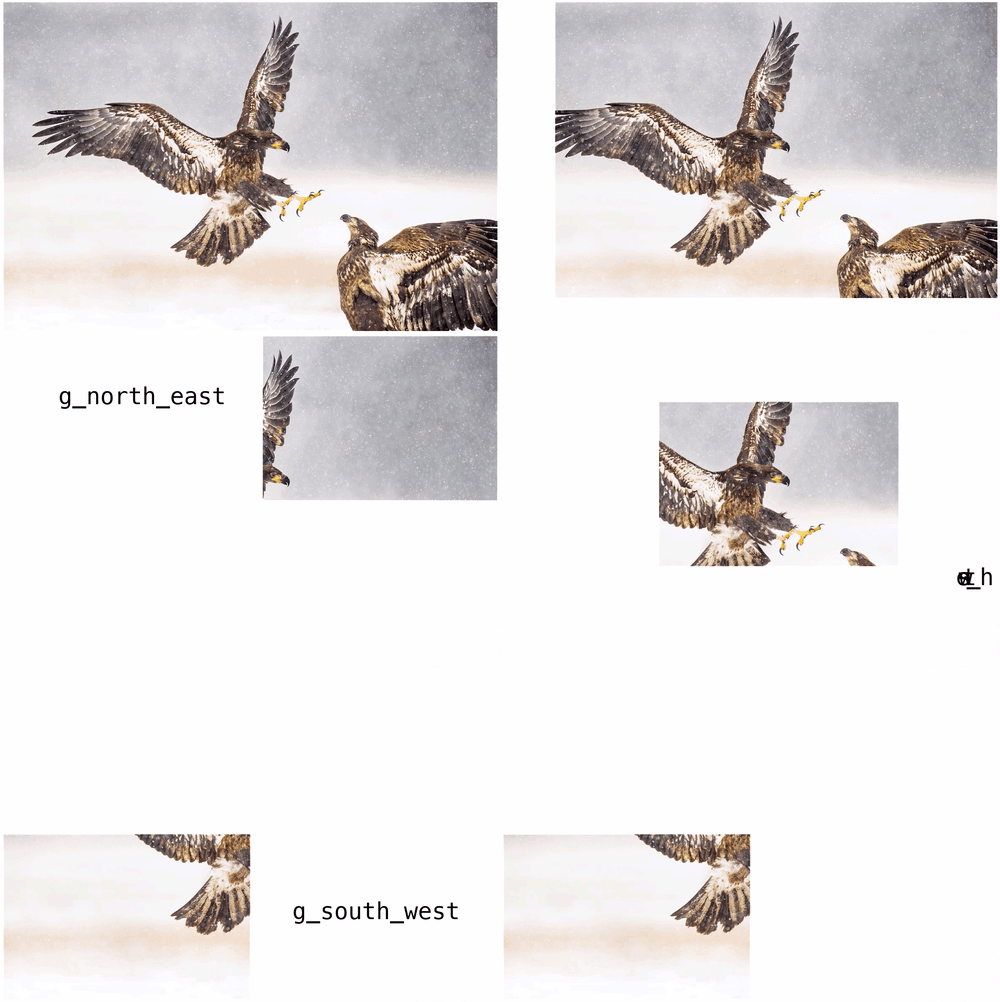
| Jump to this spot in the video 1:08 |
Compass-style directions represent a location in the image. For example, g_north_east represents the top right corner, whereas g_south_west designates the bottom-left corner. |
Content-aware cropping - facial detection
| Jump to this spot in the video 3:08 | One way to create a more reusable cropping style is to have it locate interesting or important aspects in the image. For example, we may want to automatically crop on the most prominent face in a group. This can be done using g_face, thanks to Cloudinary's facial recognition capabilities. |

Automatically crop to the most interesting area (g_auto)
| Jump to this spot in the video 3:55 | You can also apply Cloudinary's automatic gravity algorithm (g_auto), which uses a combination of heuristics or deep learning algorithms to detect and display the most interesting aspect of the image. |

Use g_auto:subject on images
| Jump to this spot in the video 4:24 | By training our neural networks with large datasets, we have created a way to determine the area of the image to which the human eye will be drawn. You can take advantage of this through the g_auto:subject transformation, providing better crop results with very challenging content, such as images with multiple faces. |

Crop to specific objects in an image
| Jump to this spot in the video 5:45 | Rather than playing with compass-style directions or using our automatic cropping transformations, you can let Cloudinary detect the object with g_auto:<object>, for example g_auto:cake, using our Cloudinary AI Content Analysis add-on. This transformation helps to ensure the object is kept when the image is cropped. |

Keep learning
- Review our documentation for more examples of Cloudinary's gravity transformations with images.
- Find out how to apply gravity transformations to your videos with Cloudinary.
- Take a look at the User-generated content guide to see all the features you can take advantage of when displaying user-generated content on your site.
- Enroll in our introductory Cloudinary Academy courses that highlight ways to apply gravity transformations, such as Fundamentals for Developers.
If you like this, you might also like...
Check out the Cloudinary Academy for free self-paced Cloudinary courses on a variety of developer or DAM topics, or register for formal instructor-led courses, either virtual or on-site.