Python: bool() function
bool() function
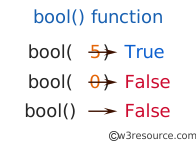
The bool() function is used to convert a value to a Boolean.
Syntax:
class bool([x])
Python: Built-in function - bool function()
Version:
(Python 3.2.5)
If x is false or omitted, this returns False; otherwise it returns True. bool is also a class, which is a subclass of int. Class bool cannot be subclassed further. Its only instances are False and True.
Return value:
Boolean Values (True/False).
Example: Python bool() function
val = True
print("val = ", bool(val))
val = False
print("val = ", bool(val))
val = 5
print("val = ", bool(val))
val = 0
print("val = ", bool(val))
val = bool()
print("val = ", bool(val))
Output:
val = True
val = False
val = True
val = False
val = False
Check if a list is empty or not ?
l = []
if not l:
 print("List is empty.")
else:
 print("List is not empty.")
l = [1, 2, 3]
if not l:
 print("List is empty.")
else:
 print("List is not empty.")
Output:
List is empty.
List is not empty.
Python Code Editor:
[フレーム]PREV : bin()
NEXT : bytearray()
Test your Python skills with w3resource's quiz