Python: any() function
any() function
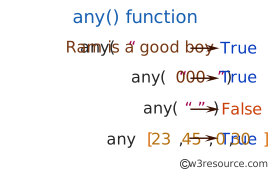
The any() function returns True if any element of the iterable is true. The function returns False if the iterable is empty.
Syntax:
any(iterable)
Python: Built-in-function - any function()
Version:
(Python 3)
Parameter:
| Name | Description | Required / Optional |
|---|---|---|
| iterable | A container is considered to be iterble, which can return its members sequentially. | Required |
Return value:
Return True if any element of the iterable is true.
Example:
def any(iterable):
 for element in iterable:
 if element:
 return True
 return False
Python: any() example with Strings:
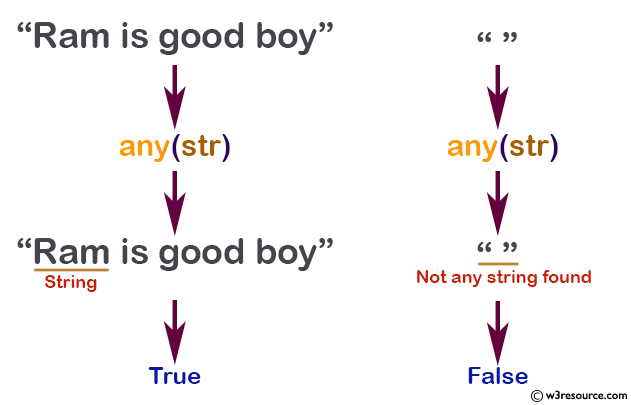
str = "Ram is good boy"
print(any(str))
# 0 is False
# '0' is True
str = '000'
print(any(str))
str = ''
print(any(str))
Output:
True
True
False
Pictorial Presentation:
Python: Built-in-function - any() function
Python: any() example with Lists:
num = [23, 45, 0, 30]
print(any(num)) #True
num = [0, False]
print(any(num)) #False
num = [0, False, 5]
print(any(num)) #True
num = []
print(any(num)) #False
Output:
True
False
True
False
Python: any() example with Dictionaris:
dict = {0: 'False'}
print(any(dict))
dict = {0: 'False', 1: 'True'}
print(any(dict))
dict = {0: 'False', False: 0}
print(any(dict))
dict = {}
print(any(dict))
# 0 is False
# '0' is True
dict = {'0': 'False'}
print(any(dict))
Output:
False
True
False
False
True
Python: any() example with Tuple
#Test if all items in a tuple are True:
tup = (0, True, False)
x = any(tup)
print(x) #True
tup = (2, 3, 4)
x = any(tup)
print(x) #True
Output:
True
True
Python: any() example with Set
#Test if all items in a set are True:
sss = {0, True, False}
x = any(sss)
print(x) #True
sss = (1, True, True)
x = any(sss)
print(x) #True
Output:
True
True
Python Code Editor:
[フレーム]Test your Python skills with w3resource's quiz