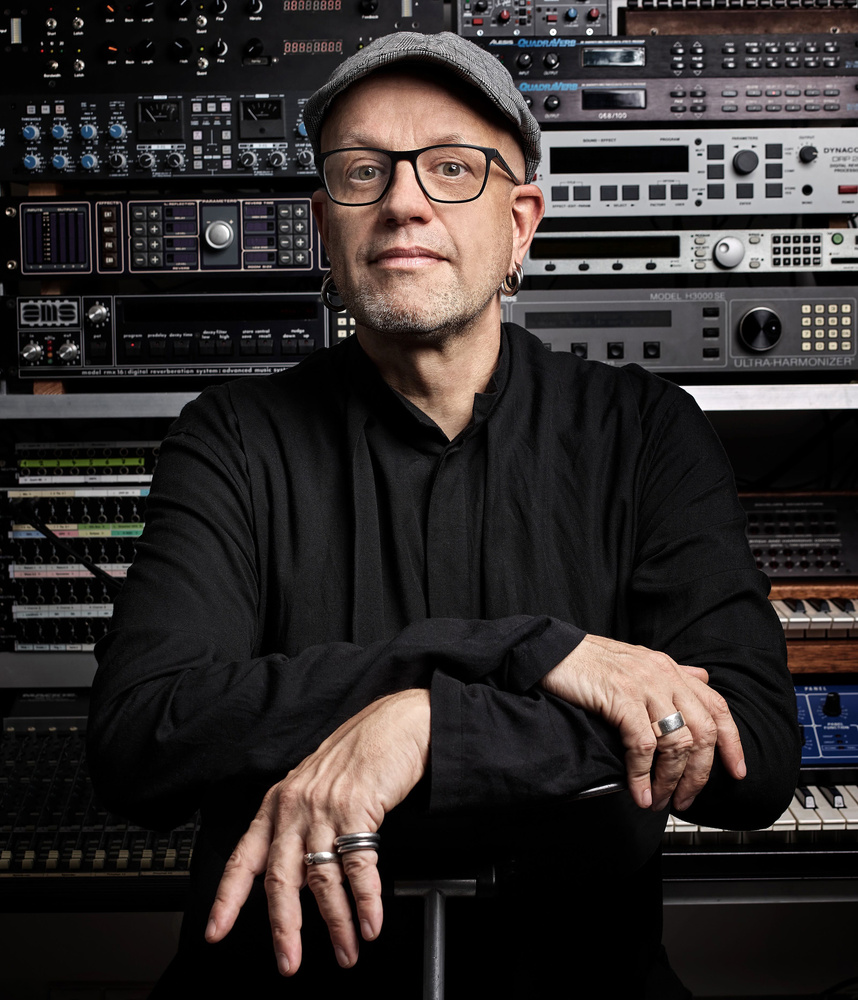
As a musician, software developer, engineer and audiovisual artist, Robert Henke’s career has been defined by his ability to not only make things his own, but to make his own things.
Few figures have shaped the landscape of electronic music technology as profoundly as Robert Henke. Equally at home designing and building software instruments and creating immersive audiovisual performances, Henke has spent more than three decades exploring the creative possibilities that emerge when engineering and artistic curiosity collide.
Best known as the co‐founder of the influential electronic music project Monolake and one of the key figures behind the birth of Ableton Live, Henke has not only redefined the sound of contemporary electronic music but, more significantly, how it is made and performed.
Throughout his career he has consistently blurred the boundaries between musician, inventor and researcher. The reissue of his seminal album Interstate (1999) offered a chance to explore the evolving relationship between technology and creativity, the philosophy behind instrument design, and how a lifelong obsession with sound continues to inspire him towards new artistic directions. Like all good superhero tales, we need to start at the beginning...
"I come from a family of engineers. No artistic involvement whatsoever, but when I was young, I was interested in abstract and minimalist art and stuff like that. I discovered electronic music when I was a teenager, with the usual figures like Jean‐Michel Jarre, Tangerine Dream, and everything that was on the edge between pop and electronic, like Yello, Depeche Mode, these kinds of things.
"I decided to buy my own synthesizer, a Juno‐6, which got stolen at some point, which is really a pity. I moved to Berlin after finishing high school, and then things really took off because I was suddenly surrounded by everyone who was involved in this new upcoming electronic music centred club culture.
"I never, ever thought I would be an artist and always considered it an essential hobby. I worked in video post‐production companies, as a theatre sound guy, a mastering engineer, those kinds of things. I always did jobs that were very, very much related to music or to sound at least, but always gave me a back door just in case whatever I was doing artistically turned out to be nonsense.
"The positive aspect, I believe, is that I was never forced to consider making a living and making compromises. I witnessed a lot of people who, in my opinion, were compromised by the fact that they had to create music that is successful, you know, as a DJ playing the stuff people like, as a music producer, doing something a bit more rhythmical because that sells, those kinds of things.
"I never felt that urge because I could always pay my bills with my other work. The negative side I think, in retrospect, is of course that a full commitment to the arts is also beautiful in itself. So, step by step, I moved from considering it as a hobby to considering it as the most important thing to do in my life. This became especially evident when Ableton was founded, and I had to make the decision between dedicating my life, my career, whatever, to the company or to find a different way.
"And this is why I can also clear up an urban myth. I’m not a founder. I declined that offer because I said, if I start founding this company together with Gerhard [Behles] and Bernd [Roggendorf], I will not make music any more. And I don’t think this is a good idea."
Do It Yourself
For Henke, however, software has never been merely a tool for producing music. It has become a creative medium in its own right. While Ableton provided an extraordinarily successful platform, his own artistic practice increasingly led him toward bespoke systems, including custom‐built instruments and self‐developed applications. In a commercial world his approach is appealingly positive and encouraging.
I make these things for myself. They inspire me and it’s fun to do. They provide me with new ideas and those kinds of things.
"I make these things for myself. They inspire me and it’s fun to do. They provide me with new ideas and those kinds of things. I need to make a living, sure, but I owe so much to all the people who were generous in my life — people who shared ideas with me, who let me borrow their equipment, who listened to me. I could only become who I am due to the generosity of other people.
"And if I build something, turning it into something that generates income would at first mean more effort, you know, setting up a web shop, etc, and I’d rather give it away for free because it’s there anyway, and what I get back is that people are happy. And to me, this is sufficient.
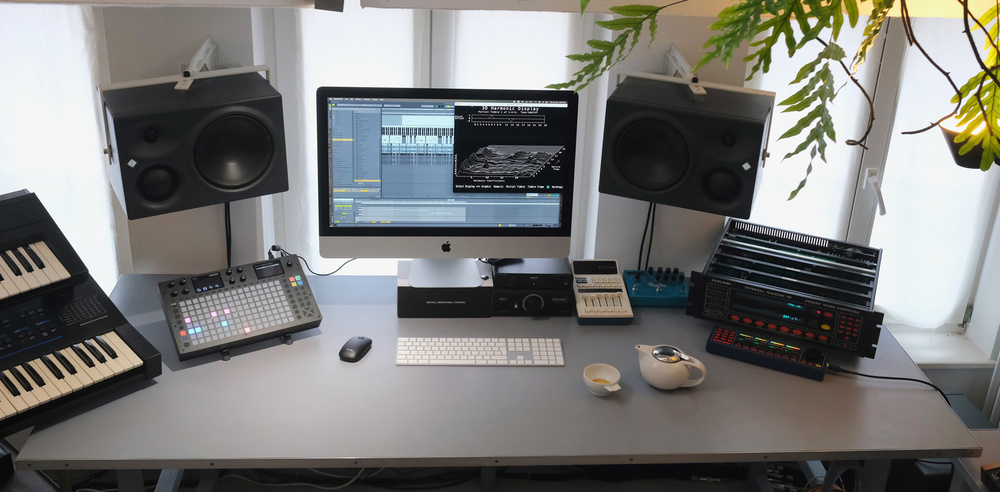
Henke’s studio is a combination of minimal workstation... Henke’s studio is a combination of minimal workstation...
"It was not my career decision to become a software developer for my own little things. In general, I would separate, of course, my work at Ableton from that, because my work at Ableton means I need to do something that is appealing to a lot of users. And there is, of course, a lot of interaction with other stakeholders and discussions and stuff like this. So that is in many ways decoupled from what I would do only for myself.
"The stuff that I do for myself indeed is part of my creative process, and the reason is that I have a specific artistic idea, and I have a vague idea how to get this done technically. And then I build it and the process of building takes time. I have lots of ideas, but I make a conscious decision to say, OK, I invest a day or two into this specific idea, and afterwards the result is something that became for me valuable because I invested time, and that means I got to explore that.
"Recently, I built a little reverb. There’s nothing special about it apart from the fact that it’s a very old technical infrastructure. It’s inspired by the very early digital reverbs from the 1970s and it sounds deliberately bad by nowadays standards, but it has wild modulation capabilities, and it creates this beautiful big, lush, low‐density chorusing effect. Since I made this thing I use it a lot, and it becomes part of my artistic colour, so to say. And for me, this is satisfying and is a justification for doing it. In a way, I extended my palette. You know,...
You are reading one of the locked Subscribers-only articles from our latest 5 issues.
You've read 30% of this article for FREE, so to continue reading...
- ✅ Log in - if you have a Digital Subscription you bought from SoundOnSound.com
- ⬇️ Buy & Download this Single Article in PDF format 0ドル.83 GBP1ドル.49 USD
For less than the price of a coffee, buy now and immediately download to your computer, tablet or mobile. - ⬇️ ⬇️ ⬇️ Buy & Download the FULL ISSUE PDF
Our 'full SOS magazine' for smartphone/tablet/computer. More info... - 📲 Buy a DIGITAL subscription (or 📖 📲 Print + Digital sub)
Instantly unlock ALL Premium web articles!We often release online-only content.
Visit our Shop Store.