Showing posts with label Microsoft. Show all posts
Showing posts with label Microsoft. Show all posts
Wednesday, September 23, 2015
No. 58 - Search in Adjacent Numbers
Question: Given an
array where two neighboring elements are adjacent (in absolute difference 1),
can you write an algorithm to search an element in the array and return its
position? If the element appears multiple times, please return the first
occurrence.
For example, if
given the array {4, 5, 6, 5, 6, 7, 8, 9, 10, 9} and an element 9, the element
appears twice in the array, and the first occurrence is at position 7.
Analysis: The most
simple and straightforward solution is to traverse the array and compare
elements one by one. This strategy works for every array, and it does not
utilize the property of the array where two neighboring elements are in
absolute difference 1.
Let's try to search
the first 9 from the array {4, 5, 6, 5, 6, 7, 8, 9, 10, 9}. Firstly we are at
position 0 where the element 4 is. The difference between 9 and 4 is 5, so we
move to the position 5. Why? Because the absolute difference between two neighboring
elements is 1. If the numbers in the array is increasingly sorted, the element
at position 5 is 9. If some elements decrease, 9 should sit on the right of
position 5. Therefore, 5 is the leftmost possible position of the element 9.
It's 7 at position
5. The difference between 7 and 9 is 2, so we move to right by distance 2 to
the position 7, where the first occurrence of 9 has been found.
We can summarize the
solution: We begin from the first element of the element, and compare it with
the given number. If the absolute difference is n,
move to the right by distance n. Then we
compare the current visited element. Repeat until the given element is found,
or the position is beyond the length of the array when the given element is not
available.
The solution can be
implemented in C/C++ as below:
int
findFirst(int*
nums, intlength, inttarget)
{
if (nums == nullptr || length <= 0)
return -1;
intindex = 0;
while (index < length && nums[index] != target)
{
int delta = target - nums[index];
index += abs(delta);
}
if(index < length)
return index;
return -1;
}
{
if (nums == nullptr || length <= 0)
return -1;
intindex = 0;
while (index < length && nums[index] != target)
{
int delta = target - nums[index];
index += abs(delta);
}
if(index < length)
return index;
return -1;
}
More coding interview questions are discussed
in my book< Coding Interviews: Questions, Analysis & Solutions>. You
may find the details of this book on Amazon.com , or Apress .
The author Harry He owns all the rights of
this post. If you are going to use part of or the whole of this article in your
blog or webpages, please add a reference to http://codercareer.blogspot.com/ . If you are going to use it in your books,
please contact the author via zhedahht@gmail.com . Thanks.
Saturday, August 9, 2014
No. 54 - Merge Ranges
Questions: Given an
array of ranges, please merge the overlapping ones. For example, four ranges
[5, 13], [27, 39], [8, 19], [31, 37] (in blue in Figure1) are merged into
two ranges, which are [5, 19] and [27, 39] (in green in Figure 1).
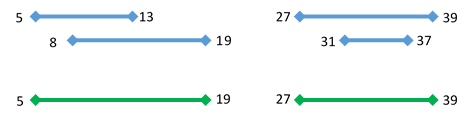
Figure 1: Merge four ranges [5, 13], [27, 39], [8, 19] and [31, 37] (in blue), and get [5, 19], and [27, 39] (in green)
Analysis: Before we
analyze how to merge an array of ranges, let’s discuss how to merge two ranges.
When two ranges don’t overlap each other, they can’t merge. When two ranges
overlap, the less starting value of two ranges becomes the starting value of
the merged range, and the greater ending value of two ranges becomes the ending
value of the merged range.
Therefore,
two ranges [5, 13] and [8, 19] are merged into a new range [5, 19], and two
ranges [27, 39] and [31, 37] are merged into a new range [27, 39]. The two
merged ranges can’t be merged further because they don’t overlap.
The
next question is: How to check whether two ranges overlap each other? When
two ranges overlap, there is at least on node in a range is contained in the
other range. For instance, the starting value 8 of the range [8, 19] is
contained in the range [5, 13], therefore, the two ranges [5, 13] and [8, 19]
overlap. No nodes in the range [8, 19] are contained in the range [31, 37], so
the two ranges don’t overlap.
The
following code shows how to merge two ranges, as well as to check whether two
ranges overlap:
publicbool Contains(int value)
{
if (value >= this.Start && value <= this.End)
{
returntrue;
}
returnfalse;
}
publicbool Overlaps(Range other)
{
if (other == null)
{
returnfalse;
}
if (this.Contains(other.Start) || this.Contains(other.End)
|| other.Contains(this.Start) || other.Contains(this.End))
|| other.Contains(this.Start) || other.Contains(this.End))
{
returntrue;
}
returnfalse;
}
publicRange Merge(Range other)
{
if (!this.Overlaps(other))
{
thrownewApplicationException("Can't merge two
ranges.");
}
int newStart = (this.Start < other.Start) ? this.Start : other.Start;
int newEnd = (this.End > other.End) ? this.End : other.End;
returnnewRange(newStart, newEnd);
}
Now
let’s move on to merge an array of ranges.The first step is to sort the ranges based on their start values. When
the ranges [5, 13], [27, 39], [8, 19], and [31, 37] are sorted, they are in the
order of [5, 13], [8, 19], [27, 39], and [31, 37].
The
next steps are to merge the sorted ranges. The merged ranges are inserted into
a data container. At each step, a range is retrieved from the sorted array, and
merged with the existing ranges in the container.
At
first the data container is empty, and the first range [5, 13] is inserted into
the container directly, without merging. Now there is only one range [5, 13] in
the container.
Then
the next range [8, 19] is retrieved. Since it overlaps the range[5, 13], and
they become [5, 19] when they merged. There is still only one range, which is [5,
19] in the container.
The
next range [27, 39] is retrieved, which does not overlap the range [5, 19] in
the container, so it is inserted into the range directly without merging. There
are two ranges [5, 19] and [27, 39] in the container.
The
last range in the sorted array is [31, 37]. It overlaps the last range [27, 39] in the container.
Therefore, the last range [27, 39] is deleted from the container, and then the
merged range is inserted into the container. At this step, the merged range is
also [27, 39].
Ranges
in the container are also sorted based on their starting values, and they don't
overlap each other. Notice that it's only necessary to check whether the new
range overlap the last range in the container. Why not the other ranges in the
container? Let's analyze what would happen when a new range in the sorted array
overlap two ranges in the container, with Figure 2:
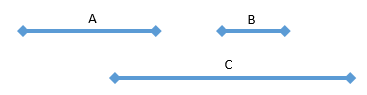
Figure 2: It causes problems when a new range overlaps two ranges in the merged container
In
Figure 2, the container has two ranges A and B, and a new range C is retrieved
from the sorted array, which overlaps the ranges A and B. Since C overlaps A,
the starting value of C should be less than the ending value of A. On the other
hand, C is retrieved from the sorted array later than B, the starting value of
C is greater than starting value of B. Additionally, B is behind A and they
don't overlap, so the starting value of B is greater than the ending value A.
Therefore, the starting value of C is greater than the ending value of A. It
contradicts.
Since
it's only necessary to merge new ranges from the sorted array with the last
range in the container. We implement the container as a stack, and the last
range is on the top of the stack.
The
following is the C# code to merge a sort an array of ranges:
publicstaticRange[]
Merge(Range[] ranges)
{
Stack<Range> results = newStack<Range>();
if (ranges != null)
{
Array.Sort(ranges, CompareRangeByStart);
foreach (var range in ranges)
{
if (results.Count == 0)
{
results.Push(range);
}
else
{
var top =
results.Peek();
if
(top.Overlaps(range))
{
var union = top.Merge(range);
results.Pop();
results.Push(union);
}
else
{
results.Push(range);
}
}
}
}
return results.Reverse().ToArray();
}
The
code with unit tests are shared at http://ideone.com/kg4TwM.
More coding interview questions are discussed
in my book< Coding Interviews: Questions, Analysis & Solutions>. You
may find the details of this book on Amazon.com ,
or Apress .
The author Harry He
owns all the rights of this post. If you are going to use part of or the whole
of this ariticle in your blog or webpages, please add a reference to http://codercareer.blogspot.com/ . If you are going to use it in your books,
please contact him via zhedahht@gmail.com . Thanks.
Labels:
Algorithm,
Amazon,
Interview Question,
Microsoft,
Stack
Tuesday, December 3, 2013
No. 50 - Numbers Appearing Once
Problem: In
an array, all numbers appear three times except one which only appears only
once. Please find the unique number.
Analysis: It is simpler if we modify the problem a little bit: Please find a unique number from an array where other numbers appear twice. We could solve this simplified problem with the XOR bitwise operation. If all numbers in the array are XORed, the result is the number appearing only once, since pairs of numbers get 0 when they are XORed.
The strategy with XOR does not work since all numbers except one appear three times, since the XOR result of a triple of numbers is the number itself.
Even though we could not solve the problem with XOR, we may still stick on the bitwise operations. A number appears three times, each bit (either 0 or 1) also appears three times. If every bit of numbers appearing three time is added, the sum of every bit should be multiple of 3.
Supposing every bit of numbers (including the unique number) in the input array is added. If the sum of a bit is multiple of 3, the corresponding bit in the unique number is 0. Otherwise, it is 1.
The solution can be implemented in Java as the code listed below:
publicstaticint FindNumberAppearingOnce(int[] numbers) {
int[] bitSum = newint[32];Analysis: It is simpler if we modify the problem a little bit: Please find a unique number from an array where other numbers appear twice. We could solve this simplified problem with the XOR bitwise operation. If all numbers in the array are XORed, the result is the number appearing only once, since pairs of numbers get 0 when they are XORed.
The strategy with XOR does not work since all numbers except one appear three times, since the XOR result of a triple of numbers is the number itself.
Even though we could not solve the problem with XOR, we may still stick on the bitwise operations. A number appears three times, each bit (either 0 or 1) also appears three times. If every bit of numbers appearing three time is added, the sum of every bit should be multiple of 3.
Supposing every bit of numbers (including the unique number) in the input array is added. If the sum of a bit is multiple of 3, the corresponding bit in the unique number is 0. Otherwise, it is 1.
The solution can be implemented in Java as the code listed below:
publicstaticint FindNumberAppearingOnce(int[] numbers) {
for(int i = 0; i < 32; ++i) {
bitSum[i] = 0;
}
for(int i = 0; i < numbers.length; ++i) {
int bitMask = 1;
for(int j = 31; j >= 0; --j) {
int bit = numbers[i] & bitMask;
if(bit != 0) {
bitSum[j] += 1;
}
bitMask = bitMask << 1;
}
}
int result = 0;
for(int i = 0; i < 32; ++i) {
result = result << 1;
result += bitSum[i] % 3;
}
return result;
}
The time efficiency of this solution is O(n), and space efficiency is O(1) because an array with 32 elements is created. It's more efficient than two straightforward solutions: (1) It's easy to find the unique number from a sorted array, but it costs O(nlogn) time to sort an array with n elements. (2) We may utilize a hash table to store the number of occurrences of each element in the array, but the cost for the hash table is O(n).
Code with unit tests is shared at http://ideone.com/tTk3RX .
More coding interview questions are discussed in my book<
Coding Interviews: Questions, Analysis & Solutions>. You may find the
details of this book on Amazon.com ,
or Apress .
The author Harry He
owns all the rights of this post. If you are going to use part of or the whole
of this ariticle in your blog or webpages, please add a reference to http://codercareer.blogspot.com/ .
If you are going to use it in your books, please contact him via
zhedahht@gmail.com . Thanks.
Friday, November 29, 2013
No. 49 - Longest Substring without Duplication
Problem:
Given a string, please get the length of the longest substring which does not
have duplicated characters. Supposing all characters in the string are in the
range from ‘a’ to ‘z’.
Analysis:
It’s not difficult to get all substrings of a string, and to check whether a
substring has duplicated characters. The only concern about this brute-force
strategy is performance. A string with n
characters has O(n2)
substrings, and it costs O(n) time to
check whether a substring has duplication. Therefore, the overall cost is O(n3).
We may improve the efficiency with dynamic programming. Let’s
denote the length of longest substring ending with the ith character by L(i).
We scan the string one character after another. When the ith character is scanned, L(i-1)
is already know. If the ith
character has not appeared before, L(i) should be L(i-1)+1. It’s more
complex when the ith
character is duplicated. Firstly we get the distance between the ith character and its
previous occurrence. If the distance is greater than L(i-1), the character is
not in longest substring without duplication ending with the (i-1)th
character, so L(i) should also be L(i-1)+1. If the distance is less than L(i-1),
L(i)
is the distance, and it means between the two occurrence of the ith character there are no
other duplicated characters.
This solution can be implemented in Java as the following
code:
publicstaticint longestSubstringWithoutDuplication(String str) {
int curLength = 0;
int maxLength = 0;
int position[] = newint[26];
for(int i = 0; i < 26; ++i) {
position[i] = -1;
}
for(int i = 0; i < str.length(); ++i) {
int prevIndex = position[str.charAt(i) - 'a'];
if(prevIndex < 0 || i - prevIndex > curLength) {
++curLength;
}
else {
if(curLength > maxLength) {
maxLength = curLength;
}
curLength = i - prevIndex;
}
position[str.charAt(i) - 'a'] = i;
}
if(curLength > maxLength) {
maxLength = curLength;
}
return maxLength;
}
L(i) is implemented as curLength in the code above. An
integer array is used to store the positions of each character.
More coding interview questions are discussed in my book
<Coding Interviews: Questions, Analysis & Solutions>. You may find
the details of this book on Amazon.com , or Apress .
The
author Harry He owns all the rights of this post. If you are going to use part
of or the whole of this ariticle in your blog or webpages, please add a
reference to http://codercareer.blogspot.com/ .
If you are going to use it in your books, please contact him via
zhedahht@gmail.com . Thanks.
Saturday, March 2, 2013
No. 45 - Closest Node in a Binary Search Tree
Problem:
Given a binary search tree and a value k,
please find a node in the binary search tree whose value is closest to k.
{
BinaryTreeNode* pClosest = NULL;
int minDistance = 0x7FFFFFFF;
BinaryTreeNode* pNode = pRoot;
while(pNode != NULL)
{
int distance = abs(pNode->m_nValue - value);
if(distance < minDistance)
{
minDistance = distance;
pClosest = pNode;
}
else if(pNode->m_nValue < value)
pNode = pNode->m_pRight;
}
The author Harry He owns all the rights of this post. If you are going to use part of or the whole of this ariticle in your blog or webpages, please add a reference to http://codercareer.blogspot.com/ . If you are going to use it in your books, please contact him via zhedahht@gmail.com . Thanks.
For instance, in the binary search tree in Figure 1, the
node closest to 29 is the node with value 28.

Figure 1: A sample binary search tree, in which the closest node to 29 is the node with value 28
Analysis:
Let’s analyze this problem step by step, taking the binary search in Figure 1
and 29 as an example.
We start from the root node with value 32, and the distance
to 29 is 3. Since the value 32 is greater than 29, and all values in the right
sub-tree are greater than 32, distances to 29 in the right sub-tree should be
greater than 3. We move to the left sub-tree.
The next node to be visited contains value 24, and the
distance to 29 is 5. Since 5 is greater than the previous closest distance 3,
the closest node up to now remains the node with value 32. Additionally, the
current value 24 is less than 29, and all values in the left sub-tree are less
than 24, so distances to 29 in the left sub-tree will be greater than 5. We
move on to visit the right sub-tree.
The next node to be visited contains value 28, and the
distance to 29 is 1. Since 1 is less than the previous closest distance 3, the
closest node is updated to the node with value 28. Additionally, the value 28 is less
than 29, and all values in the left sub-tree areless than 28, so distances to 29
in the left sub-tree will be greater than 1. Let’s continue to visit the right
sub-tree.
Finally we reach a left node with value 31. The distance to
29 is 2 and it is greater than the previous closest distance 1, so the closest node to 29 is still the node with
value 28.
According to the step-by-step analysis above, we could
implement the following code:
BinaryTreeNode* getClosestNode(BinaryTreeNode*
pRoot, int value){
BinaryTreeNode* pClosest = NULL;
int minDistance = 0x7FFFFFFF;
BinaryTreeNode* pNode = pRoot;
while(pNode != NULL)
{
int distance = abs(pNode->m_nValue - value);
if(distance < minDistance)
{
minDistance = distance;
pClosest = pNode;
}
if(distance == 0)
break;
if(pNode->m_nValue > value)
pNode = pNode->m_pLeft;else if(pNode->m_nValue < value)
pNode = pNode->m_pRight;
}
return pClosest;
}
More coding interview
questions are discussed in my book <Coding Interviews: Questions, Analysis
& Solutions>. You may find the details of this book on Amazon.com , or Apress .
The author Harry He owns all the rights of this post. If you are going to use part of or the whole of this ariticle in your blog or webpages, please add a reference to http://codercareer.blogspot.com/ . If you are going to use it in your books, please contact him via zhedahht@gmail.com . Thanks.
Saturday, February 23, 2013
No. 44 - Dynamic Programming on Stolen Values
Problem: There
are n houses built in a line, each of
which contains some value in it. A thief is going to steal the maximal value in
these houses, but he cannot steal in two adjacent houses because the owner of a
stolen house will tell his two neighbors on the left and right side. What is
the maximal stolen value?
For example, if there are four houses with values {6, 1, 2,
7}, the maximal stolen value is 13 when the first and fourth houses are stolen.
Analysis: A function f(i) is defined to denote the maximal
stolen value from the first house to the ith
house, and the value contained in the ith house is denoted as vi. When the thief reaches the ith
house, he has two choices: to steal or not. Therefore, f(i) can be defined with
the following equation:

It would be much more efficient to calculate in bottom-up order
than to calculate recursively. It looks like a 1D array with size n is needed, but actually it is only
necessary to cache two values for f(i-1) and f(i-2) to calculate f(i).
This algorithm can be implemented with the following C++
code:
int maxStolenValue(const
vector<int>& values)
{
int length = values.size();
if(length == 0)
return 0;
int value1 = values[0];
if(length == 1)
return value1;
int value2 = max<int>(values[0],
values[1]);
if(length == 2)
return value2;
int value;
for(int i = 2; i <
length; ++i)
{
value
= max<int>(value2, value1 + values[i]);
value1 = value2;
value2 = value;
}
return value;
}
More coding interview questions are discussed in my book <Coding Interviews: Questions, Analysis & Solutions>. You may find the details of this book on Amazon.com, or Apress.
The author Harry He owns all the rights of this post. If you are going to use part of or the whole of this ariticle in your blog or webpages, please add a reference to http://codercareer.blogspot.com/. If you are going to use it in your books, please contact him via zhedahht@gmail.com . Thanks.
Subscribe to:
Posts (Atom)