Showing posts with label Amazon. Show all posts
Showing posts with label Amazon. Show all posts
Monday, April 4, 2016
No. 59 - Duplications in Arrays
Questions: All numbers in an array with length n+1 are in range from 1 to n, so there is at least one duplication in the
array. How to find any a duplication? Please don't modify the input array.
Analysis: The simple solution is to utilize
hash tables. When scanning the array, array elements are inserted into the hash
table one by one. In this way, it's easy to find a duplication with the hash
table, which costs O(n) space.
Let's try not to
employ extra space. Why there are duplications in the array? If there are no
duplications, the count of numbers ranging from 1 to n is n. Since the array
contains more than n numbers, there
should be duplications. It looks like it's important to count numbers in
ranges.
Let's divide numbers
from 1 to n into two ranges, split with
the number in the middle (denoted as m),
and then count the numbers of the two subranges. If the count of numbers from 1
to m is greater than m, the duplication is in the range from 1 to m. Otherwise, there should be at least one
duplication in the range from m+1 to n. And then we continue the recursive process
until we find the duplication.
The Java code is
listed below:
static int
countRange(int[] numbers, int start, int
end)
{
int count = 0;
for(int
i = 0; i < numbers.length; i++)
if(numbers[i] >= start &&
numbers[i] <= end)
++count;
return count;
}
static int
getDuplication(int[] numbers)
{
intstart = 1;
int end = numbers.length;
while(end >= start)
int middle = ((end - start) >>
1) + start;
int count = countRange(numbers,
start, middle);
if(end == start) {
if(count > 1)
return start;
else
break;
}
if(count > (middle - start + 1))
end = middle;
else
start = middle + 1;
}
return-1;
}
The code with unit
tests is shared at http://ideone.com/lhV22m.
More coding interview questions are discussed
in my book< Coding Interviews: Questions, Analysis & Solutions>. You
may find the details of this book on Amazon.com , or Apress .
The author Harry He owns all the rights of
this post. If you are going to use part of or the whole of this article in your
blog or webpages, please add a reference to http://codercareer.blogspot.com/ . If you are going to use it in your books,
please contact the author via zhedahht@gmail.com . Thanks.
Labels:
Algorithm,
Amazon,
Binary Search,
Google,
Interview Question
Saturday, October 4, 2014
No. 56 - Maximal Value of Gifts
Question:
A board has n*m cells, and there is a gift with some value (value is greater than
0) in every cell. You can get gifts starting from the top-left cell, and move
right or down in each step, and finally reach the cell at the bottom-right
cell. What’s the maximal value of gifts you can get from the board?

For example, the maximal value of gift from the board above
is 53, and the path is highlighted in red.
Analysis:
It is a typical problem about dynamic programming. Firstly let’s analyze it
with recursion. A function f(i, j)
is defined for the maximal value of gifts when reaching the cell (i, j).
There are two possible cells before the cell (i, j) is reached: One is
(i - 1, j), and the other is the cell (i,
j-1). Therefore, f(i, j)= max(f(i-1,
j), f(i, j-1)) + gift[i, j].
Even though it’s a recursive equation, it’s not a good idea
to write code in recursion, because there might be many over-lapping
sub-problems. A better solution is to solve is with iteration. A 2-D matrix is
utilized, and the value in each cell (i,
j) is the maximal value of gift when
reaching the cell (i, j) on the board.
The iterative solution can be implemented in the following
Java code:
publicstaticint getMaxValue(int[][] values) {
int rows = values.length;int cols = values[0].length;
int[][] maxValues = newint[rows][cols];
for(int i = 0; i < rows; ++i) {
for(int j = 0; j < cols; ++j) {
int left = 0;
int up = 0;
if(i > 0) {
up = maxValues[i - 1][j];
}
if(j > 0) {
left = maxValues[i][j - 1];
}
maxValues[i][j] = Math.max(left, up) + values[i][j];
}
}
return maxValues[rows - 1][cols - 1];
}
Optimization
The maximal value of gifts when reaching the cell (i, j)
depends on the cells (i-1, j) and (i, j-1) only, so it is
not necessary to save the value of the cells in the rows i-2 and above. Therefore, we can replace the 2-D matrix with an
array, as the following code shows:
publicstaticint getMaxValue(int[][] values) {
int rows = values.length;
int cols = values[0].length;
int[] maxValues = newint[cols];
for (int i = 0; i < rows; ++i) {
for (int j = 0; j < cols; ++j) {
int left = 0;
int up = 0;
if (i > 0) {
up = maxValues[j];
}
if (j > 0) {
left = maxValues[j - 1];
}
maxValues[j] = Math.max(left, up) +
values[i][j];
}
}
return maxValues[cols - 1];
}
The source code with unit test cases is shared at http://ideone.com/2vLRMk.
The author Harry He owns all the rights of this post. If you are going to use part of or the whole of this ariticle in your blog or webpages, please add a reference to http://codercareer.blogspot.com/ . If you are going to use it in your books, please contact the author via zhedahht@gmail.com . Thanks.
Saturday, September 13, 2014
No. 55 - Translating Numbers to Strings
Question: Given a
number, please translate it to a string, following the rules: 1 is translated
to 'a', 2 to 'b', …, 12 to 'l', …, 26 to 'z'. For example, the number 12258 can
be translated to "abbeh", "aveh", "abyh",
"lbeh" and "lyh", so there are 5 different ways to
translate 12258. How to write a function/method to count the different ways to
translate a number?
Analysis: Let's take
the number 12258 as an example to analyze the steps to translate from the
beginning character to the ending one. There are two possible first characters
in the translated string. One way is to split the number 12258 into 1 and 2258
two parts, and 1 is translated into 'a'. The other way is to split the number
12258 into 12 and 258 two parts, and 12 is translated into 'l'.
When the first one
or two digits are translated into the first character, we can continue to
translate the remaining digits. Obviously, we could write a recursive
function/method to translate.
Let's define a
function f(i)
as the count of different ways to translate a number starting from the ith digit, f(i)=g(i)*f(i+1)+h(i, i+1)*f(i+2).
The function g(i) gets 1 when the ith digit is in the range 1 to 9 which can be converted to a
character, otherwise it gets 0. The function h(i, i+1)
gets 1 the ith and (i+1)th digits are in the
range 10 to 26 which can also be converted to a character. A single digit 0
can't be converted to a character, and two digits starting with a 0, such as 01
and 02, can't be converted either.
Even though the
problem is analyzed with recursion, recursion is not the best approach because
of overlapping sub-problems. For example,The problem to translate 12258 is split into two sub-problems: one is to
translate 1 and 2258, and the other is to translate 12 and 258. In the next
step during recursion, the problem to translate 2258 can also split into two
sub-problems: one is to translate 2 and 258, and the other is to translate 22
and 58. Notice the sub-problem to translate 258 reoccurs.
Recursion
solves problem in the top-down order. We could solve this problem in the
bottom-up order, in order to eliminate overlap sub-problems. That's to say, we start to translate the
number from the ending digits, and then move from right to left during
translation.
The following is the
C# code to solve this problem:
publicstaticint
GetTranslationCount(int number)
{
if (number <= 0)
{
return 0;
}
string numberInString = number.ToString();
return GetTranslationCount(numberInString);
}
privatestaticint
GetTranslationCount(string number)
{
int length = number.Length;
int[] counts = newint[length];
for (int i = length - 1; i >= 0; --i)
{
int count = 0;
if (number[i] >= '1' && number[i] <= '9')
{
if (i < length - 1)
{
count += counts[i + 1];
}
else
{
count += 1;
}
}
if (i < length - 1)
{
int digit1 = number[i] - '0';
int digit2 = number[i + 1] - '0';
int converted = digit1 * 10 + digit2;
if (converted >= 10 && converted
<= 26)
{
if (i <
length - 2)
{
count += counts[i + 2];
}
else
{
count += 1;
}
}
}
counts[i] = count;
}
return counts[0];
}
In order to simply
the code implementation, we first convert the number into a string, and then
translate.
The code with unit tests is shared at http://ideone.com/7wihgj.
More coding interview questions are discussed in my book< Coding Interviews: Questions, Analysis & Solutions>. You may find the details of this book on Amazon.com, or Apress.
The author Harry He owns all the rights of this post. If you are going to use part of or the whole of this ariticle in your blog or webpages, please add a reference to http://codercareer.blogspot.com/. If you are going to use it in your books, please contact him via zhedahht@gmail.com . Thanks.
Saturday, August 9, 2014
No. 54 - Merge Ranges
Questions: Given an
array of ranges, please merge the overlapping ones. For example, four ranges
[5, 13], [27, 39], [8, 19], [31, 37] (in blue in Figure1) are merged into
two ranges, which are [5, 19] and [27, 39] (in green in Figure 1).
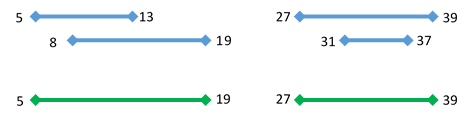
Figure 1: Merge four ranges [5, 13], [27, 39], [8, 19] and [31, 37] (in blue), and get [5, 19], and [27, 39] (in green)
Analysis: Before we
analyze how to merge an array of ranges, let’s discuss how to merge two ranges.
When two ranges don’t overlap each other, they can’t merge. When two ranges
overlap, the less starting value of two ranges becomes the starting value of
the merged range, and the greater ending value of two ranges becomes the ending
value of the merged range.
Therefore,
two ranges [5, 13] and [8, 19] are merged into a new range [5, 19], and two
ranges [27, 39] and [31, 37] are merged into a new range [27, 39]. The two
merged ranges can’t be merged further because they don’t overlap.
The
next question is: How to check whether two ranges overlap each other? When
two ranges overlap, there is at least on node in a range is contained in the
other range. For instance, the starting value 8 of the range [8, 19] is
contained in the range [5, 13], therefore, the two ranges [5, 13] and [8, 19]
overlap. No nodes in the range [8, 19] are contained in the range [31, 37], so
the two ranges don’t overlap.
The
following code shows how to merge two ranges, as well as to check whether two
ranges overlap:
publicbool Contains(int value)
{
if (value >= this.Start && value <= this.End)
{
returntrue;
}
returnfalse;
}
publicbool Overlaps(Range other)
{
if (other == null)
{
returnfalse;
}
if (this.Contains(other.Start) || this.Contains(other.End)
|| other.Contains(this.Start) || other.Contains(this.End))
|| other.Contains(this.Start) || other.Contains(this.End))
{
returntrue;
}
returnfalse;
}
publicRange Merge(Range other)
{
if (!this.Overlaps(other))
{
thrownewApplicationException("Can't merge two
ranges.");
}
int newStart = (this.Start < other.Start) ? this.Start : other.Start;
int newEnd = (this.End > other.End) ? this.End : other.End;
returnnewRange(newStart, newEnd);
}
Now
let’s move on to merge an array of ranges.The first step is to sort the ranges based on their start values. When
the ranges [5, 13], [27, 39], [8, 19], and [31, 37] are sorted, they are in the
order of [5, 13], [8, 19], [27, 39], and [31, 37].
The
next steps are to merge the sorted ranges. The merged ranges are inserted into
a data container. At each step, a range is retrieved from the sorted array, and
merged with the existing ranges in the container.
At
first the data container is empty, and the first range [5, 13] is inserted into
the container directly, without merging. Now there is only one range [5, 13] in
the container.
Then
the next range [8, 19] is retrieved. Since it overlaps the range[5, 13], and
they become [5, 19] when they merged. There is still only one range, which is [5,
19] in the container.
The
next range [27, 39] is retrieved, which does not overlap the range [5, 19] in
the container, so it is inserted into the range directly without merging. There
are two ranges [5, 19] and [27, 39] in the container.
The
last range in the sorted array is [31, 37]. It overlaps the last range [27, 39] in the container.
Therefore, the last range [27, 39] is deleted from the container, and then the
merged range is inserted into the container. At this step, the merged range is
also [27, 39].
Ranges
in the container are also sorted based on their starting values, and they don't
overlap each other. Notice that it's only necessary to check whether the new
range overlap the last range in the container. Why not the other ranges in the
container? Let's analyze what would happen when a new range in the sorted array
overlap two ranges in the container, with Figure 2:
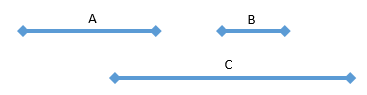
Figure 2: It causes problems when a new range overlaps two ranges in the merged container
In
Figure 2, the container has two ranges A and B, and a new range C is retrieved
from the sorted array, which overlaps the ranges A and B. Since C overlaps A,
the starting value of C should be less than the ending value of A. On the other
hand, C is retrieved from the sorted array later than B, the starting value of
C is greater than starting value of B. Additionally, B is behind A and they
don't overlap, so the starting value of B is greater than the ending value A.
Therefore, the starting value of C is greater than the ending value of A. It
contradicts.
Since
it's only necessary to merge new ranges from the sorted array with the last
range in the container. We implement the container as a stack, and the last
range is on the top of the stack.
The
following is the C# code to merge a sort an array of ranges:
publicstaticRange[]
Merge(Range[] ranges)
{
Stack<Range> results = newStack<Range>();
if (ranges != null)
{
Array.Sort(ranges, CompareRangeByStart);
foreach (var range in ranges)
{
if (results.Count == 0)
{
results.Push(range);
}
else
{
var top =
results.Peek();
if
(top.Overlaps(range))
{
var union = top.Merge(range);
results.Pop();
results.Push(union);
}
else
{
results.Push(range);
}
}
}
}
return results.Reverse().ToArray();
}
The
code with unit tests are shared at http://ideone.com/kg4TwM.
More coding interview questions are discussed
in my book< Coding Interviews: Questions, Analysis & Solutions>. You
may find the details of this book on Amazon.com ,
or Apress .
The author Harry He
owns all the rights of this post. If you are going to use part of or the whole
of this ariticle in your blog or webpages, please add a reference to http://codercareer.blogspot.com/ . If you are going to use it in your books,
please contact him via zhedahht@gmail.com . Thanks.
Labels:
Algorithm,
Amazon,
Interview Question,
Microsoft,
Stack
Subscribe to:
Posts (Atom)