CTRL provides access to an unusually comprehensive 10‐band parametric EQ, which offers a wide range of filter types. CTRL provides access to an unusually comprehensive 10‐band parametric EQ, which offers a wide range of filter types.
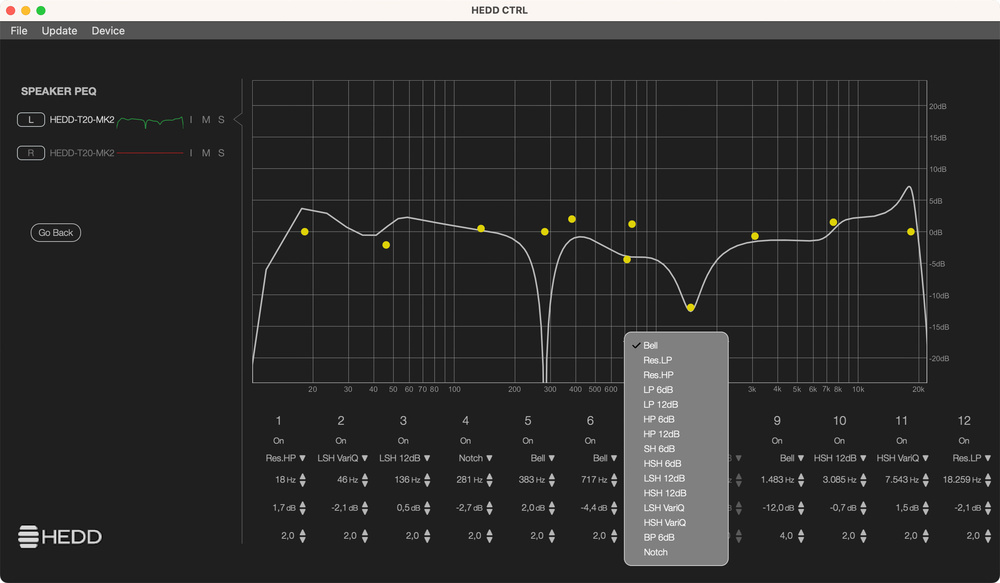
HEDD’s Mk2 monitors and BASS subs now benefit from comprehensive remote control.
As 2025 drew to a close, Berlin‐based HEDD Audio launched the CTRL Network Remote System Control and Calibration software for the company’s Mk2 monitors and BASS subwoofers. The Mk2 range are seriously high‐performance nearfield monitors (see our October 2021 review of the Type 07 Mk2, and last year’s review of the Type 05 Mk2), and the compact three‐way Type 20 Mk2 supplied for this review are no exception!
The Mk2’s DSP functionality allows the user to adapt the monitors’ response to suit the room and their positioning within it. In addition to source‐selection switching (balanced analogue or AES digital) and a ±12dB input sensitivity control, the Mk2 rear panel also carries controls for ±4dB high‐ and low‐frequency shelving EQs at 3kHz and 200Hz respectively; a three‐position (‐1,‐2 or ‐4dB) Desk EQ at 180Hz; normal and extended bass responses (‐3dB at 32Hz and 26Hz on the Type 20 Mk2); and a 80Hz high‐pass filter that can be activated when using a HEDD BASS subwoofer. The Mk2 DSP also powers HEDD’s proprietary Lineariser, a switchable high‐resolution, zero‐phase FIR filter that compensates for frequency‐dependent latencies within the monitor in order to improve transient resolution, source separation and imaging accuracy.
Mk2 monitors also feature HEDD’s CoP (Closed or Ported) option, which offers two distinctly different bass responses. In Closed mode, precisely shaped plugs are used to block the monitor’s reflex port, producing (in general terms) a tighter, more controlled low‐frequency response than that of an open port. In contrast, an open reflex port will (again in general terms) deliver a looser, louder, and more extended low‐frequency response than a closed port. A rear panel CoP switch selects different time‐domain compensation profiles for each mode, since opening or closing a port not only affects the monitor’s frequency response, but also changes its group delay (frequency‐dependent latency).
The CTRL...
You are reading one of the locked Subscribers-only articles from our latest 5 issues.
You've read 30% of this article for FREE, so to continue reading...
- ✅ Log in - if you have a Digital Subscription you bought from SoundOnSound.com
- ⬇️ Buy & Download this Single Article in PDF format 0ドル.83 GBP1ドル.49 USD
For less than the price of a coffee, buy now and immediately download to your computer, tablet or mobile. - ⬇️ ⬇️ ⬇️ Buy & Download the FULL ISSUE PDF
Our 'full SOS magazine' for smartphone/tablet/computer. More info... - 📲 Buy a DIGITAL subscription (or 📖 📲 Print + Digital sub)
Instantly unlock ALL Premium web articles!We often release online-only content.
Visit our Shop Store.