FLEA have replicated one of the most influential mics of all time — but without the valve.
Slovakia’s FLEA Microphones have now been around for well over 20 years. In that time, they’ve built up an enviable reputation for their meticulous recreations of classic microphones. FLEA’s Vintage series pays homage to the most celebrated large‐diaphragm valve mics, and includes faithful replicas of the Neumann U47, U48, M49 and M50, the AKG C12 and the Telefunken ELA M 251. More recently, they introduced the Next range of mics, which are also inspired by the classics without being exact clones.
The mic under review here is part of the Vintage line, but is not a valve microphone. FLEA’s M 251 FET is an attempt to capture the magic of the ELA M 251 in a phantom‐powered, solid‐state design. The advantages of this include lower cost, low noise and greater convenience, with no need for a dedicated power supply. But does the M 251 FET still have the special sonic qualities that make the Telefunken original the most sought‐after vocal mic of all time?
In The Ring
At the heart of all good C12 and ELA M 251 microphones is AKG’s ‘brass ring’ CK12, which has been described as the most complex microphone capsule ever built, and is notoriously difficult to replicate. Unlike the main Neumann designs, it hasn’t yet proved amenable to mass (re)production in the Far East, and so modern‐day mic builders are faced with a choice. You can buy a cheap capsule that outwardly looks like a CK12, and perhaps tinker with the circuit to make the on‐axis frequency response somewhat like that of a C12 or ELA M 251. Or you can buy a handmade capsule that is actually constructed like a CK12 — if you can find someone to make it, and if you can justify the cost.
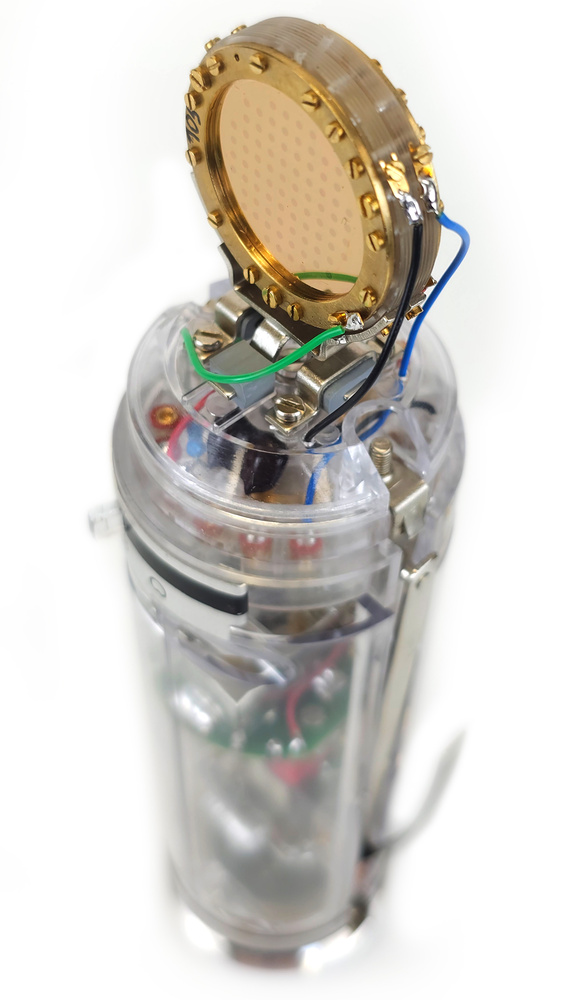
As befits their reputation, FLEA have always taken the second approach, and their earlier C12 copies used Tim Campbell’s excellent CT12 capsule. However, they have since developed their own CK12 clone, which is now being used in all of their AKG‐inspired mics, including the M 251 FET.
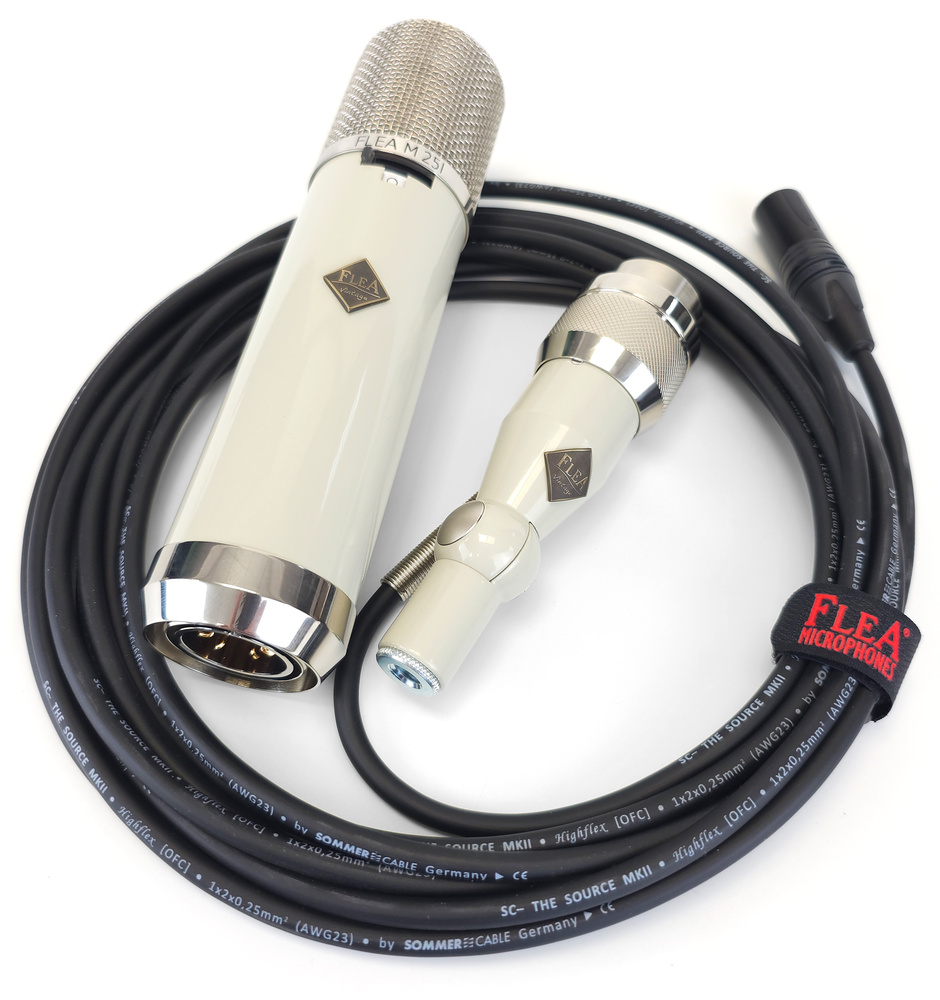
One of the reasons why FLEA mics are so highly regarded is that they’ve always gone the extra mile to recreate the construction of the originals. FLEA mics don’t just look a bit like their inspirations when viewed from a distance; they follow the dimensions precisely, and also reproduce the finish as closely as possible. That has led FLEA to make an interesting decision in designing the M 251 FET. As it’s a standard phantom‐powered microphone, there’s no functional reason why it needs to have a bespoke connector or cable. But in order to maintain the look and feel of the ELA M 251, they’ve equipped it with a period‐correct swivel standmount, with a multi‐pin connector and a captive cable.
This, of course, has pros and cons. Like the original, FLEA’s standmount is a lovely piece of engineering that holds the mic securely at any angle. But like the original, it offers minimal shock protection, and the captive cable is a fixed length that may not be convenient for all applications.
The construction of the entire system is every bit as good as you’d expect from FLEA’s reputation. The cream‐coloured enamel finish on the body is flawless, the headbasket is divided authentically into silver and black halves to denote front and back, and the T‐shaped pattern selection switch is spot on. In short, it looks like an ELA M251 fresh from the factory floor, inasmuch as it’s possible to know what that would look like. It also comes in a wooden box that is a beautiful object in its own right.
When Neumann and AKG mics first made it across the Atlantic, their high sensitivity compared with ribbon and moving‐coil mics caused problems at some studios, where the preamps and consoles weren’t set up to deal with it. For this reason, the output on export models was often ‘strapped’ to give a 50Ω nominal impedance and a reduced sensitivity. Although this is less likely to be needed today, it’s a marker of FLEA’s authenticity and attention to detail that they offer a 50Ω version of the M 251 FET with reduced sensitivity compared with the standard 200Ω version. The standard version was sent for review, and boasts specifications remarkably close to those of the valve version. Self‐noise is a very decent 10dBA in both cases, whilst sensitivity is 18.5mV/Pa, marginally higher than the valve 251’s 18mV/Pa. Maximum SPL is quoted as 132dB, though it’s not stated what distortion level is reached at this point.
One thing that’s characteristic of all CK12‐based mics is a frequency response plot that shows dual peaks, centred somewhere around 5‐6 kHz and 10‐12 kHz, and varying in extent with polar pattern.
25 To One
The M 251 FET uses FLEA’s own recreation of the AKG CK12 capsule. The M 251 FET uses FLEA’s own recreation of the AKG CK12 capsule.I’ve reviewed a number of 251‐inspired mics over the years, and have experienced a much greater variation in sound than you might expect. This is probably the result of several factors. For one, ageing and the variability of original CK12 capsules means that not all surviving Telefunken examples are alike, so the sound of the original is a bit of a moving target. And for another, most modern copies change the design in some ways. At the cheaper end of the market, they usually employ Chinese‐made capsules, which, while they might be edge‐terminated like the CK12, are internally more similar to the Neumann K67. Another key factor in the C12 and 251 sound is the Haufe T14/1 transformer; some manufacturers reproduce this accurately, whilst others choose not to. FLEA, as you’d expect, fall into the former group.
One thing that’s characteristic of all CK12‐based mics is a frequency response plot that shows dual peaks, centred somewhere around 5‐6 kHz and 10‐12 kHz, and varying in extent with polar pattern. That tendency is borne out by FLEA’s published graphs for the M 251 FET, with the upper peak being most prominent in omni and the lower in figure‐8. The response is broadly flat through the midrange, and bass extension seems to measure well, despite the T14/1’s supposed deficiencies in this department.
In subjective terms, the FLEA is one of the brighter CK12‐equipped mics I’ve tested, but not in an unpleasant or unbalanced way. Tonally, it falls somewhere in between my AKG C414EB, which is actually quite a warm‐sounding mic, and my C24, which is very bright. In general, I found I could match the timbre of the C24 with a boost at 9‐10 kHz; this needed to be broader and wider in cardioid than in omni. And in a direct comparison between the two, I didn’t lament the lack of a valve in the FLEA M 251 FET. On drums, for example, the slight compression that the C24’s valve imparts is perhaps visible when comparing the waveforms of the recorded parts, but it’s less apparent in the sound.
On‐axis tonality usually varies with polar pattern in large‐diaphragm mics, and the FLEA is no exception. As is typical with the CK12, switching to figure‐8 moves the brightness down from the ‘air’ region to the realms of the tangible, but it’s nicely controlled, and all three patterns are very usable. Off‐axis response is a strength of the CK12, and although it will never be as pure as a small‐diaphragm mic, it sounded good to me.
It’s the ability to complement the human voice that really marks out a good C12 or ELA M 251.
The high value placed on older CK12‐based mics reflects, to a large extent, their unique qualities as vocal microphones. They often excel as drum overheads and on acoustic instruments, but it’s the ability to complement the human voice that really marks out a good C12 or ELA M 251. I didn’t have the chance to compare the FLEA M 251 FET to an original 251, but I certainly liked it very much on vocals. It shows its value especially with the female voice, which can be more challenging to record well, and many of which don’t always play to the strengths of something like a U87. The M 251 FET ticks all the right boxes here.
Luxury Goods
Although it’s more affordable than FLEA’s valve 251, the M 251 FET certainly isn’t a budget mic. For around the same price or less, you could have your pick of solid‐state models, including world‐class mics based around CK12‐type capsules from Austrian Audio (OC‐S10) and Josephson (C716), and Nordic Audio Labs’ superb NU‐24K, which to my ears has similar sonic strengths. And it’s priced similarly to BeesNeez’s Tribute 2, a highly regarded valve‐based 251 recreation. But, in its own way, the FLEA M 251 FET is unique. No‐one gets closer to the look and feel of the original ELA M 251, and at the same time, the practical advantages of ditching the valve and power supply are obvious. If you’re seriously contemplating spending this much money on a mic, find a friendly dealer who will let you compare the options — but make sure the M 251 FET is among them.
Summary
Despite being a solid‐state mic, the FLEA M 251 FET painstakingly recreates the look and feel of the Telefunken original, and sounds exactly as you’d hope it would.