
Computer Engineering BSE @ University of Pennsylvania
Full‐Stack Development | Hardware Design | Embedded Systems | Machine Learning
"I build complete systems from first principles—from 3,488 discrete CMOS transistors to production web applications processing 20MB+ files. My work bridges silicon and software, delivering solutions that scale from nanoseconds to terabytes."


- Full-Stack Hardware Engineering: Complete ALU designed from individual MOSFETs—no integrated circuits, no abstractions
- Verification at Scale: Custom Python test framework validates 1.24M+ test cases across all operations
- Multi-Paradigm Design: Seamless integration of KiCad schematics, SPICE simulations, Logisim logic verification, and Python automation
- Production-Grade Documentation: Interactive TypeScript/Next.js website with real-time design exploration
- Languages: Python (42.9%), SMT/Verilog (37.4%), SystemVerilog (7.7%), C++ (5.9%)
This project demonstrates mastery of digital logic, circuit design, verification methodologies, and full-stack web development—all in one cohesive system.

- Next.js + TypeScript with per‐channel SVD for real‐time rank‐k image reconstructions
- Performance: Handles 20MB+ uploads; ~45% faster processing; CLS=0; Lighthouse 90/73/100
- Tech: Linear algebra optimization, Web Workers, responsive React components
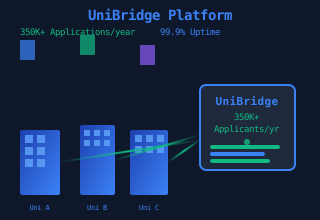
- Centralized admissions platform: FastAPI + Next.js 14 + PostgreSQL + Redis
- Performance: 0.8s FCP, 1.4s Speed Index; OAuth2 + AES‐256 encryption
- DevOps: CI/CD pipelines via GitHub Actions; containerized deployment
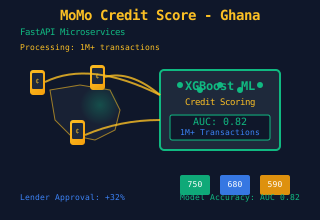
- FastAPI microservices + XGBoost ML: AUC 0.82; <400ms P99 inference
- Explainability: React dashboard with SHAP-based feature analysis
- Compliance: Data privacy and regulatory compliance built-in
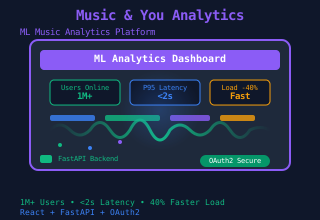
- Personality Prediction: Big‐Five traits from Spotify data (300+ tracks/user, 35+ features)
- 16‐endpoint REST API: Sub‐5s predictions; async streaming for engagement
- ML Pipeline: Feature engineering + gradient boosting + real-time inference
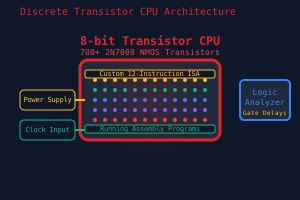
- 700+ discrete transistors; custom 12‐instruction ISA
- Python assembler + comprehensive test framework
- Propagation delay analysis and optimization
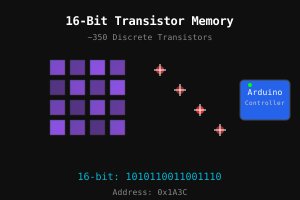
- D‐flip‐flop arrays with custom bus control; Arduino integration
- 1,000+ stable access cycles; sub‐μs read/write operations
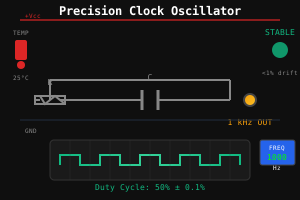
- Ultra‐stable RC multivibrator; <1% drift across temperature
- Precision duty‐cycle control; analog design mastery
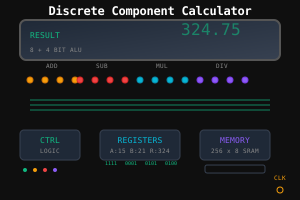
- Four‐function arithmetic; ripple‐carry adders; custom 7‐segment decoder
- <5ns propagation latency on 16‐bit operations

- Programming: Python, TypeScript/JavaScript, C/C++, Verilog, SystemVerilog
- Web: React, Next.js, FastAPI, Node.js, Tailwind CSS
- ML/Data: XGBoost, scikit-learn, pandas, NumPy, SHAP
- Hardware: Verilog, SystemVerilog, VHDL, Assembly
- Databases: PostgreSQL, Redis, MongoDB
- DevOps: Docker, Kubernetes, AWS, GitHub Actions, CI/CD
- Hardware: KiCad, SPICE, Logisim, Arduino, FPGA, Oscilloscopes
- Testing: pytest, Jest, Cypress, custom test frameworks
- Full-Stack Development: End-to-end application design, deployment, optimization
- Digital Design: Combinational/sequential logic, ALUs, memory systems, CPUs
- Verification: Test automation, simulation, formal verification, 1.24M+ tests validated
- Performance Engineering: Sub-400ms APIs, 0.8s FCP, 45% optimization gains
- System Architecture: Microservices, distributed systems, hardware-software co-design

BBC News Voice of America Deutsche Welle Wikipedia
International recognition for advocacy, technical excellence, and social impact

Open to discussing technology, collaborating on projects, and exploring opportunities in hardware, software, or systems engineering.
Chip Design • VLSI Systems • Full-Stack Engineering • Machine Learning • Embedded Systems • Tech for Good