You signed in with another tab or window. Reload to refresh your session.You signed out in another tab or window. Reload to refresh your session.You switched accounts on another tab or window. Reload to refresh your session.Dismiss alert
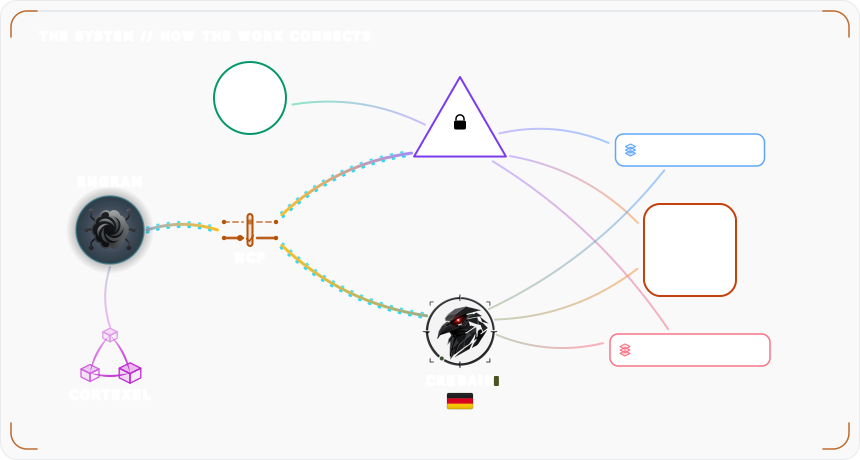
NCP sits at the center as a shared interface. Solid connections identify local v1 adapters; the dash-dot connection identifies Haldir's pinned v0.8 adapter. Short dashed arrows show library dependencies. A long dashed open arrow connects CREBAIN to Prisoma for environment and sensor data; that integration remains under qualification. Dotted lines show assets or exports. Moving dashes on a continuous line identify perception tools. Motion is decorative; each connection retains its meaning when still. These connections do not require every project to run together or depict a runtime broker.
Read the connections: solid paired arrows = local NCP interfaces; short dashed arrows = library dependencies; long dashed open arrow = environment integration under qualification; dotted lines = assets or exports; moving dashes on a continuous line = perception tools; dash-dot line with a square end = Haldir's pinned NCP v0.8 interface.
Different jobs: Engram runs neural models. CREBAIN runs a standalone 3D environment and sensor fusion. Galadriel monitors possible sensor tampering. Prisoma organizes experiments and evidence for embodied agents. NCP defines their shared messages.
CREBAIN and Prisoma: CREBAIN is Prisoma's selected environment for embodied-agent experiments. CREBAIN owns world dynamics and sensor observations. Prisoma owns experiment design, comparisons, and evidence. CREBAIN runs independently. Its selected one-drone force-control test passed branch comparisons with actual RGB, acoustic, and thermal output. Prisoma has separate local LeWM inference and deterministic affine experiment results. Their complete environment adapter remains under qualification.
Scene ownership: CREBAIN consumes scenes. Melkor converts splat assets; the atlas projects provide mesh assets. Prisoma records and analyzes experiments that use an environment. These asset links describe intended inputs, not a qualified import pipeline.
One integrated example: In the current integrated test, CREBAIN sends observations to Engram, which returns action proposals. Engram also sends sensor diagnostics to Galadriel and complete exchanges to Prisoma. NCP carries these messages. Independent adapter qualification remains open.
NCP local simulation v1 candidate. Installed-artifact qualification and final release gates remain open.
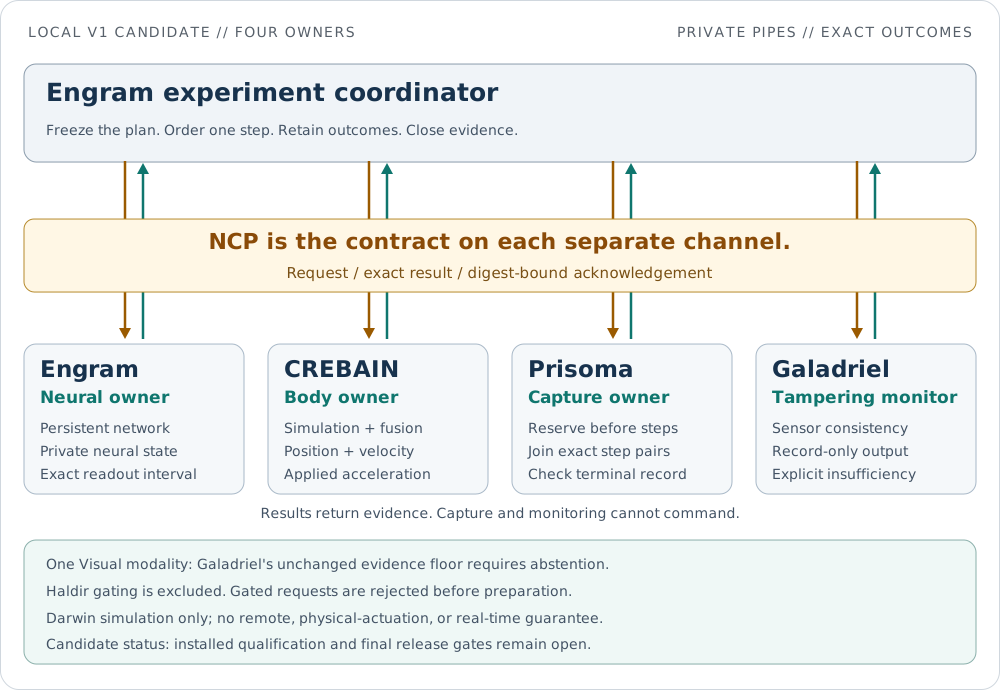
Engram coordinates one local experiment and privately owns neural state. CREBAIN owns body and fusion state. Prisoma captures exact step pairs. Galadriel records actual detector output with explicit abstention.
Each owner exchanges bounded NCP requests and exact retained results through its own private process pipes. NCP is the shared contract, not another simulation engine.
One Visual modality remains insufficient for Galadriel's unchanged two-modality minimum. An unavailable observation never becomes a zero residual or a nominal report.
Supported boundary: This candidate targets local Darwin simulation. Haldir gating, remote endpoints, physical actuation, and real-time guarantees are excluded. Gated requests must be rejected before endpoint preparation. Capture and monitor results grant no command authority.
The tested Engram implementation is private Paper2Brain source. The public Engram repository is a placeholder, not an executable release. Read the NCP repository and release status.
One local v1 composition: four owners and their private channels
CREBAIN (Adaptive Response & Awareness System) — research prototype for spatial awareness and sensor fusion: Gaussian-splat scene visualization, simulated cameras, ML object detection, multimodal 3...
Engram Neural Modeling Labs — computational-neuroscience research on spiking networks and neural modeling. Code will be open-sourced after publication.
C++17 toolkit for 3D Gaussian splats: deterministic conversion, inspection, geometry-based scene completion and viewing across PLY, SPZ and glTF, with CPU/Metal and optional CUDA backends. v2 harde...
Python generation pipeline behind a public MIT dataset of 2,023 unique glTF 2.0 Binary meshes (33.5 GB) for robot/cobot simulation, manipulation research and VLA training. Published on Hugging Face...