
HTTP mocking for Rust!
Mockito is a library for generating and delivering HTTP mocks in Rust. You can use it for integration testing or offline work. Mockito runs a local pool of HTTP servers which create, deliver and remove the mocks.
- Supports HTTP1/2
- Runs your tests in parallel
- Comes with a wide range of request matchers (Regex, JSON, query parameters etc.)
- Checks that a mock was called (spy)
- Mocks multiple hosts at the same time
- Exposes sync and async interfaces
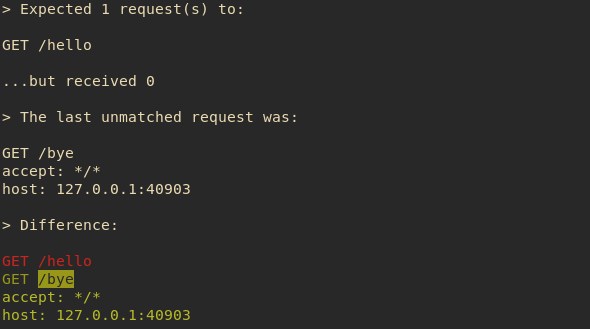
- Prints out a colored diff of the last unmatched request in case of errors
- Simple, intuitive API
- An awesome logo
The full documentation is available at https://docs.rs/mockito.
Before upgrading, make sure to check out the changelog.
Add mockito to your Cargo.toml and start mocking:
#[test]
fn test_something() {
 // Request a new server from the pool
 let mut server = mockito::Server::new();
 // Use one of these addresses to configure your client
 let host = server.host_with_port();
 let url = server.url();
 // Create a mock
 let mock = server.mock("GET", "/hello")
 .with_status(201)
 .with_header("content-type", "text/plain")
 .with_header("x-api-key", "1234")
 .with_body("world")
 .create();
 // Any calls to GET /hello beyond this line will respond with 201, the
 // `content-type: text/plain` header and the body "world".
 // You can use `Mock::assert` to verify that your mock was called
 mock.assert();
}
If Mock::assert fails, a colored diff of the last unmatched request is displayed:
Use matchers to handle requests to the same endpoint in a different way:
#[test]
fn test_something() {
 let mut server = mockito::Server::new();
 server.mock("GET", "/greetings")
 .match_header("content-type", "application/json")
 .match_body(mockito::Matcher::PartialJsonString(
 "{\"greeting\": \"hello\"}".to_string(),
 ))
 .with_body("hello json")
 .create();
 server.mock("GET", "/greetings")
 .match_header("content-type", "application/text")
 .match_body(mockito::Matcher::Regex("greeting=hello".to_string()))
 .with_body("hello text")
 .create();
}
Start multiple servers to simulate requests to different hosts:
#[test]
fn test_something() {
 let mut twitter = mockito::Server::new();
 let mut github = mockito::Server::new();
 // These mocks will be available at `twitter.url()`
 let twitter_mock = twitter.mock("GET", "/api").create();
 // These mocks will be available at `github.url()`
 let github_mock = github.mock("GET", "/api").create();
}
Write async tests (make sure to use the _async methods!):
#[tokio::test]
async fn test_simple_route_mock_async() {
 let mut server = Server::new_async().await;
 let m1 = server.mock("GET", "/a").with_body("aaa").create_async().await;
 let m2 = server.mock("GET", "/b").with_body("bbb").create_async().await;
 let (m1, m2) = futures::join!(m1, m2);
 // You can use `Mock::assert_async` to verify that your mock was called
 // m1.assert_async().await;
 // m2.assert_async().await;
}
Start a stand-alone server on a dedicated port:
fn main() {
 let opts = mockito::ServerOpts {
 host: "0.0.0.0",
 port: 1234,
 ..Default::default()
 };
 let mut server = mockito::Server::new_with_opts(opts);
 let _m = server.mock("GET", "/").with_body("hello world").create();
 loop {}
}
The current minimum support Rust toolchain is 1.85.0
- Check the existing issues and pull requests.
- One commit is one feature - consider squashing.
- Format code with
cargo fmt. - :shipit:
Run tests:
cargo test...or run tests using a different toolchain:
rustup run --install 1.85.0 cargo test...or run tests while disabling the default features (e.g. the colors):
cargo test --no-default-featuresMockito uses rustfmt as a general code style.
Install rustfmt:
rustup component add rustfmt
Format code:
cargo fmt
Some editors might provide a plugin to format your Rust code automatically.
Mockito uses clippy and it should be run always on the minimum supported Rust version, in order to ensure backwards compatibility.
Install clippy:
rustup component add clippy
The linter is always run on the minimum supported Rust version:
rustup run --install 1.70.0 cargo clippy-mockito
Release:
cargo publish
Install rust nightly:
rustup install nightly
Run benchmarks:
rustup run nightly cargo bench