This repo contains an implementation of the Synacor Challenge VM with tests written using the Snow library. A blog post about the development can be located here.
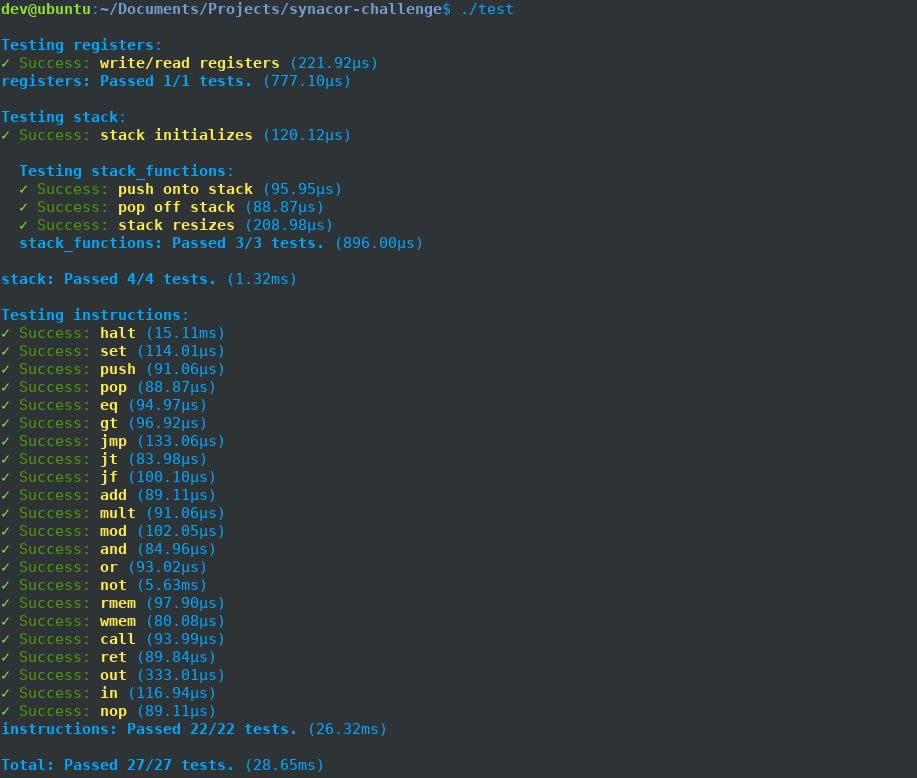
- three storage regions
- memory with 15-bit address space storing 16-bit values
- eight registers
- an unbounded stack which holds individual 16-bit values
- all numbers are unsigned integers 0..32767 (15-bit)
- all math is modulo 32768; 32758 + 15 => 5
- each number is stored as a 16-bit little-endian pair (low byte, high byte)
- numbers 0..32767 mean a literal value
- numbers 32768..32775 instead mean registers 0..7
- numbers 32776..65535 are invalid
- programs are loaded into memory starting at address 0
- address 0 is the first 16-bit value, address 1 is the second 16-bit value, etc
- After an operation is executed, the next instruction to read is immediately after the last argument of the current operation. If a jump was performed, the next operation is instead the exact destination of the jump.
- Encountering a register as an operation argument should be taken as reading from the register or setting into the register as appropriate.
- The program "9,32768,32769,4,19,32768" occupies six memory addresses and should:
- Store into register 0 the sum of 4 and the value contained in register 1.
- Output to the terminal the character with the ascii code contained in register 0.
halt: 0
 stop execution and terminate the program
set: 1 a b
 set register <a> to the value of <b>
push: 2 a
 push <a> onto the stack
pop: 3 a
 remove the top element from the stack and write it into <a>; empty stack = error
eq: 4 a b c
 set <a> to 1 if <b> is equal to <c>; set it to 0 otherwise
gt: 5 a b c
 set <a> to 1 if <b> is greater than <c>; set it to 0 otherwise
jmp: 6 a
 jump to <a>
jt: 7 a b
 if <a> is nonzero, jump to <b>
jf: 8 a b
 if <a> is zero, jump to <b>
add: 9 a b c
 assign into <a> the sum of <b> and <c> (modulo 32768)
mult: 10 a b c
 store into <a> the product of <b> and <c> (modulo 32768)
mod: 11 a b c
 store into <a> the remainder of <b> divided by <c>
and: 12 a b c
 stores into <a> the bitwise and of <b> and <c>
or: 13 a b c
 stores into <a> the bitwise or of <b> and <c>
not: 14 a b
 stores 15-bit bitwise inverse of <b> in <a>
rmem: 15 a b
 read memory at address <b> and write it to <a>
wmem: 16 a b
 write the value from <b> into memory at address <a>
call: 17 a
 write the address of the next instruction to the stack and jump to <a>
ret: 18
 remove the top element from the stack and jump to it; empty stack = halt
out: 19 a
 write the character represented by ascii code <a> to the terminal
in: 20 a
 read a character from the terminal and write its ascii code to <a>; it can be assumed that once input starts, it will continue until a newline is encountered; this means that you can safely read whole lines from the keyboard and trust that they will be fully read
noop: 21
 no operation