parallelLDAcontains various implementation of multi threaded LDAsingleLDAcontains various implementation of single threaded LDAtopwordsa tool to explore topics learnt by the LDA/HDPperplexitya tool to calculate perplexity on another dataset using word|topic matrixdatagenpackages txt files for our programpreprocessingfor converting from UCI or cLDA to simple txt file having one document per line
- All codes are under
srcwithin respective folder - For running Topic Models many template scripts are provided under
scripts datais a placeholder folder where to put the databuildanddistfolder will be created to hold the executables
- gcc >= 5.0 or Intel® C++ Compiler 2016 for using C++14 features
- split >= 8.21 (part of GNU coreutils)
We will show how to run our LDA on an UCI bag of words dataset
-
First of all compile by hitting make
make
-
Download example dataset from UCI repository. For this a script has been provided.
scripts/get_data.sh
-
Prepare the data for our program
scripts/prepare.sh data/nytimes 1
For other datasets replace nytimes with dataset name or location.
-
Run LDA!
scripts/lda_runner.sh
Inside the
lda_runner.shall the parameters e.g. number of topics, hyperparameters of the LDA, number of threads etc. can be specified. By default the outputs are stored underout/. Also you can specify which inference algorithm of LDA you want to run:simpleLDA: Plain vanilla Gibbs sampling by Griffiths04sparseLDA: Sparse LDA of Yao09aliasLDA: Alias LDAFTreeLDA: F++LDA (inspired from Yu14lightLDA: light LDA of Yuan14
The make file has some useful features:
-
if you have Intel® C++ Compiler, then you can instead
make intel
-
or if you want to use Intel® C++ Compiler's cross-file optimization (ipo), then hit
make inteltogether
-
Also you can selectively compile individual modules by specifying
make <module-name>
-
or clean individually by
make clean-<module-name>
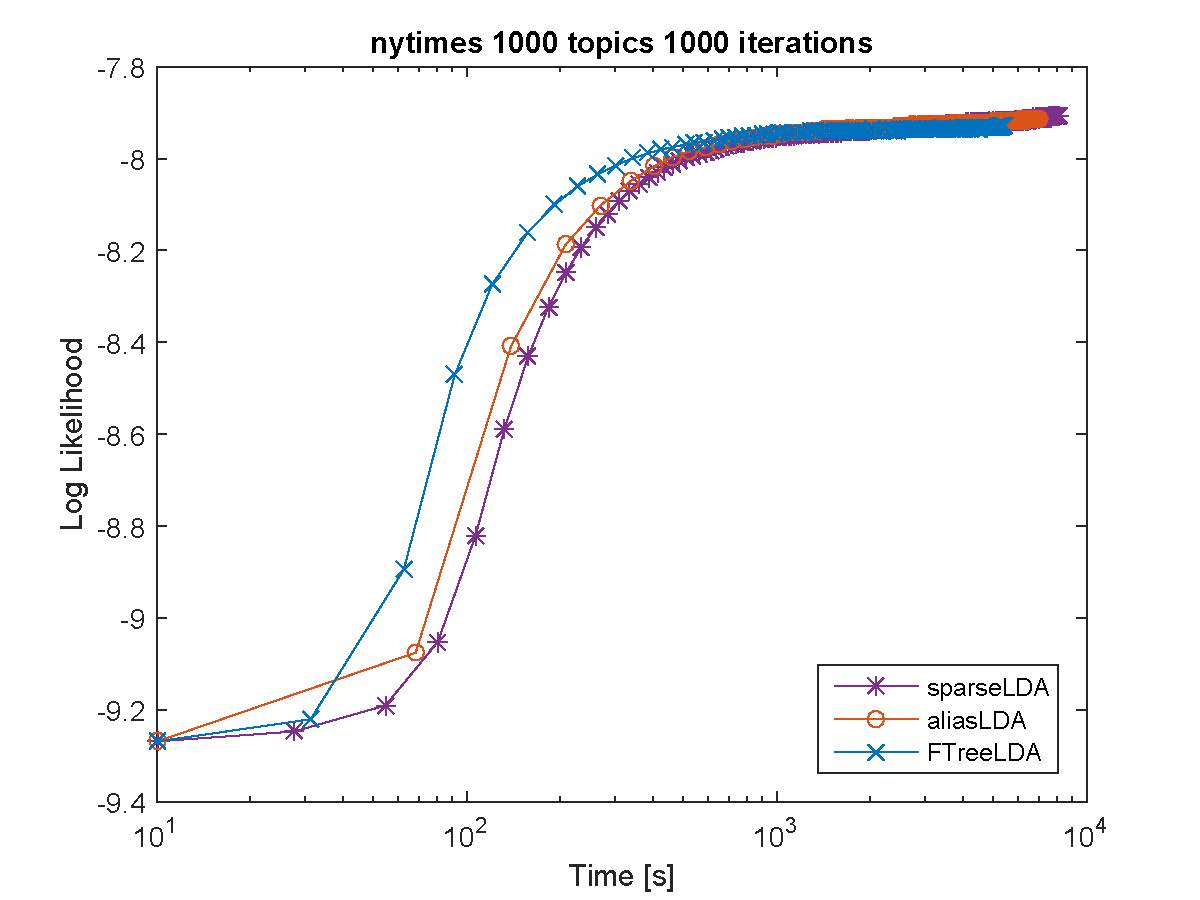
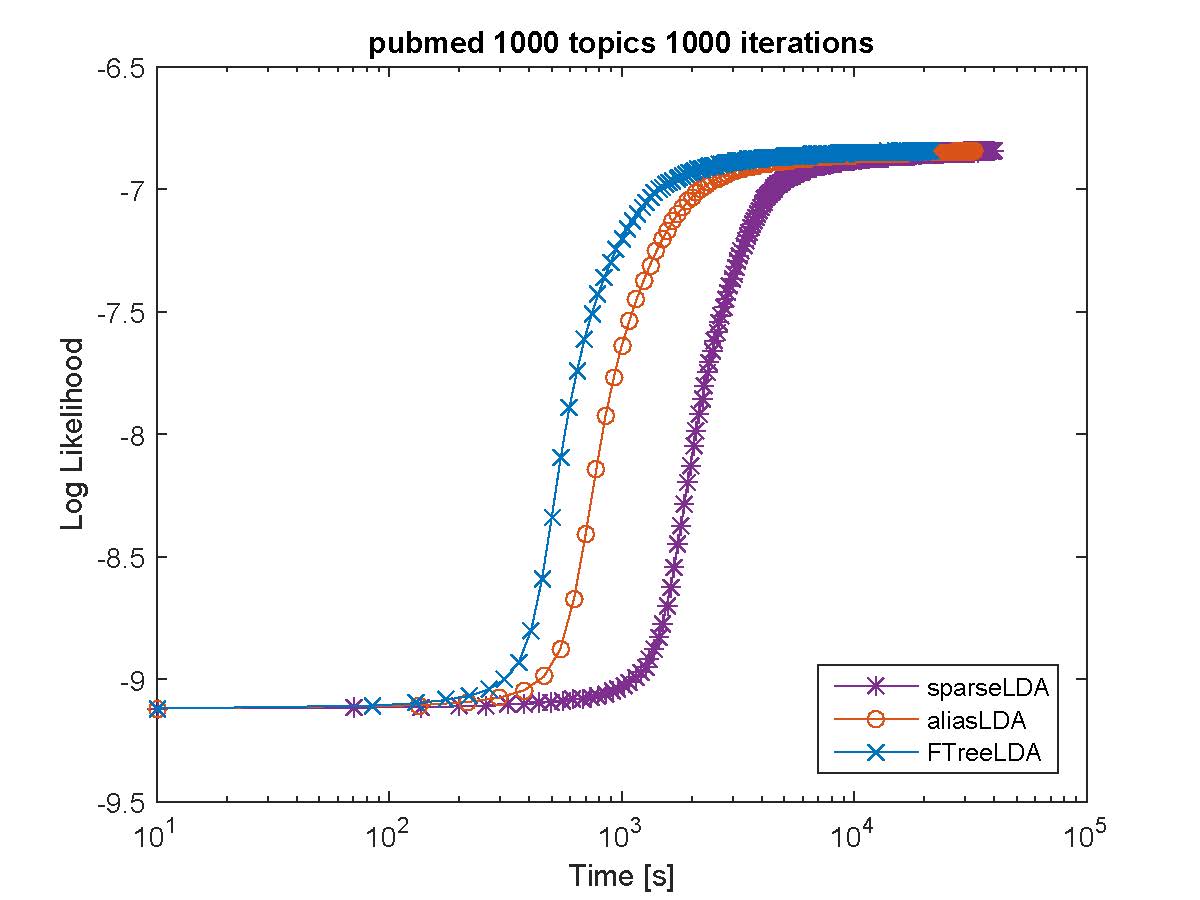
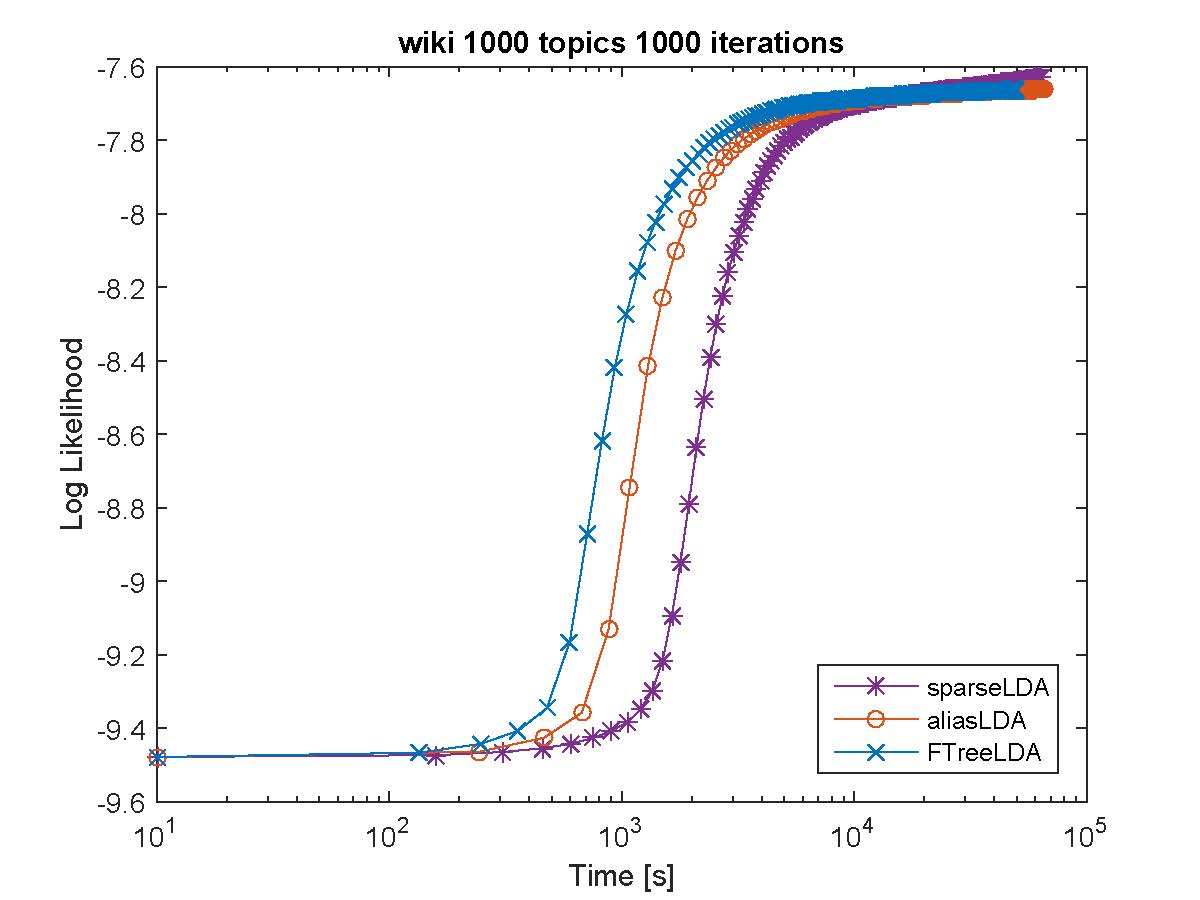
Based on our evaluation F++LDA works the best in terms of both speed and perplexity on a held-out dataset. For example on Amazon EC2 c4.8xlarge, we obtained more than 25 million/tokens per second. Below we provide performance comparison against various inference procedures on publicaly available datasets.
| Dataset | V | L | D | L/V | L/D |
|---|---|---|---|---|---|
| NY Times | 101,330 | 99,542,127 | 299,753 | 982.36 | 332.08 |
| PubMed | 141,043 | 737,869,085 | 8,200,000 | 5,231.52 | 89.98 |
| Wikipedia | 210,218 | 1,614,349,889 | 3,731,325 | 7,679.41 | 432.65 |
Experimental datasets and their statistics. V denotes vocabulary size, L denotes the number of training tokens, D denotes
the number of documents, L/V indicates the average number of occurrences of a word, L/D indicates the average length of a
document.