
Pathify makes working with Vuex easy, with a declarative, state-based, path syntax:

Paths can reference any module, property or sub-property:
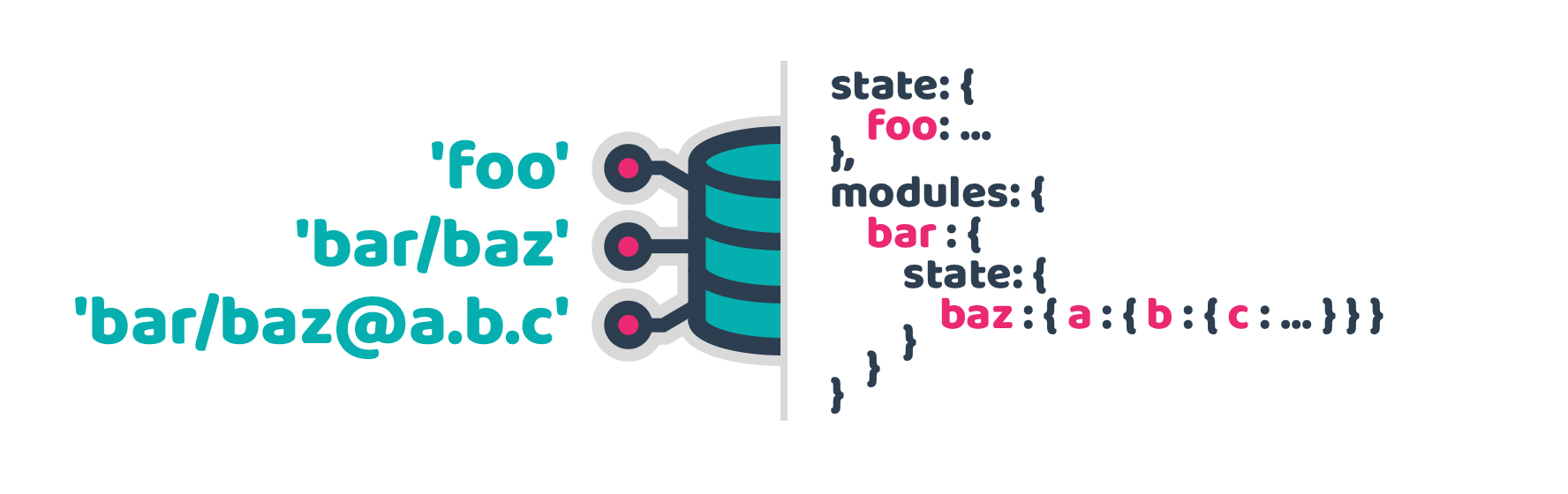
Pathify's aim is to simplify the overall Vuex development experience by abstracting away Vuex's complex setup and reliance on manually-written code. The path syntax does the heavy-lifting, with a small set of helper functions used to directly access or wire up components to the store.
Get or set data without syntax juggling or worrying about implementation:
store.get('loaded')
store.set('loaded', true)
Reach into sub-properties and arrays:
store.get('products@items.0.name')
store.set('products@items.1.name', 'Vuex Pathify')
Set up one or two-way data binding on any store value without bloat or fuss:
computed: {
 products: get('products'),
 category: sync('filters@category')
}
Wire multiple properties (or sub-properties) using array, object and wildcard formats:
computed: {
 ...sync('filters@sort', [
 'order',
 'key'
 ]),
 ...sync('filters@sort', {
 sortOrder: 'order',
 sortKey: 'key'
 }),
 ...sync('filters@sort.*')
}
Use variable expansion to dynamically reference store properties:
computed: {
 product: get('products@items:index')
}
Set up mutations – including sub-property mutations – in a single line:
make.mutations(state)
In practical terms, Pathify results in:
- less cognitive overhead
- zero store boilerplate
- one-liner wiring
- cleaner code
- lighter files
The code comparison demo demonstrates reductions in lines of code of between 2 and 14 times (or more) depending on store size and setup.
To see the principles behind such radical code reduction, check out the Pathify 101.
Get started:
Demos: