rtd ci codecov pyversions pypi pypistatus license coc codestyle colab
kwx is a toolkit for multilingual keyword extraction based on Google's BERT, Latent Dirichlet Allocation and Term Frequency Inverse Document Frequency. The package provides a suite of methods to process texts of any language to varying degrees and then extract and analyze keywords from the created corpus (see kwx.languages for the various degrees of language support). A unique focus is allowing users to decide which words to not include in outputs, thereby guaranteeing sensible results that are in line with user intuitions.
For a thorough overview of the process and techniques see the Google slides, and reference the documentation for explanations of the models and visualization methods.
Installation ⇧
kwx can be downloaded from PyPI via pip or sourced directly from this repository:
pip install kwx
git clone https://github.com/andrewtavis/kwx.git
cd kwx
python setup.py install
import kwx
Models ⇧
Implemented NLP modeling methods within kwx.model include:
• BERT ⇧
Bidirectional Encoder Representations from Transformers derives representations of words based on nlp models ran over open-source Wikipedia data. These representations are then leveraged to derive corpus topics.
kwx uses sentence-transformers pretrained models. See their GitHub and documentation for the available models.
• LDA ⇧
Latent Dirichlet Allocation is a generative statistical model that allows sets of observations to be explained by unobserved groups that explain why some parts of the data are similar. In the case of kwx, documents or text entries are posited to be a mixture of a given number of topics, and the presence of each word in a text body comes from its relation to these derived topics.
Although not as computationally robust as some machine learning models, LDA provides quick results that are suitable for many applications. Specifically for keyword extraction, in most settings the results are similar to those of BERT in a fraction of the time.
• TFIDF ⇧
The user can also compute Term Frequency Inverse Document Frequency keywords - those that are unique in a text body in comparison to another that's compared. This is a useful baseline when a user has another text or text body to compare the target corpus against.
• Word Frequency ⇧
Finally a user can simply query the most common words from a text corpus. This method is used in kwx as a baseline to check model efficacy.
Usage ⇧
Keyword extraction can be useful to analyze surveys, tweets and other kinds of social media posts, research papers, and further classes of texts. examples/kw_extraction provides an example of how to use kwx by deriving keywords from tweets in the Kaggle Twitter US Airline Sentiment dataset.
The following outlines using kwx to derive keywords from a text corpus with prompt_remove_words as True (the user will be asked if some of the extracted words need to be replaced):
• Text Cleaning ⇧
from kwx.utils import prepare_data
input_language = "english" # see kwx.languages for options
# kwx.utils.clean() can be used on a list of lists
text_corpus = prepare_data(
 data="df_or_csv_xlsx_path",
 target_cols="cols_where_texts_are",
 input_language=input_language,
 min_token_freq=0, # for BERT
 min_token_len=0, # for BERT
 remove_stopwords=False, # for BERT
 verbose=True,
)
• Keyword Extraction ⇧
from kwx.model import extract_kws
num_keywords = 15
num_topics = 10
ignore_words = ["words", "user", "knows", "they", "don't", "want"]
# Remove n-grams for BERT training
corpus_no_ngrams = [
 " ".join([t for t in text.split(" ") if "_" not in t]) for text in text_corpus
]
# We can pass keywords for sentence_transformers.SentenceTransformer.encode,
# gensim.models.ldamulticore.LdaMulticore, or sklearn.feature_extraction.text.TfidfVectorizer
bert_kws = extract_kws(
 method="BERT", # "BERT", "LDA", "TFIDF", "frequency"
 bert_st_model="xlm-r-bert-base-nli-stsb-mean-tokens",
 text_corpus=corpus_no_ngrams, # automatically tokenized if using LDA
 input_language=input_language,
 output_language=None, # allows the output to be translated
 num_keywords=num_keywords,
 num_topics=num_topics,
 corpuses_to_compare=None, # for TFIDF
 ignore_words=ignore_words,
 prompt_remove_words=True, # check words with user
 show_progress_bar=True,
 batch_size=32,
)
The BERT keywords are:
['time', 'flight', 'plane', 'southwestair', 'ticket', 'cancel', 'united', 'baggage',
'love', 'virginamerica', 'service', 'customer', 'delay', 'late', 'hour']
Should words be removed [y/n]? y
Type or copy word(s) to be removed: southwestair, united, virginamerica
The new BERT keywords are:
['late', 'baggage', 'service', 'flight', 'time', 'love', 'book', 'customer',
'response', 'hold', 'hour', 'cancel', 'cancelled_flighted', 'delay', 'plane']
Should words be removed [y/n]? n
The model will be rerun until all words known to be unreasonable are removed for a suitable output. kwx.model.gen_files could also be used as a run-all function that produces a directory with a keyword text file and visuals (for experienced users wanting quick results).
Visuals ⇧
kwx.visuals includes the following functions for presenting and analyzing the results of keyword extraction:
• Topic Number Evaluation ⇧
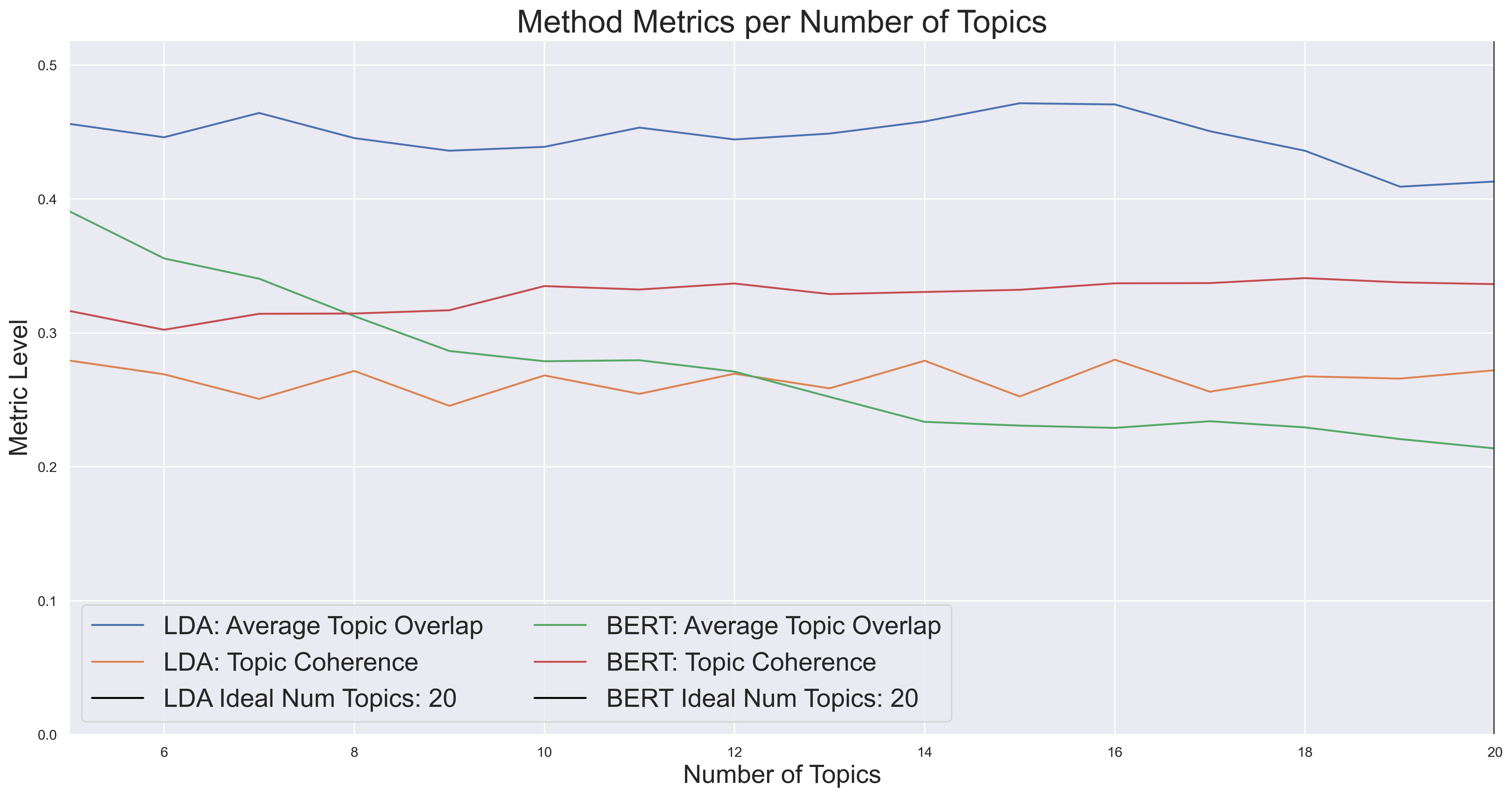
A graph of topic coherence and overlap given a variable number of topics to derive keywords from.
from kwx.visuals import graph_topic_num_evals
import matplotlib.pyplot as plt
graph_topic_num_evals(
 method=["lda", "bert"],
 text_corpus=text_corpus,
 num_keywords=num_keywords,
 topic_nums_to_compare=list(range(5, 15)),
 metrics=True, # stability and coherence
)
plt.show()
• t-SNE ⇧
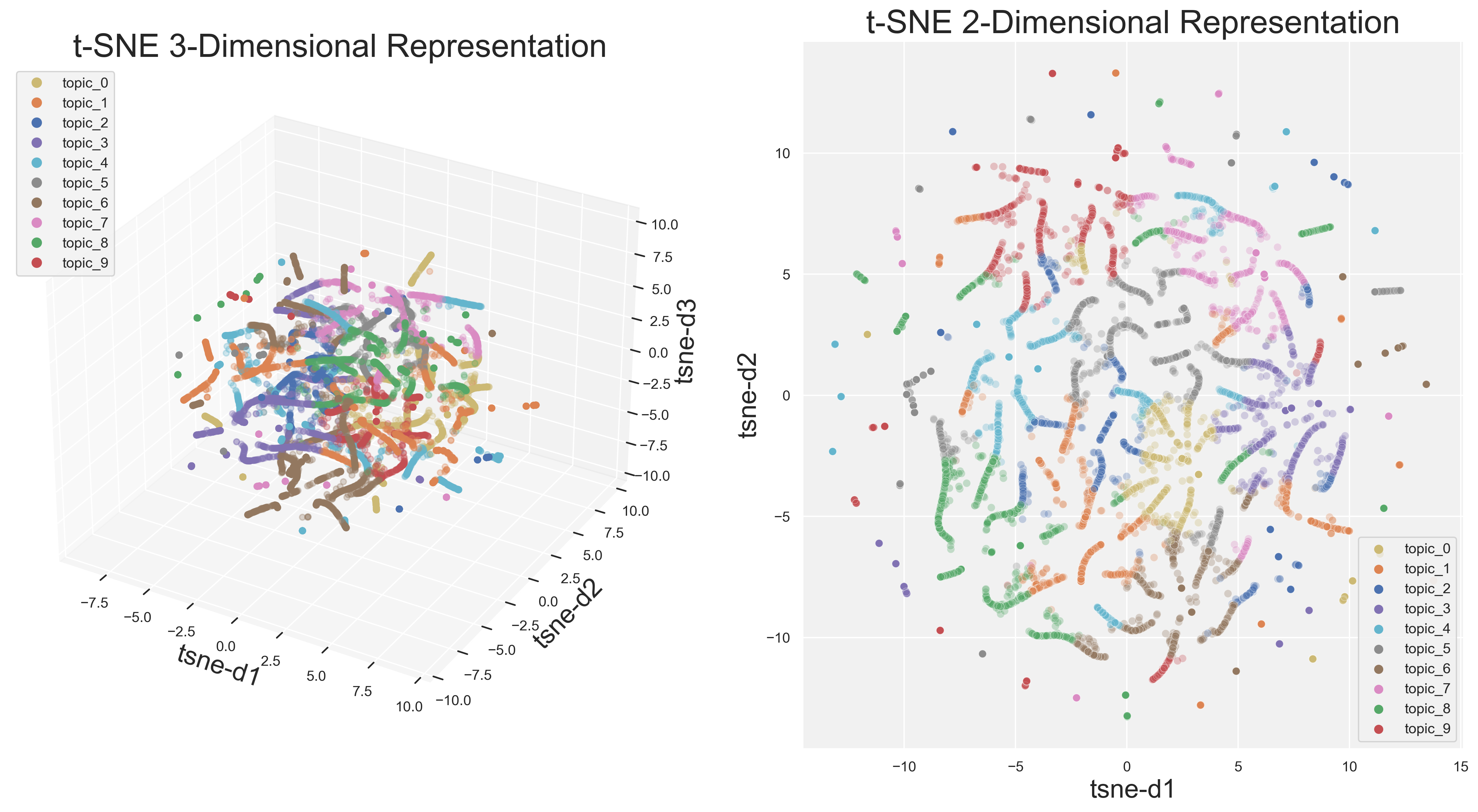
t-SNE allows the user to visualize their topic distribution in both two and three dimensions. Currently available just for LDA, this technique provides another check for model suitability.
from kwx.visuals import t_sne
import matplotlib.pyplot as plt
t_sne(
 dimension="both", # 2d and 3d are options
 text_corpus=text_corpus,
 num_topics=10,
 remove_3d_outliers=True,
)
plt.show()
• pyLDAvis ⇧
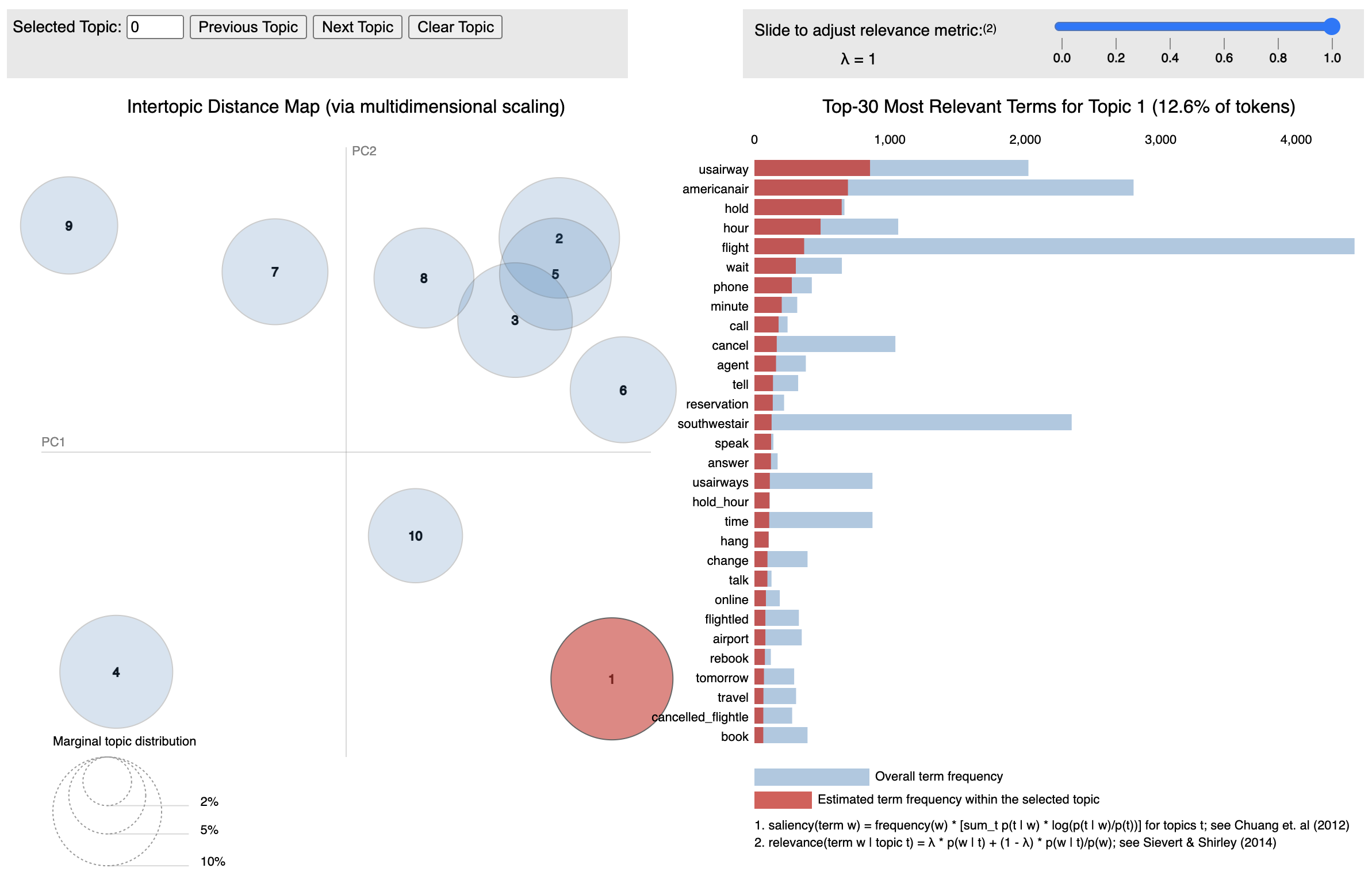
pyLDAvis is included so that users can inspect LDA extracted topics, and further so that it can easily be generated for output files.
from kwx.visuals import pyLDAvis_topics
pyLDAvis_topics(
 method="lda",
 text_corpus=text_corpus,
 num_topics=10,
 display_ipython=False, # For Jupyter integration
)
• Word Cloud ⇧
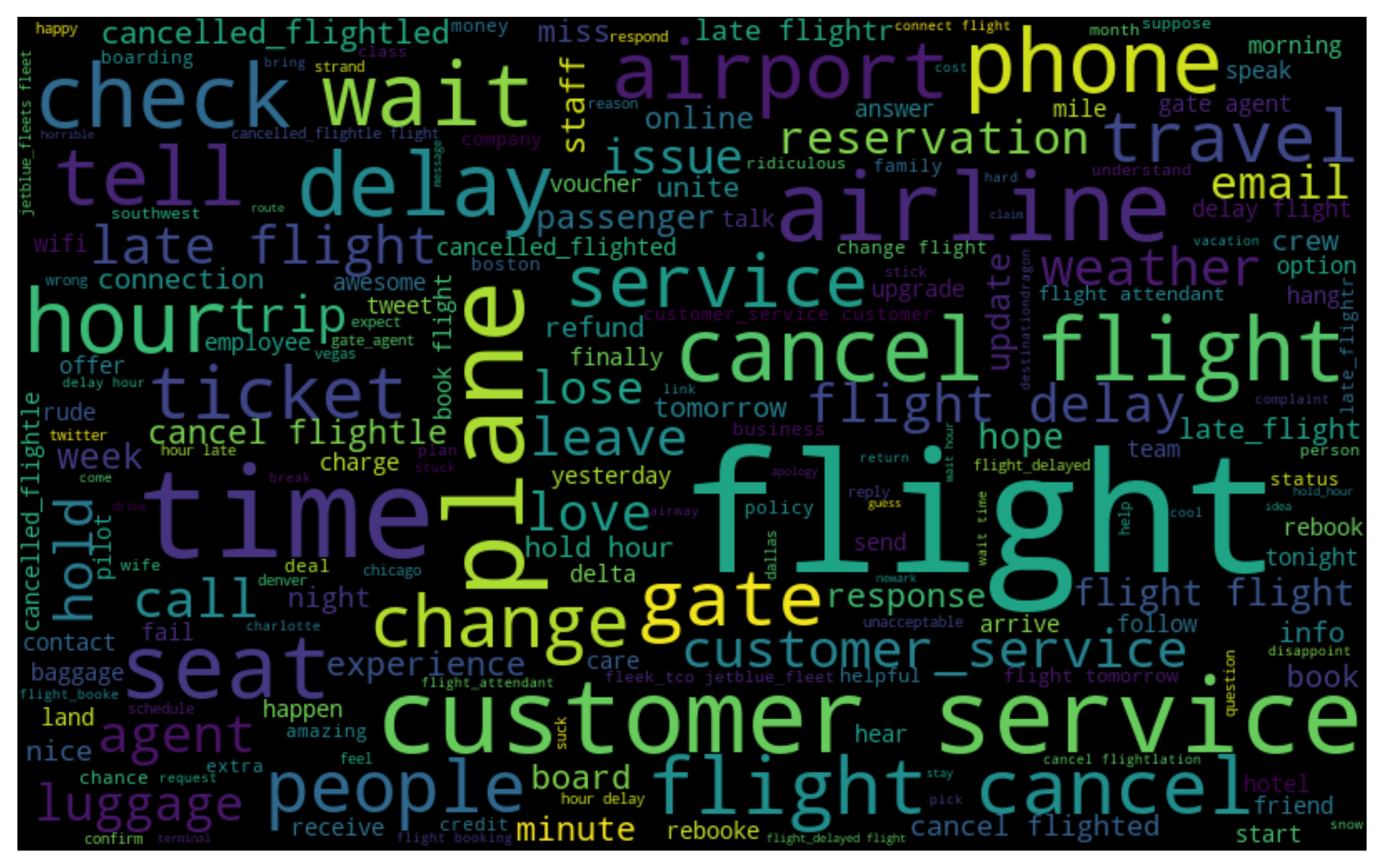
Word clouds via wordcloud are included for a basic representation of the text corpus - specifically being a way to convey basic visual information to potential stakeholders. The following figure from examples/kw_extraction shows a word cloud generated from tweets of US air carrier passengers:
from kwx.visuals import gen_word_cloud
ignore_words = ["words", "user", "knows", "they", "don't", "want"]
gen_word_cloud(
 text_corpus=text_corpus,
 ignore_words=None,
 height=500,
)
To-Do ⇧
Please see the contribution guidelines if you are interested in contributing to this project. Work that is in progress or could be implemented includes:
-
Including more methods to extract keywords (see issue)
-
Adding key phrase extraction as an option for kwx.model.extract_kws (see issues)
-
Adding t-SNE and pyLDAvis style visualizations for BERT models (see issues)
-
Converting the translation feature over to use another translation api rather than py-googletrans (see issue)
-
Updates to kwx.languages as lemmatization and other linguistic package dependencies evolve
-
Creating, improving and sharing examples
-
Improving tests for greater code coverage
-
Updating and refining the documentation