Talk:QWERTZ

It is of interest to the following WikiProjects:


QWERTZ means Quartz and that's a clock company.
- No ... in German, "Quarz" means quartz. The same word as in English, just without a "t". Qwertz does not mean anything, and it is an impossible word too, since in German, a Q is always followed by a u. --87.122.11.99 (talk) 14:48, 20 March 2009 (UTC) Reply
There is no é, à, or è in german (only for borrowed words) and on usual keyboards you can type them only with key-sequences. Maybe in Switzerland it's different.
Polish keyboard also use this —Preceding unsigned comment added by 125.25.41.40 (talk) 14:47, 20 September 2008 (UTC) Reply
I think the map is outdated. Polish should be all green since Poles don't use QWERTZ keyboard at all. On the other hand, Denmark, along with Sweden, have their own keys: "æ", "ø", "å". So they should be green-yellow check. — Preceding unsigned comment added by 93.174.1.127 (talk) 09:40, 16 February 2016 (UTC) Reply
As a Pole using computers since around 1995 I absolutely agree with the above. I was astonished to read about the usage of the QWERTZ keyboard layout in Poland. This should be changed ASAP. Where did someone take this information from???
==Stub no more--2409:40E5:12E:FE04:D165:A92B:734:44FE (talk)===^=£... I'm listing this as a computer-hardware stub. Change it if anyone has any objections... Or just expand. I for one don't know anything about qwertz keyboards... --Comfortably numb55 (talk) 22:22, 25 October 2008 (UTC) Reply
- I'm highly knowledgable about U.S. tyaqsmu b ugoooooooouu90- from 1970 through about 1992, and I rate myself "moderate" for computer topics prior to 2002. This article is reasonably detailed and comprehensive, so I removed the "stub" tag. -- Jo3sampl (talk) 13:41, 29 August 2011 (1
O
Although the text is correctly stating in Germany "Ctrl" is replaced by "Strg" the picture is not and therefor wrong. —Preceding unsigned comment added by 89.246.222.102 (talk) 06:58, 14 April 2009 (UTC) Reply
Some special symbols also have a different place, and the Ctrl key is called Strg (for Steuerung, English "control", although it is sometimes misinterpreted as String).
... Only German QWERTZ keyboards have the Strg key, Swiss keyboards have the same key labeled ctrl.
Yet the picture of the German-Austrian keyboard has Ctrl, not Strg, keys.
http://upload.wikimedia.org/wikipedia/commons/thumb/3/36/KB_Germany.svg/800px-KB_Germany.svg.png
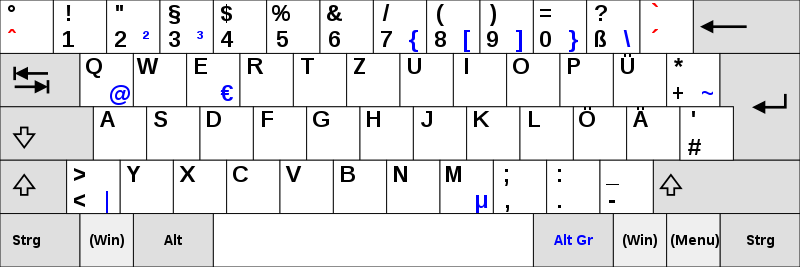
64.85.240.2 (talk) 15:09, 9 July 2009 (UTC) Reply
- On all my (German) Macs, (of 2001, 2005 and 2009, respectively) the ctrl key is called "ctrl"... -- megA (talk) 17:04, 6 December 2011 (UTC) Reply
This article is strikingly lacking any description of the history of the QWERTZ layout. The equivalent article on QWERTY points out that the QWERTY layout originated in 1873. This QWERTZ article only mentions some standards from the late 20th century that seem to be mainly taking into account computer keyboards. Obviously, typewriters have been in use for decades before that in QWERTZ-using countries such as Germany - did they still use QWERTY back then? Otherwise, when was QWERTZ originally devised and introduced? 85.180.116.25 (talk) 22:32, 11 April 2015 (UTC) Reply
- QWERTZ was created by the International Organization for Standardization ISO for German languages where Z is more prevalent in German grammar than in another other language, the QWERTZ keyboard effectively did not exist until 1945. It is a mid 20th century creation. The use of QWERTZ in Switzerland follows the 62% of the Swiss population, whom speaks Germany with disregard to the French and Italian speaking parts of Switzerland. Read my Thread from 7 days ago for better clarity and information, and to request a change to the SNV so Swiss french keyboards are QWERTY ANSI (French Canadian) and Swiss Italian are QWERTY ISO (Italian). ~2026-41160-25 (talk) 15:29, 22 July 2026 (UTC) Reply
What's with the reported position of the pipe characters? Where does this come from? Here's a Swiss-French keyboard http://i.imgur.com/TQrVbdr.jpg These characters are swapped in many online references but I don't know whether there are two variants or they just propagated from incorrect sources. In any case, all keyboards I've used have ¦ over the 1, | over the 7; not the other way around. 2A02:AA13:8105:2500:8990:5D99:5A44:9958 (talk) 07:28, 10 September 2017 (UTC) Reply

Swiss Mac keyboard layout appears to differ from Swiss PC keyboard layout. The Macs put the @ symbol by the G, while Windows keyboard put it by the 2. The photo only shows a Windows Swiss keyboard layout. --Sam (talk) 18:55, 4 March 2020 (UTC) Reply
Commonly-used letters near each other
[edit ]The article states that QWERTZU...etc was chosen because TZ and ZU go together often and this would somehow prevent typewriter jamming. Wasn't QWERTY invented in the first place to deliberately move commonly-used letters apart from each other? Because hitting them semi-simultaneously would cause jamming.
see subject 62.2.169.30 (talk) 23:17, 23 March 2023 (UTC) Reply
In the overview section, the 'three main reasons' are pretty much a verbatim translation of the corresponding German article here: https://de.wikipedia.org/wiki/Tastaturbelegung#Besonderheiten_der_QWERTZ-Variante
However, the German original states those points as consequences, while they are mentioned as reasons in this article. Maybe that should be changed... 37.76.6.68 (talk) 10:44, 5 August 2023 (UTC) Reply
I am bringing this to light as Switzerland uses the German layout, QWERTZ all over the country, when QWERTY (ANSI, with french accents) and QWERTY (ISO, Italian) would make more sense to use in French and Italian speaking parts, instead QWERTZ is forced upon the entire Swiss population even in regions where German isn't spoken, making the QWERTZ layout in Switzerland Swiss-German Specific and not localized. ~2026-39232-44 (talk) 15:36, 11 July 2026 (UTC) Reply
- To request a change of the Swiss layout, you can do so via the following means of contact:
- Contact the Swiss Association for Standardization (SNV), the national umbrella for standards in Switzerland, via their headquarters in Winterthur.
- Call them at +41 52 224 54 54
- By email info(@)snv.ch
- In Person: Sulzerallee 70, 8404 Winterthur. Their business hours are Monday through Friday, 08:00–12:00 and 13:30–16:30
- It would be better if the Swiss French layout followed QWERTY ANSI and if the Swiss Italian layout followed QWERTY ISO in their localized versions than the base Swiss German QWERTZ ISO Layout. ~2026-39232-44 (talk) 08:04, 15 July 2026 (UTC) Reply