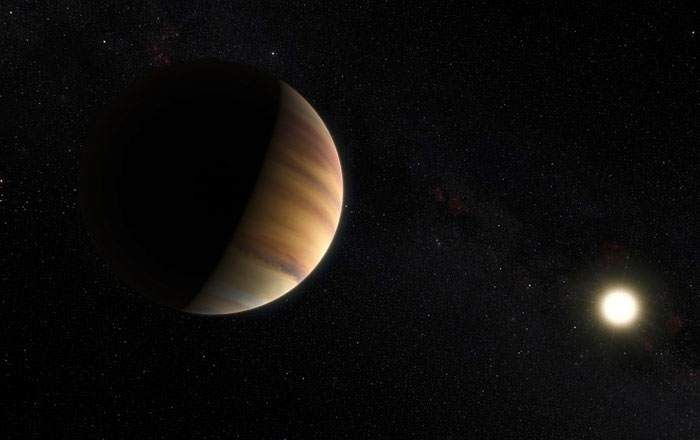
The first-ever direct detection of the spectrum of visible light reflected from an exoplanet has been made by an international team of astronomers. Using the High Accuracy Radial velocity Planet Searcher (HARPS) instrument at the European Southern Observatory’s La Silla Observatory in Chile, the astronomers studied light from 51 Pegasi b – the first exoplanet discovered orbiting a Sun-like star. Their observations not only uncovered new properties of this well-known object, but the work is also a successful proof-of-concept demonstration of a new technique for exoplanet detection.
51 Pegasi b lies a mere 50 light-years from Earth in the Pegasus constellation and was discovered in 1995. Famous as the first confirmed exoplanet found orbiting an ordinary star much like the Sun, 51 Pegasi b is a typical “hot Jupiter”. This is a relatively common type of exoplanet that is similar in size and mass to Jupiter but that orbits much closer to its parent star and so has its gaseous atmosphere “puffed up” by the intense heat.
Exoplanetary transmission
Currently, the two most common methods of detecting exoplanets involve observing a star’s radial velocity to see if it “wobbles” from the pull of an exoplanet, or looking for a tiny dip in the intensity of a star as the companion exoplanet transits across its face. But those keen on studying the atmosphere of an exoplanet usually observe the spectrum of the parent star’s light as it is filtered through the exoplanet’s atmosphere during transit – a method known as “transmission spectroscopy”.
In the new work, a team led by PhD student Jorge Martins of the Institute of Astrophysics and Space Sciences and the University of Porto, Portugal, used the HARPS spectrograph to observe 51 Pegasi b and pick out visible, albeit faint, light from the exoplanet. At optical wavelengths, the light we see from an exoplanet is actually reflected light from the star, only several orders of magnitude fainter. Using the parent star’s spectrum as a template, the researchers look for a similar signature of light reflected from the planet as it orbits its star. As the method does not depend on viewing an exoplanetary transit, it could be used to study many more exoplanets directly in visible light, revealing previously undetected characteristics such as their actual mass.
The team then apply a “cross-correlation function of a binary mask” – an image-processing technique that was first proposed by Martins in 2013. This amplifies the weak light reflected from the hot Jupiter’s atmosphere to amplify the minute planetary signal, which is easily swamped by other effects and sources of noise.
Reflective data
“This type of detection technique is of great scientific importance, as it allows us to measure the planet’s real mass and orbital inclination, which is essential to more fully understand the system,” says Martins. He adds that it also allows researchers “to estimate the planet’s reflectivity, or albedo, which can be used to infer the composition of both the planet’s surface and atmosphere”.
The team observed 90 spectra over seven different nights for a total of 12.5 hours of observing time. The researchers carefully selected windows during which the exoplanet could be observed close to “superior conjunction” – when the day side of the planet faces Earth – to maximize the amount of light coming from the planet. They found that 51 Pegasi b has a mass about half that of Jupiter but with a larger diameter and an orbit with an inclination of about nine degrees to the direction of the Earth.
The team noted it was particularly interesting that the detection was possible with data collected by an existing observing facility, as it was initially thought that the technique would only work with extremely high signal-to-noise ratio spectra that would be available with upcoming telescopes. Indeed, the results demonstrate the promise of this technique, especially in light of next-generation instruments such as ESPRESSO on the Very Large Telescope and the European Extremely Large Telescope.
The research is published in the journal Astronomy and Astrophysics.