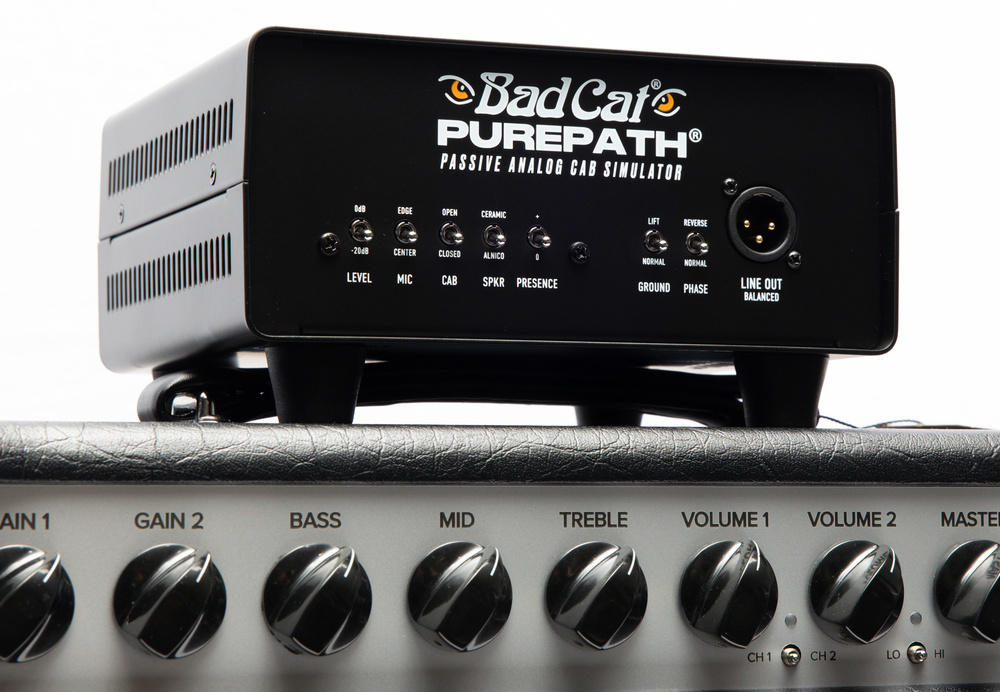
The Purepath, from Bad Cat amps, is a fully analogue reactive load and speaker emulator. Yes, you read that right: an analogue speaker sim launching in the age of dynamic convolution, impulse responses and hyper‐detailed digital modelling. So, how can a bunch of passive filters possibly compete with the forensic tonal authenticity of a digital speaker impulse response or model? The answer is that it doesn’t really have to — speaker simulation is about more than just a frequency response. The Purepath doesn’t just seek to recreate the sound of a miked cabinet, but leans heavily on the preservation of a normal working relationship between the amplifier and speaker. And the latter is actually every bit as important in creating a musically satisfying, playable outcome for guitarists.
A guitar speaker’s impedance varies across the frequency spectrum, with a pronounced resonant peak in the low end, a dip through the midrange, and a rising characteristic in the high frequencies. And guitar amplifiers, and tube amps in particular, are built around the expectation of this behaviour, responding dynamically to it, altering clipping thresholds, compression and power delivery depending on the instantaneous load ‘seen’ by the output transformer. The responsiveness, or otherwise, of an amp and speaker combination — the ‘feel’ for the player — is very largely determined by this constantly varying electrical relationship.
Naturally, all reactive loads, whether partnered with an analogue or digital speaker emulation, are designed to emulate this electrical and mechanical behaviour in a real loudspeaker, allowing the amplifier to operate as though it were driving a physical cabinet. The issue with a digital system is that it is likely to be required to emulate a variety of different speaker cabs, which means that the impedance curve of the load cannot be too specific to any one type without compromising the others to some extent. The Purepath, in being less ambitious in the range of what it seeks to offer, is actually able to be more focused on producing a familiar playing experience.
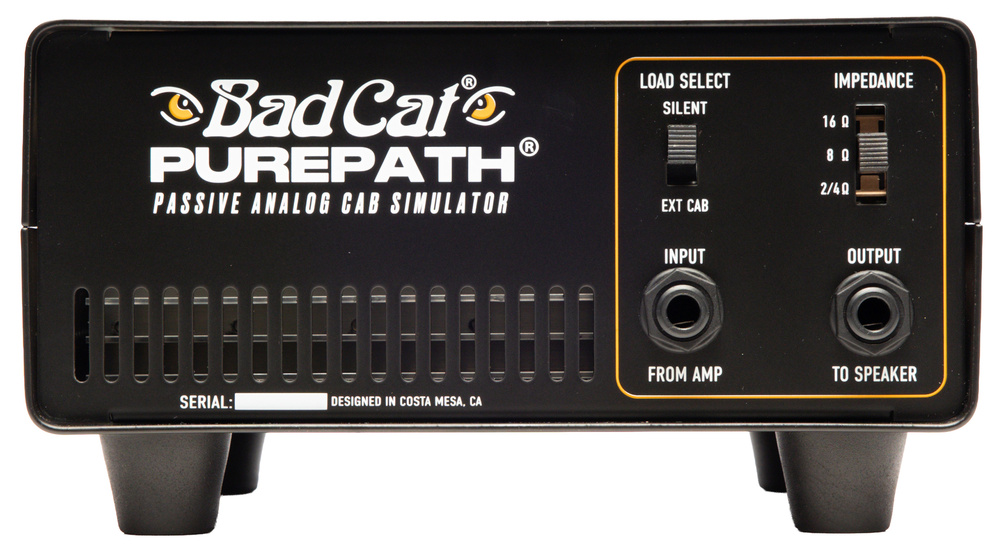
There’s very little to tweak: tonally there’s only a few two‐position mini‐switches for Mic position (Edge/Center); Cab type (Open/Closed); Speaker type (Ceramic/Alnico); and Presence (0/1). Further switches cover Output Level (0dB/‐20 dB); Ground Lift; and Normal/Reverse polarity. Round the back you get to select Silent operation or an external speaker cab, as well as a choice of operating as a 4Ω, 8Ω or 16Ω load, the latter being a fairly rare option in a reactive load box.
Switches on the rear configure the Purepath to present different loads to the amp, and for operation with or without a speaker attached. Switches on the rear configure the Purepath to present different loads to the amp, and for operation with or without a speaker attached.
The great thing about the Purepath’s tonal switches is that they don’t do too much: that’s what I meant about being less ambitious. All the switch positions and combinations are fully usable. The Center ‘mic position’ is slightly brighter and edgier, the Closed cab voicing is slightly tighter with a bit more resonant ‘thump’, and the Alnico speaker setting is slightly sweeter and more vintage‐voiced, but never so much that you couldn’t use the opposite settings and compensate with a small tweak of the amp or guitar’s controls. A bit like using an actual speaker, really!
If you’re connecting an actual speaker via the Purepath, the load is disengaged... so you don’t have to make a parallel‐load calculation for the combined impedance.
There’s a fan, driven from the voltage generated across the load, but it’s used solely for cooling and doesn’t come on at all if the input isn’t loud enough; I can’t say I ever heard it in action during normal studio usage. If you’re connecting an actual speaker via the Purepath, the load is disengaged (leaving just the filters active on the XLR line output) so you don’t have to make a parallel‐load calculation for the combined impedance — the switch setting is only relevant in Silent mode.
The Purepath ‘feels’ just great to play, and it sounds really good, too! It didn’t seem to matter what I was feeding it with, every sound was usable and convincingly speaker‐like. There’s a lot of low end in the output if there’s a lot of low end in the input, so a high‐pass is often helpful — that would have been a nice extra to have on board — but the one thing the Purepath never required was any top‐end roll‐off on distorted signals, and that’s a first for me with an analogue speaker sim. There’s only so much you can do in terms of filter complexity with entirely passive circuitry, but designer Bruce Egnater (of Egnater amps fame) has clearly done something very right in Bad Cat’s Purepath. There is a certain irony about the fact that many of the most usable guitar‐speaker IRs are double‐miked, often with a combination of two very different microphones, like a Shure SM57 and a Royer 121 ribbon, or a large‐diaphragm capacitor mic. These combinations tend to smooth out some of the peaks and troughs of the individual mics’ responses, resulting in a sound that is more consistent and very often more musically useful than the raw output of a single close mic. Recording engineers have been double‐miking real speaker cabinets in the studio for decades, for the same reasons. Early analogue speaker sims don’t sound exactly like a real speaker heard in a room, but they do give a very usable rendering of the smoother, curated response of a well‐engineered miked speaker in a recording or live show. Purepath is the same: lively and immediate, with zero latency, and just the right sort of realism!
The Purepath is a product where you won’t get the full experience just from hearing it: it needs to be ‘felt’ as a player. If you aren’t looking to emulate lots of different speakers and mics, but just want the sound of your amp and speaker for recording or a PA feed without the variables of miking, this just might be the one for you.