Necker Cube
The necker cube is an illusion in which a two-dimensional drawing of an array of cubes appears to simultaneously protrude from and intrude into the page.
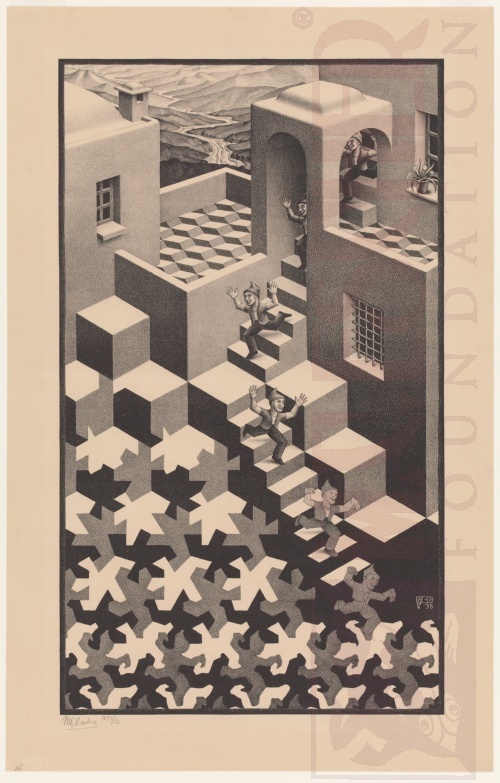
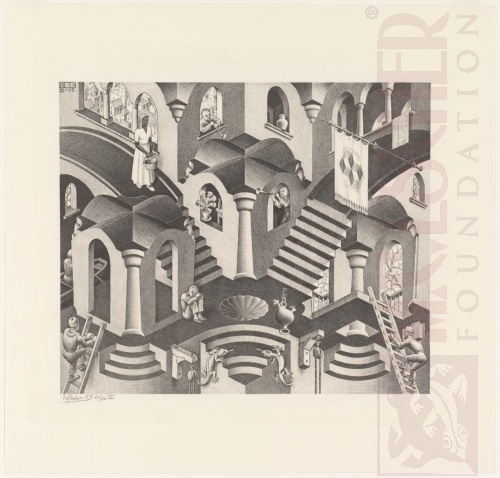
A Necker cube appears on the banner shown in Escher's lithographs "Metamorphosis I" (Bool et al. 1982, p. 271; Forty 2003, p. 39), "Cycle" (Bool et al. 1982, p. 274), and "Convex and Concave". It is also the basis for the arcade game Q*bert.
Depending on the view point chosen for projection, the cubes may be composed of one, two, or three types of rhombi.
The Necker cube is also a tiling that was used in ancient times, including as a mosaic on the floor of one of the houses in Pompeii, as illustrated in the photograph above (courtesy of S. Jaskulowski).
The image above shows a Necker cube pattern emblazoned on a quilt created by Janice Ewing using a pattern by Karen Combs.
See also
Cube, Rhombus, Schroeder Stairs, TilingExplore with Wolfram|Alpha
More things to try:
References
Bool, F. H.; Kist, J. R.; Locher, J. L.; and Wierda, F. M. C. Escher: His Life and Complete Graphic Work. New York: Abrams, 1982.Cromwell, P. R. Polyhedra. New York: Cambridge University Press, p. 155, 1997.Escher, M. C. "Metamorphosis I." Woodcut on two sheets. 1937. https://mcescher.com/wp-content/uploads/2019/08/LW298-Metamorphose.jpg.Escher, M. C. "Cycle." Lithograph. 1938. https://mcescher.com/wp-content/uploads/2019/04/LW-305.jpg.Escher, M. C. "Convex and Concave." Lithograph. 1955. https://mcescher.com/wp-content/uploads/2019/05/LW-399.jpg.Fineman, M. The Nature of Visual Illusion. New York: Dover, pp. 25 and 118, 1996.Forty, S. M.C. Escher. Cobham, England: TAJ Books, 2003.Jablan, S. "Impossible Figures." https://www.mi.sanu.ac.rs/vismath/jablan/impos.htm.Newbold, M. "Animated Necker Cube." https://dogfeathers.com/java/necker.html.Trott, M. Graphica 1: The World of Mathematica Graphics. The Imaginary Made Real: The Images of Michael Trott. Champaign, IL: Wolfram Media, pp. 12 and 84, 1999.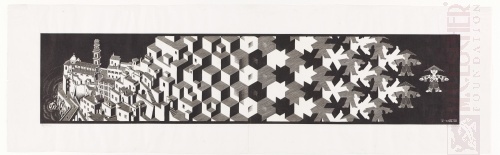
Referenced on Wolfram|Alpha
Necker CubeCite this as:
Weisstein, Eric W. "Necker Cube." From MathWorld--A Wolfram Resource. https://mathworld.wolfram.com/NeckerCube.html