Polypharmacy Interventions in Older Adults — Network Meta-Analysis
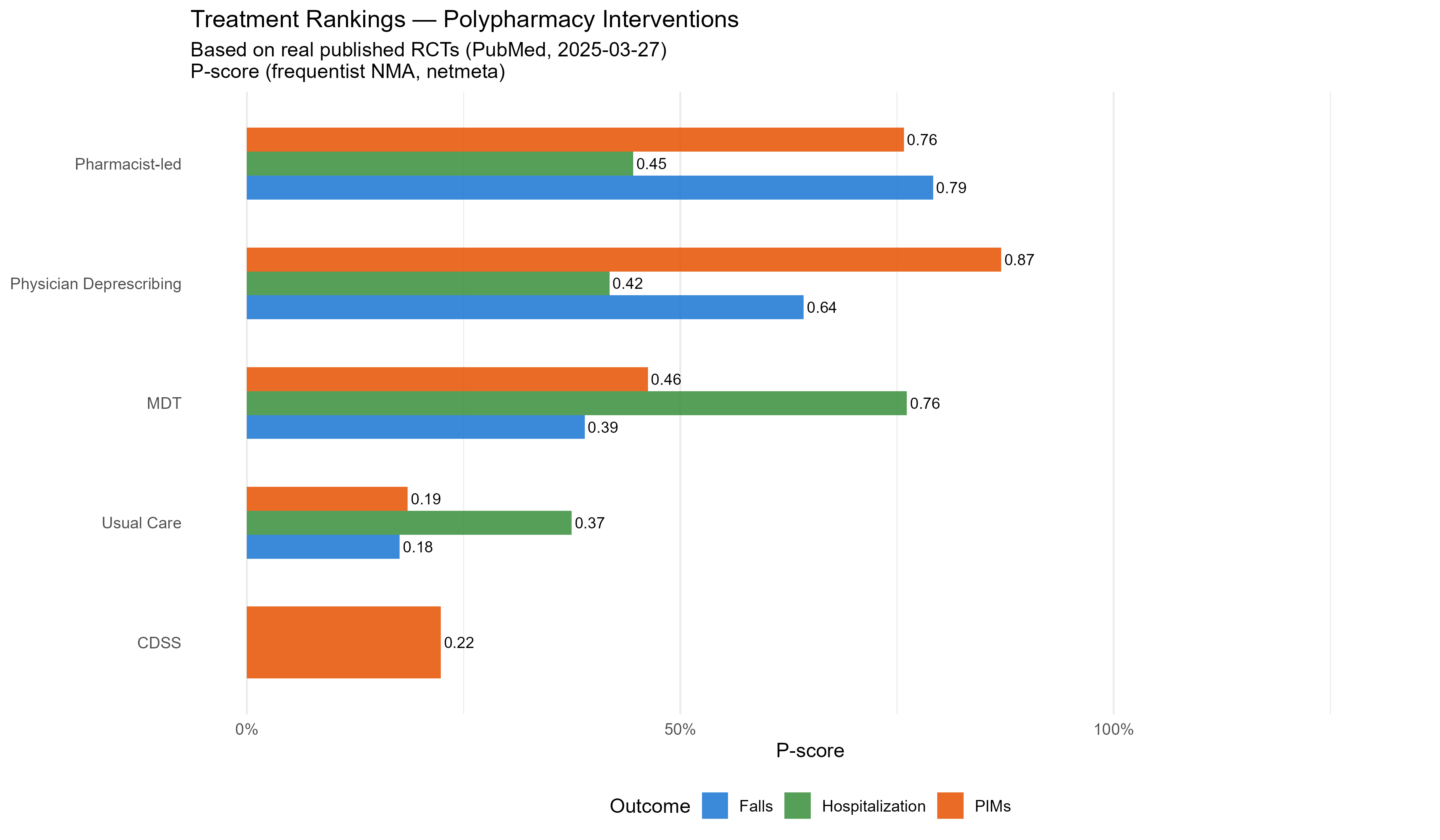
5 strategies compared across 3 outcomes: Pharmacist-led review ranked #1 for falls; Deprescribing ranked #1 for PIMs reduction.
Project path: projects/polypharmacy-nma/
Pipeline stages: 01 Protocol → 02 Search → 06 Analysis → 07 Manuscript
Background
Polypharmacy (>=5 medications) affects over 40% of older adults and is associated with falls, hospitalization, and potentially inappropriate medication (PIM) use. Multiple intervention strategies exist — pharmacist-led review, CDSS, multidisciplinary team (MDT) care, physician deprescribing, and usual care — but no head-to-head trials have compared them simultaneously. This NMA fills that gap using real published RCT data from PubMed.
Included Studies (8 real RCTs, 2011-2026)
| Study |
PMID |
Node |
Region |
Setting |
| Lapane 2011 |
21649623 |
Pharmacist |
N. American |
Institutionalized |
| Che 2024 |
39078632 |
MDT |
Asian |
Institutionalized |
| McCarthy 2022 (OPERAM) |
34986166 |
Deprescribing |
European |
Community |
| Niquille 2021 (QC-DeMo) |
33933030 |
MDT |
European |
Institutionalized |
| Kua 2020 |
32423694 |
MDT |
Asian |
Institutionalized |
| Hellemans 2026 (ASPIRE) |
41619153 |
Pharmacist |
European |
Institutionalized |
| Cateau 2021 (IDeI) |
34798826 |
Pharmacist |
European |
Institutionalized |
| Streit 2023 (OPTICA) |
37225248 |
CDSS |
European |
Community |
Treatment Networks
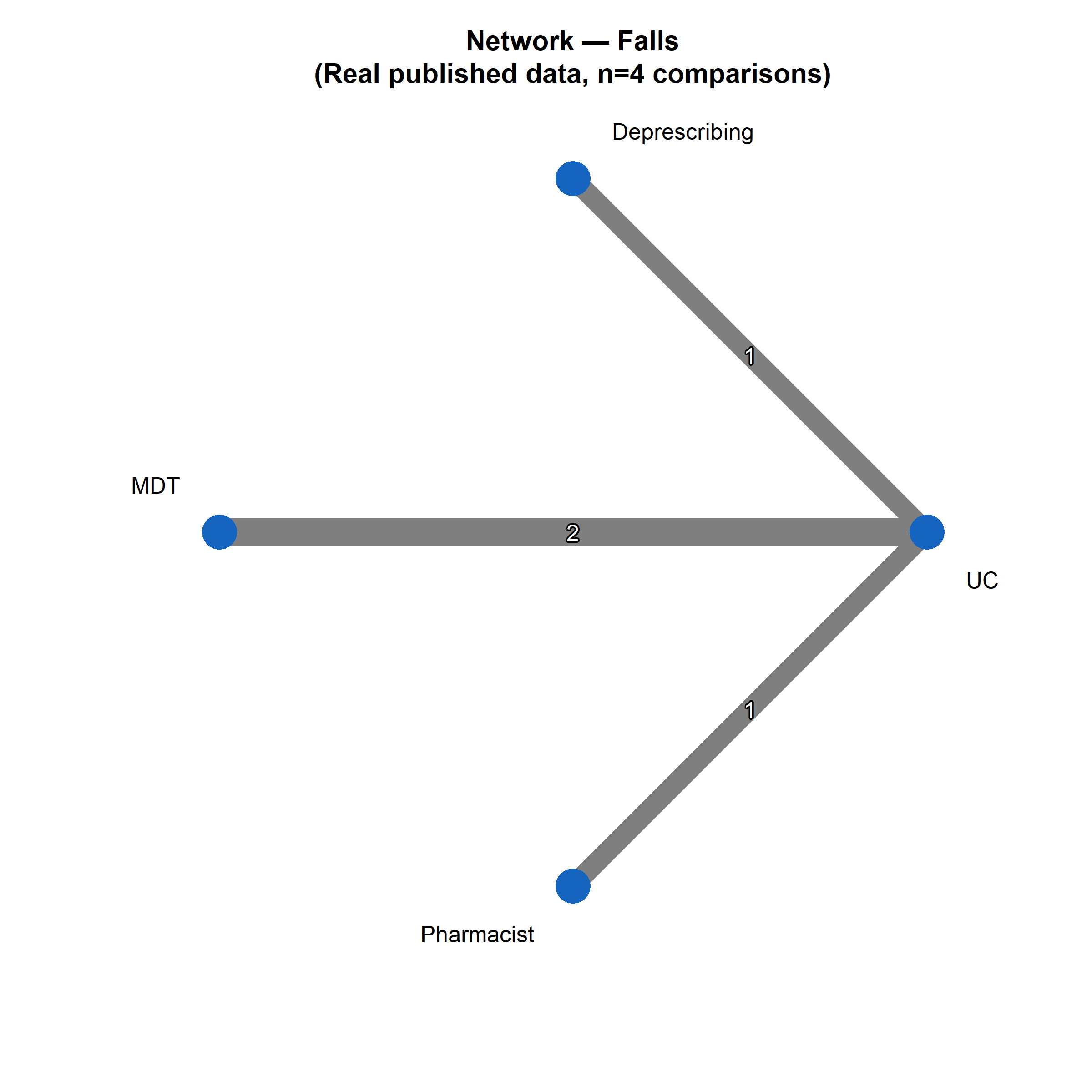
Falls Network
Falls network (k=4 trials): Pharmacist, MDT, Deprescribing vs. Usual Care. I2=0%.
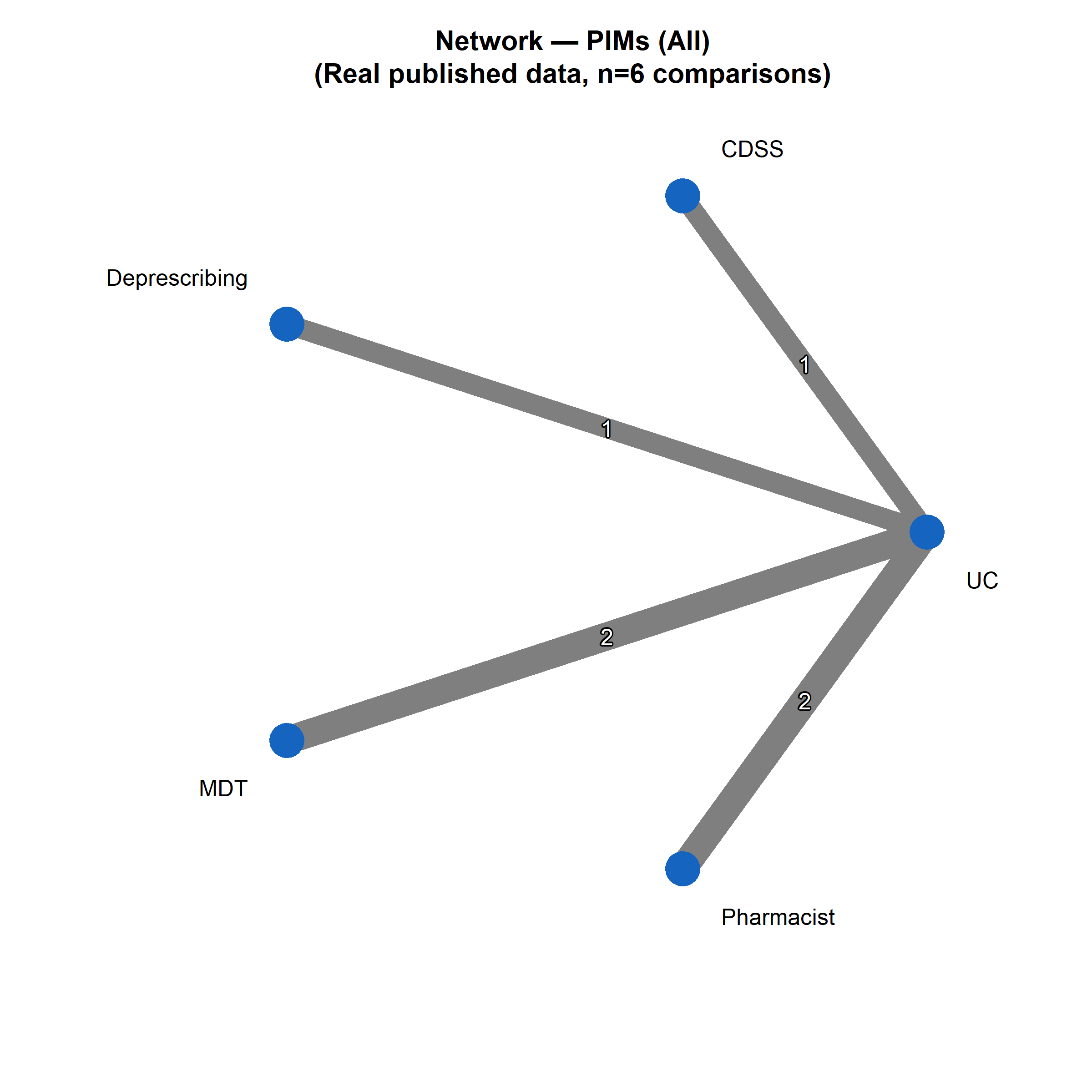
PIMs Network
PIMs network (k=6 trials): all 5 nodes including CDSS. I2=81%.
Forest Plots
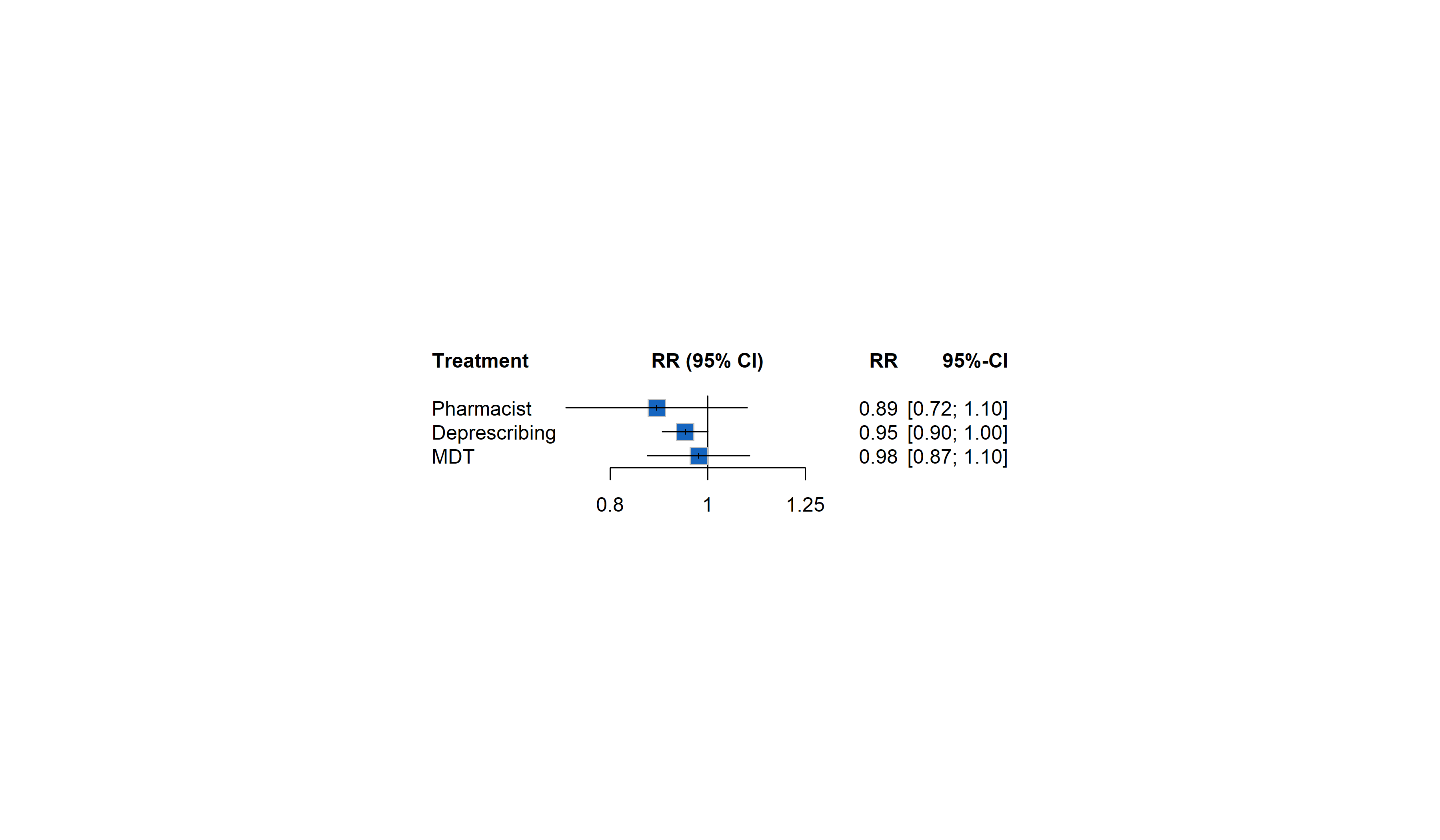
Falls Forest
Falls NMA — low heterogeneity (I2=0%), consistent directional effect favoring active interventions.
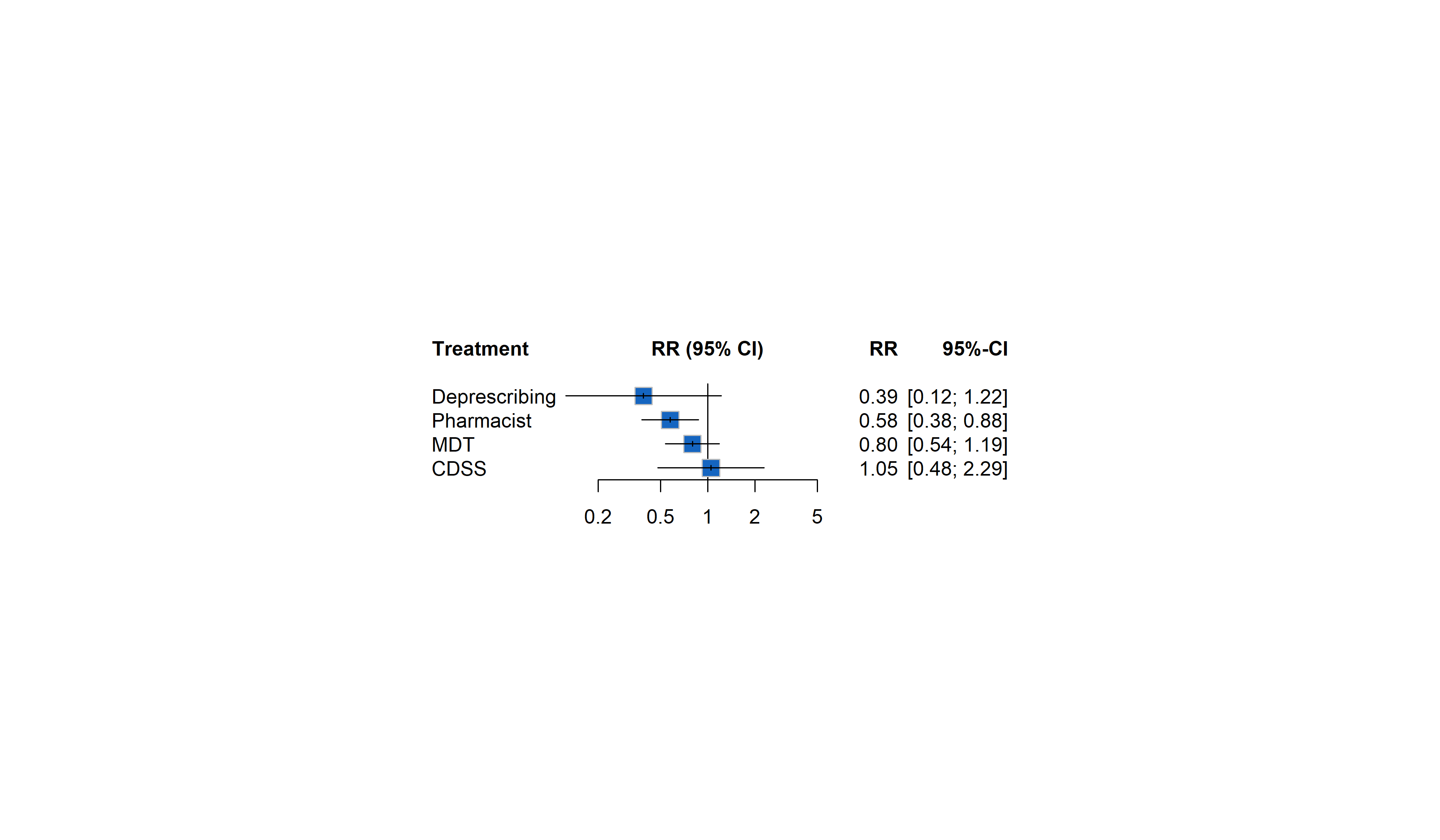
PIMs Forest
PIMs NMA — high heterogeneity (I2=81%), subgroup analysis triggered by setting.
P-score Rankings
Combined Ranking
Comparative P-score rankings across all three outcomes.
Key Findings
| Outcome |
I2 |
#1 (P-score) |
#2 (P-score) |
Notes |
| Falls |
0% |
Pharmacist (0.79) |
Deprescribing (0.64) |
Robust; no subgroup needed |
| Hospitalization |
97.3% |
MDT (0.76) |
Pharmacist (0.45) |
Dominated by Kua 2020 (Singapore NH, HR=0.16); interpret with caution |
| PIMs (all) |
81% |
Deprescribing (0.87) |
Pharmacist (0.76) |
CDSS last (0.22); no significant effect |
| PIMs (European) |
88.5% |
Deprescribing (0.85) |
Pharmacist (0.73) |
Consistent with overall |
| PIMs (Asian) |
N/A |
Insufficient data (k=1) |
— |
Kua 2020 only |
Clinical Implications
- Fall prevention: Pharmacist-led medication review is the top-ranked strategy for fall risk reduction in older adults with polypharmacy, especially in institutionalized settings.
- PIMs reduction: Both deprescribing (STOPP/START-guided) and pharmacist-led review are highly effective; choose based on local resources.
- Hospitalization: Extreme heterogeneity (I2=97.3%) precludes reliable conclusions. MDT care shows dramatic effect in Singapore NH model (Kua 2020), but generalizability is uncertain.
- CDSS: The OPTICA trial showed no significant PIMs reduction; passive technology-only approaches appear insufficient without reinforcing prescriber behavior change.
Methodology
- Analysis type: Frequentist Network Meta-Analysis (NMA)
- Software: R 4.3.0 —
netmeta package (v2.x)
- Ranking metric: P-scores (frequentist SUCRA equivalent); higher = better
- Heterogeneity rule: I2 > 50% triggers auto subgroup (setting for falls/hosp; region for PIMs)
- Outcome measures: log-HR / log-IRR / log-OR converted to contrast format with SE from 95% CI
- Bayesian NMA: Planned extension (requires JAGS for gemtc/true SUCRA)
Pipeline
Stages completed:
Total committed: 90 files
Generated with meta-pipe — AI-assisted meta-analysis pipeline
#NMA #Polypharmacy #GeriatricPharmacy #Deprescribing #Falls #PIMs
|