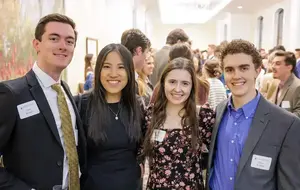
The de Nicola Center for Ethics and Culture congratulates the 203 student Sorin Fellows who completed their studies at Notre Dame, Saint Mary's College, and Holy Cross College in 2026. In all, 119 undergraduates and 84 graduate and professional Sorin Fellows participated in commencement ceremonies this year, joining more than 1,035 existing Sorin Fellow alumni.
"Our Sorin Fellows truly are the jewel in the crown of Our Lady’s University," said Jennifer Newsome Martin, director of the de Nicola Center for Ethics and Culture and the John J. Cavanaugh Professor of the Humanities at the University of Notre Dame. "Throughout their years of study, they were eager to engage the Catholic tradition and pursue the life of the mind in community and friendship. These Sorin Fellows are men and women of service, compassion, and faith, full of the love of Christ and neighbor, and we look forward to seeing how they ‘make prayers of their education,’ in the words of Blessed Basil Moreau."
Sorin Fellow Martin Soros ’26 was honored as the class valedictorian. In his commencement address, he spoke about his role in the design and construction of the St. Olaf’s ice chapel on Notre Dame’s campus in February, where more than 2,400 students braved 19-degree weather to pray at an evening Mass on the Feast of the Presentation. The ice chapel that he and fellow Sorin Fellow Wesley Buonerba ’27 built, he said, echoed the vision of University founder Rev. Edward Sorin, C.S.C., who had "the courage to build something that would radiate warmth in this cold world."
"Like Father Sorin, we stand before a world that has grown cold," said Soros. "And though the people we encounter may know nothing about Notre Dame, we can leave a mark on their hearts with the warmth we have cultivated here. This may seem daunting. But we’ve been doing it for four years, and we are just getting started."
Sorin Fellow Manny Uzobuife ’26 won a Marshall Scholarship and will pursue an M.Sc. in Pharmacology and Toxicology at the University of Liverpool. Anne Griffin ’26 won a Fulbright Scholarship and will serve as an English teaching assistant in Turkey. Gabriela Sierocka ’26 was honored with first place in the 2026 Library Research Award from the Hesburgh Libraries.
Among the undergraduate Sorin Fellows, 43 graduated with academic honors of cum laude or higher (3.783 GPA). Following graduation, 26 are heading to graduate schools to pursue further studies. Three members of the class received commissions to enter into military service: one in the U.S. Space Force and two in the U.S. Army. Four are entering or continuing seminary studies and religious life. Ten are heading to medical or dental school; nine will begin teaching high school. Wedding bells will ring for at least 15 Sorin Fellows over the next few months.
Among the 35 graduating Sorin Fellows in Notre Dame Law School, Amanda Soto J.D. ’26 received the Anne C. Hamilton Award, recognizing the graduating student who has done the most to help his or her fellow Law School students. John Shaughnessy J.D. ’26 was honored with the Captain William O. McLean Law School Community Citizenship Award, awarded to those who have done the most to contribute to students’ lives. Simon Brake J.D. ’26 won first place in the Religious Liberty Student Writing Competition, and Mary Peterson J.D. ’26 won the Jessup International Moot Court Award. Eight Sorin Fellows are heading to clerkships with judges at the federal and state level. A full list of Law School awards can be found here.
Among our 49 graduate Sorin Fellows, 26 earned academic honors of cum laude or higher. Several Ph.D. students are going on to teaching positions around the country: Solomon Fellow Evelyn Behling will join the University of Tennessee’s Baker School of Public Policy and Public Affairs as an assistant professor in American civics, while Sorin Fellow Joseph Heston will stay at Notre Dame as a visiting assistant professor in the Department of Aerospace and Mechanical Engineering.
"The de Nicola Center has made my time at Notre Dame so beneficial and enjoyable," said Behling. "The center has provided me with ample spiritual and material support, community through various events, a wonderful study space, and not the least, many snacks. Notably, the center funded a walking pilgrimage I took to Canterbury, England to the bones of St. Thomas More and St. Thomas Becket. I later realized that during that pilgrimage I walked quite near to the home of my now fiancé, whom I will marry at the Basilica of the Sacred Heart, because Notre Dame, including the de Nicola Center, is so special to us."
The de Nicola Center's Sorin Fellows student formation program, now in its twelfth year, provides Notre Dame, Saint Mary’s College, and Holy Cross College undergraduate and graduate students opportunities and resources to integrate their social, intellectual, and spiritual values in the context of their collegiate experience and in the discernment and pursuit of their vocations. More than 800 students participated in the program in 2025–26. Learn more about the Sorin Fellows program on our website.
Congratulations to all of our graduating Sorin Fellows!
]]>The de Nicola Center for Ethics and Culture presented the 2026 Notre Dame Evangelium Vitae Medal—the nation’s most important award for heroes of the pro-life movement—to the family of the late Wm. David Solomon, associate professor of philosophy emeritus and founding director of the Center, at a Mass and dinner attended by more than 400 guests on May 1, 2026, at the University of Notre Dame.
A member of the philosophy faculty at Notre Dame for almost 50 years, Solomon taught and researched in the areas of virtue ethics, ethical theory, and medical ethics, shaping the minds of countless students and inspiring colleagues across the disciplines. In 1999, Solomon founded the Center for Ethics and Culture, where he served as director until 2012. He retired from teaching in 2016 and passed away in 2025.
"[Solomon’s] philosophical work in bioethics, virtue ethics, and medical ethics, the founding of the Center, his joyful pro-life commitments and labors on behalf of the unborn, his devotion to the thought of Pope John Paul II, his extraordinary generosity as a teacher and doctoral advisor, his self-giving love of his dear wife, children, and extended family, and his love for his friends—who were and are without number—cohered into an extraordinarily integrated life that sprang from the abundance of a festive, jubilant heart," said Jennifer Newsome Martin, director of the de Nicola Center and John J. Cavanaugh Associate Professor of the Humanities, in the medal citation. "If, as Evangelium Vitae states, the Gospel of Life is ‘celebrated above all in daily living, which should be filled with self-giving love for others’ . . . William David Solomon remains one of the truest exemplars of the ‘people of life and for life.’"
The presentation of the medal was preceded by a video tribute to Solomon’s work, featuring reflections from Bishop Kevin Rhoades (Fort Wayne–South Bend); O. Carter Snead, Charles E. Rice Professor of Law and director of the de Nicola Center from 2012 to 2024; Stanley Hauerwas (Duke University); 2012 Evangelium Vitae medal recipient Helen Alvaré (Antonin Scalia Law School); and former students and colleagues of Solomon’s.
In remarks after receiving the medal on behalf of her late husband, Mary Louise Solomon spoke movingly about his work and legacy in terms of fortuity, blessing, and miracle. She reflected on their shared awakening to the pro-life cause and their journey as a couple toward the Catholic faith. Though raised as a Southern Baptist, "I think David started becoming Catholic almost as soon as we arrived here," she noted. "Anyone on this campus breathes in this faith. It’s the reaction to that Catholic air that matters. David, who loved being here and learning everything, soaked it in." The Solomons were received into full communion in the Catholic Church in 2024.
"I am sorry that I am standing here instead of David," she concluded. "But I am quite sure that he is here with us now. And I am sure we all will agree that our being here this evening is a fortuity, a blessing, and certainly, for me, a miracle."
During his tenure as founding director of the Center for Ethics and Culture, Solomon established the annual Fall Conference, now the University’s largest interdisciplinary academic conference, which gathers more than 1,200 guests and 150 speakers—both Catholic and those from other faith traditions—for three days of conversation and exchange on the most vexed questions of ethics, culture, and public policy. In 2011, Solomon established two of the Center for Ethics and Culture’s landmark culture of life initiatives: the annual Vita Institute, which provides intensive intellectual formation for leaders working to build a culture of life both nationally and internationally, as well as the Evangelium Vitae Medal, envisioned as an enduring celebration of individuals and organizations whose heroic work proclaims the gospel of life.
Rev. Gregory P. Haake, C.S.C., incoming Vice President for Mission Engagement and Church Affairs at the University of Notre Dame, delivered remarks before he offered the dinner blessing. He praised the work of the de Nicola Center to build and support, in the words of Pope St. John Paul II, "a civilization of truth and love": "Through the tireless efforts of the de Nicola Center and its founding director David Solomon, who is just one among the exemplary models of this devotion to the ethic of life honored by the Evangelium Vitae medal, the Center challenges the cynicism and brutal pragmatism that is so contrary to the truth that we pursue and share, and contrary to the love that animates our desire for justice for those whose lives need defending."
At the conclusion of the celebration, John P. O’Callaghan, professor of philosophy at Notre Dame and longtime friend and colleague, reflected on Solomon’s deep friendships as an expression of the gospel of life. "What David did in his wonderful life was to show us in so many countless ways how to give life to one another," said O’Callaghan. "He knew, as Aquinas argued, that the life of grace is a participation in the kingdom of heaven already here and now, alive amongst here and now. Amidst all our faults, our wrong turns, our self-serving and isolation, David saw the blessedness of others here and now. And he loved us."
O’Callaghan concluded, "David Solomon: apostolus evangelii vitae, ‘apostle of the good news of life.’ He has competed well; he has finished the race; he has kept the faith. From now on the crown of righteousness awaits him, which the Lord, the just judge, will award to him on that day, and not only to him, but to all who have longed for His appearance."
The Notre Dame Evangelium Vitae Medal, named after Pope John Paul II’s 1995 encyclical, is the nation’s most important lifetime achievement award for heroes of the pro-life movement, honoring individuals whose efforts have advanced the Gospel of Life by steadfastly affirming and defending the sanctity of human life from its earliest stages.
Announced annually on Respect Life Sunday, the first Sunday of October, the Notre Dame Evangelium Vitae award consists of a specially commissioned medal and 10,000ドル prize presented at a banquet following a celebratory Mass in the Basilica of the Sacred Heart. Visit the de Nicola Center website for more information about the Evangelium Vitae Medal.
]]>The entire de Nicola Center for Ethics and Culture family mourns the passing of our dear friend and Faculty Fellow Ernest Morrell, the Coyle Professor of Literacy Education, professor of English and Africana studies, and associate dean of the College of Arts & Letters. Professor Morrell was a brilliant scholar, a man of deep love for his family and his faith, and a beloved collaborator and contributor to the mission of the de Nicola Center.
Over the years, Morrell shared his wisdom and insight with the de Nicola Center in a variety of ways—over dinner with our student Sorin Fellows, in presentations at our annual Fall Conference, and in his faithful service as an administrator in the College. We are honored to share highlights from some of those public presentations below:
May Ernest rest in peace, and may his family and friends know the consolation of the Holy Spirit.
]]>James Wilson, the de Nicola Center’s 2025–26 postdoctoral fellow, has long held a fascination with Southern writer William Faulkner. The author became the subject of Wilson’s dissertation at the University of Cambridge, which Wilson is currently working to develop into a book.
"The poet and trappist monk Thomas Merton once described Faulkner as a biblical prophet—an author who is ‘more prophetic, in the biblical sense, than any theologian writing in the 20th century,’" Wilson says. "Though Merton planned to write a book on the matter, he tragically died before he could write it. In many ways, I see my dissertation as picking up where Merton left off. It’s been amazing that the de Nicola Center has given me the time and the resources to begin turning it into a book and bringing it to life."
In addition to writing and participating in the intellectual life of the Center during his postdoctoral fellowship, Wilson is offering an undergraduate course this spring semester in the Department of Theology based on his doctoral dissertation, titled "Faulkner and the Bible: Modernism, Metaphysics, and Prophecy." The course focuses on the relevance of the Christian and Hebrew Scriptures in Faulkner’s writing, addressing questions of ethics and religious experience in works spanning from the masterpiece The Sound and the Fury to the much-lauded Absalom! Absalom!
"Faulkner has always been my ‘lion in the path,’ so to speak, over the years—my Virgil who met me outside the gates of Hades and showed me the way out of the dark woods," says Wilson. "After almost a century, his strange, biblically haunted stories still manage to crackle with spiritual vitality— simultaneously managing to confront you in the hidden depths of your existential experience while awakening you to some mysterious, disturbing meaningfulness beneath the crust of time and history."
Wilson relishes the opportunity to use Faulkner’s oeuvre as an entry point to introduce students to the broad array of American modernist fiction, which he finds to be an under-explored genre even among Notre Dame’s well-read undergraduates. He encourages students to embrace the difficulty that comes with reading modernist fiction and to treat it as a mystery to be engaged rather than a question to be answered.
"I wanted to explore the relationship between theology and literature through a new lens," says Kate Apelian, a Sorin Fellow and senior theology major in Wilson’s class. "Professor Wilson strikes the delicate balance between guiding the class in grappling with the questions posed by Faulkner and encouraging us to present our own observations. I always leave class with a sense that the questions we discussed together have metaphysical import in my own life beyond the scope of the classroom and the text."
Wilson professes to be impressed by his students’ ability to embrace Faulkner’s intimidating prose, successfully analyzing works that puzzle even expert literary critics. "This group of students, more than any I have taught, has a rare combination of earnestness, insight, and a deep sense of spiritual humility," says Wilson. "They simultaneously bring an intellectual seriousness to the task of reading and understanding, without feeling the need to impose their preconceived conclusions and agendas onto a complex and challenging text."
Wilson first visited the de Nicola Center in 2018 with his band the Sons of Bill, performing a concert for Sorin Fellows and the Notre Dame community. "Music and the arts were always a focal point in my spiritual life, a way of reaching into the deepest parts of myself and the hidden meaning of experience, as a means of trying to connect with the deepest parts of others," he says. The band went on hiatus while Wilson pursued his degree at Cambridge, during which time he was a frequent presenter at the de Nicola Center’s annual Fall Conference. "Though my life as a teacher and scholar may look very different from my former life on the stage, from the inside, it all feels like part of one coherent story—a unified vocation."
Wilson will offer a public lecture at Notre Dame on April 15, entitled "Cormac McCarthy’s The Road: Literature, Metaphysics, and Apocalypse," with a response from Cyril O’Regan, the Catherine F. Huisking Professor of Theology emeritus. "McCarthy is not only one of the few contemporary authors who situates himself in a self-conscious conversation with the canon of Western Literature, but I also see him as perhaps the only 21st century author to take up Faulkner’s ‘biblically prophetic’ mantle—diagnosing the deep spiritual pathologies of the age by situating them within the timeless drama of the Biblical story," Wilson says. "Though, much like [with] Faulkner, many contemporary critics read his disturbing fiction as morbid, pessimistic, and hopelessly nihilistic, I believe this misses out on the biblical depth of McCarthy’s imaginative vision. Like Faulkner, McCarthy simply has what Toni Morrison described as an ‘unflinching gaze’—a refusal to look away when everyone else looks away. After living my life with these authors, I've found that what animates this ‘gaze’ is a spiritual courage and an unwavering commitment to reality—something like faith."
*Updated April 8, 2026 with public lecture details.
]]>Angela Knobel is no stranger to South Bend. The de Nicola Center’s 2025–26 Myser Visiting Fellow received her doctorate in philosophy from Notre Dame and considers the University a second home. "I’ve always loved Notre Dame," she says. "From the moment I set foot on campus as a prospective graduate student a million years ago, Notre Dame has felt like home to me. I remember walking around campus all those years ago thinking, ‘I can be happy here.’"
Now an accomplished professor of philosophy at the University of Dallas, Knobel is spending this year as the de Nicola Center’s Myser Fellow researching and reflecting on the theme of motherhood in preparation for a new book, Other Selves: Motherhood and the Moral Life.
The de Nicola Center’s Myser Fellowship provides extraordinary scholars the opportunity to conduct a year of research at the University of Notre Dame while engaging deeply in the intellectual life and scholarly community of the Center—its faculty, student Sorin Fellows, and the wider tri-campus community of Notre Dame, Saint Mary’s College, and Holy Cross College. "The events for the Center and the other events that I have been able to do have helped me refine my thinking," she says. "They have given me opportunities to think through and clarify ideas and chapters in my book in a more rigorous way."
Knobel describes her current book as a different kind of project than the technical philosophical works she has previously published, while maintaining the tight argumentation that the Thomistic philosophical tradition demands. An expert in ethics and bioethics, she considers the current book as a new challenge, filling a gap in philosophical discussion of motherhood.
"There are lots of books on motherhood," Knobel explains, "but almost nothing that tries to understand motherhood in light of the ethical naturalism of Aristotle and Aquinas. In some sense, it has more original philosophical thinking than my other work, because it’s an application of a kind of philosophical school of thought to something that very few philosophers in that school have had much (or anything) to say about."
In addition to her research and writing, Knobel has offered several lectures and seminars during her time as the Myser Fellow. She delivered the annual McMahon Aquinas Lecture at Saint Mary’s College in September, a talk entitled "Motherhood and the Meaning of Self-Gift: Reflections on The Giving Tree ," which she says helped her develop the central thesis of her book, "whether and to what extent motherhood involves a loss or fragmentation of the self, and in what sense motherhood requires self-sacrifice and self gift."
"Angela Knobel is one of the most important Thomistic ethicists of our generation," said Michael Waddell, McMahon Aquinas Chair in Philosophy at Saint Mary’s College and himself a former de Nicola Center Myser Fellow. "Her book on Aquinas and the infused moral virtues is the definitive work on the subject, and her forthcoming book on motherhood promises to be just as important. Her innovative use of literature—including children’s literature—along with the writings of Aquinas and other philosophers to address existentially pressing and perennially important themes related to motherhood is breaking new ground both in Thomistic studies and in the growing field of philosophical reflection on motherhood."
Knobel also presented a paper exploring artistic representations of motherhood at the de Nicola Center’s 25th annual Fall Conference this past November and has led several reading groups and seminar-style discussions with Sorin Fellows on themes of motherhood and family through the lens of classic literature. This past January, she led a public discussion with Rev. Gregory Pine, O.P., about his book on the practice of virtue in conversation, illuminating themes found in Thomistic moral philosophy. Most recently, she offered a webinar hosted by the de Nicola Center on Leo Tolstoy’s Anna Karenina, which drew registrants from across the country for a conversation around motherhood and happiness in one of the great novels of the Western tradition.
Knobel explains that Anna Karenina is a particularly rich source of literary reflection on many of the topics she is exploring in her research. "Dolly is described as having been utterly used up by motherhood—made old, ugly before her time—while Anna’s rejection of motherhood keeps her beautiful and alive," she says. "Some scholars describe Anna and Dolly as equally tragic. And it is true that Dolly does seem to be unhappy. But she’s not unhappy in all respects, and there’s a good case to be made that she does find happiness and peace in the love and care she feels for her children. So thinking about what goes on with Dolly seems like an important piece of thinking about the respects in which motherhood helps us flourish."
"The Myser Fellowship has given me time to devote uninterrupted and focused attention to my project," says Knobel. "It has allowed me to do in months what would normally have taken years. Today I had a conversation with Notre Dame professor David O’Connor about a single line in Aristotle I’d been thinking about. He was able to point me to an entire book that carefully works out an intuition I’ve had about that line, and then I was able to pull up the book on the Hesburgh library website and read the relevant material right away. This is an example of something that simply would not have been possible for me without the Myser Fellowship."
More information on the Center’s Myser Fellowship is available here.
]]>The de Nicola Center for Ethics and Culture is pleased to partner with the University of Notre Dame’s Global Catholic Research Initiative to welcome Rev. Roberto Regoli to the University as a visiting scholar for the Spring 2026 semester. Father Regoli is professor of contemporary Church history and former director of the Department of History and Cultural Heritage of the Church at the Pontifical Gregorian University in Rome, as well as the recently appointed president of the Vatican Foundation Joseph Ratzinger–Benedict XVI. During his residency with the de Nicola Center, Father Regoli will serve as the inaugural visiting fellow of Notre Dame’s Global Catholic Research Initiative.
"We are honored to work together with our friends in the Global Catholic Research Initiative to welcome Father Regoli, a world-renowned expert on the modern Holy See and a longtime friend and collaborator of the de Nicola Center," said Jennifer Newsome Martin, director of the de Nicola Center and John J Cavanaugh Associate Professor of the Humanities. "He has been an invaluable partner to the Center over the years, and we look forward to the fruitful conversations that our student and faculty fellows will share with him this semester."
"I couldn’t be more delighted to join the de Nicola Center in welcoming Father Regoli as the first visiting fellow of the Global Catholic Research Initiative," said Kathleen Sprows Cummings, director of the Global Catholic Research Initiative and John A. O’Brien Collegiate Professor of American Studies and History. "Father Regoli’s deep engagement with the history of global Catholicism, as well as his affiliation with the Pontifical Gregorian University and the Joseph Ratzinger–Benedict XVI Vatican Foundation, make him an ideal inaugural GCRI Fellow. While I look forward to learning more from him this semester about the history of papal diplomacy, I am particularly eager to glean his insights about how GCRI can stimulate field-defining research across broad intellectual networks on Catholicism as a dynamic, global tradition."
Father Regoli’s research focuses on the contemporary papacy from Pius VII to Benedict XVI, particularly in the realm of pontifical diplomacy. He serves as editor of the journal Archivum Historiae Pontificiae and is the author of Beyond the Crises in the Church: The Pontificate of Benedict XVI (St. Augustine’s Press, 2024). In collaboration with the de Nicola Center, he helped to organize the 2024 international conference "Benedict XVI’s Legacy: Unfinished Debates on Faith, Culture, and Politics."
"I am honored to be at the de Nicola Center to build upon the scholarly partnership begun two years ago with the two-part conference, first at the Gregorian and then at Notre Dame, discussing Pope Benedict XVI’s legacy," said Father Regoli, who organized the conference with Rev. John Paul Kimes (University of Notre Dame) and Rev. Jordi Pujol (Pontificia Università della Santa Croce). The collaboration led to two published volumes of the papers presented at the conference (one to be released by University of Notre Dame Press), as well as the University of Notre Dame’s second-ever Ratzinger Prize for the conference’s keynote speaker, Cyril O’Regan (University of Notre Dame).
On January 27, 2026, Father Regoli was announced as the successor to Rev. Federico Lombardi, S.J., as the new president of the Ratzinger Foundation, which works to promote the late pontiff’s theological vision through conferences, scholarly research, and international partnerships. The Foundation also administers the annual Ratzinger Prize, the most prestigious award in theology for "scholars who have distinguished themselves with particular merit in the activity of publication and/or scientific research."
During his time in residence at Notre Dame, Father Regoli will conduct research in the Hesburgh Library as part of a book project on the Holy See’s role in international relations from the French Revolution to the present. He will also offer a public lecture on his work and mentor the de Nicola Center’s graduate and undergraduate Sorin Fellows to support their own scholarship and research.
]]>The de Nicola Center for Ethics and Culture at the University of Notre Dame is proud to announce that the late Wm. David Solomon, associate professor of philosophy emeritus and founding director of the Center, has been named the recipient of the fifteenth annual Notre Dame Evangelium Vitae Medal, the nation’s most important award for heroes of the pro-life movement. The medal will be presented to Professor Solomon’s family at a special Mass and dinner on Friday, May 1, 2026, at the University of Notre Dame.
Rev. Robert A. Dowd, C.S.C., president of the University of Notre Dame, reflected on the significance of Solomon’s enduring impact. "Professor Solomon left a lasting legacy at Our Lady’s University—one of sincere pursuit of the truth in friendship and dialogue, and an unflagging commitment to the inherent dignity of all human life," said Father Dowd. "That legacy lives on through the efforts of the de Nicola Center for Ethics and Culture, which he founded, as it shares the richness of the Catholic moral and intellectual tradition through teaching, research, and dialogue. Notre Dame is deeply grateful for David's transformative leadership and vision, and it is a special joy to honor his legacy with the Evangelium Vitae Medal."
"David Solomon was a beloved scholar who dedicated his considerable talent to upholding the dignity of every human life with a generous spirit of hospitality," said Jennifer Newsome Martin, director of the de Nicola Center for Ethics and Culture. "His entire career as a professor, colleague, and mentor was a joyful witness to the magnetic power of the University’s distinctive Catholic mission to attract people from across the disciplines to build and sustain ‘a culture of life and civilization of love.’"
A native of Texas, Solomon earned his B.A. at Baylor University and his Ph.D. in philosophy at the University of Texas before joining the Notre Dame faculty in 1968. Over the course of nearly five decades, his teaching and scholarship focused on virtue ethics, ethical theory, and medical ethics, shaping the minds of countless students and inspiring colleagues across the disciplines.
In 1999, Solomon founded the Center for Ethics and Culture at the University of Notre Dame with a bold vision to share the richness of the Catholic moral and intellectual tradition and bring the university’s voice into the public discussion of the most vital issues of our day. The Center would build its work upon the charge of the University’s Task Force on Ethics, which affirmed that "Normative teaching and inquiry at Notre Dame should be distinguished by fidelity to the core convictions of the tradition of thought Notre Dame has inherited: that human beings are created in the image of a God who loves us and calls us to eternal life; that we therefore have a dignity which cannot be alienated, overridden, or ignored; and that the most vulnerable among us have the most urgent claim on the consciences of us all."
Under Solomon’s leadership, the Center for Ethics and Culture launched signature initiatives that established a community of scholars and students to consider enduring questions of justice, human dignity, and the common good in friendship and community. He established the Fall Conference, now Notre Dame’s largest interdisciplinary academic gathering, which annually welcomes more than 1,200 guests and 150 speakers from around the world for three days of reflection and dialogue on broad topics in ethics, culture, and public policy today. He also oversaw Notre Dame’s annual Medical Ethics Conference, which drew experts and professionals from across the country to engage with pressing issues in medical ethics and bioethics at the intersection of healthcare and human dignity.
In 2011, Solomon established two of the Center for Ethics and Culture’s landmark culture of life initiatives. The annual Vita Institute was designed to provide an intensive intellectual formation program for leaders working to build a culture of life both nationally and internationally, with a focus on questions in social science, biology, philosophy, theology, law, and communication. That year, Solomon also inaugurated the Evangelium Vitae Medal itself, envisioning it as an enduring celebration of heroic individuals whose life work proclaims the gospel of life. The Center also supported the University’s participation in the annual March for Life in Washington, D.C., leading Notre Dame students, faculty, and staff in a joyful public witness to the dignity of all human life.
In all, Solomon ensured that the Center remained a place of hospitality, friendship, and joyful Christian witness, animated by his belief that dialogue and camaraderie are essential to the pursuit of truth. "David Solomon was one of Notre Dame's most beloved and dedicated teachers, a shining light of creativity and dynamism in its philosophy department, and the visionary founder of what is now called the de Nicola Center for Ethics and Culture," said O. Carter Snead, Charles E. Rice Professor of Law and Solomon’s successor as director of the Center. "He was a tireless and courageous voice at Notre Dame on behalf of the intrinsic equal dignity of all members of the human family, born and unborn. His passing earlier this year was heartbreaking for us all, and presenting the 2026 Notre Dame Evangelium Vitae Medal to his family is a fitting tribute to David’s tremendous legacy as a true champion for life."
Solomon’s own life bore witness to the transformative power of the faith he so joyfully served. Born and raised a Southern Baptist, he and his wife Lou were received into the Catholic Church in May 2024. He died on February 26, 2025, leaving behind a legacy of scholarship, friendship, and faith that continues to inspire all who knew him.
The Notre Dame Evangelium Vitae Medal, named after Pope St. John Paul II’s 1995 encyclical Evangelium Vitae, is awarded annually by the de Nicola Center for Ethics and Culture to honor individuals and organizations whose outstanding contributions have advanced the proclamation of the sanctity of human life.
Announced annually on Respect Life Sunday, the first Sunday of October, the Notre Dame Evangelium Vitae award consists of a specially commissioned medal and 10,000ドル prize presented at a banquet following a celebratory Mass in the Basilica of the Sacred Heart. Registration for the 2026 Evangelium Vitae Medal Mass and dinner will be available through the de Nicola Center’s website in early 2026. For more information, visit ethicscenter.nd.edu/programs/culture-of-life/evangelium-vitae-medal/.
]]>The de Nicola Center for Ethics and Culture is pleased to welcome three new graduate mission fellows for the 2025–26 academic year: Solomon Fellows Rev. Brendan Baran, O.P., and Nicholas Ramirez, and Polking Fellow Joseph Mann.
As part of its mission as an interdisciplinary research center, the de Nicola Center annually awards two competitive fellowships for graduate and professional students at the University of Notre Dame who share the de Nicola Center’s interest in the moral and intellectual tradition of the Church, and whose research aligns with the mission of the Center. In addition to receiving a financial scholarship, during their time at Notre Dame Solomon and Polking Fellows play an active role in the life of the de Nicola Center, take part in regular Center events and conferences, and interact with its wide network of faculty and student fellows.
"Every year, the de Nicola Center welcomes elite rising scholars to Notre Dame, individuals whose work across the disciplines augments our own efforts to support serious research that engages the breadth of the Catholic tradition," said Jennifer Newsome Martin, director of the de Nicola Center for Ethics and Culture and the John J. Cavanaugh Professor of the Humanities. "Our Solomon and Polking Fellowships are a concrete expression of our mission to support the next generation of scholars who will go on to share the fruits of their studies in their academic and professional careers."
The Solomon Fellowship was established in 2016 to honor W. David Solomon, the legendary founding director of the de Nicola Center, who taught in the Department of Philosophy from 1968 to 2016 and directed more than 40 doctoral dissertations. The competitive fellowship is awarded to an incoming Ph.D. student in the College of Arts and Letters who has a demonstrated passion for the Catholic moral and intellectual tradition that animated Solomon’s own exemplary academic career. This year, the Center awarded two fellowships in memory of Professor Solomon, who died in February 2025.
Father Baran is a member of the St. Joseph Province of the Order of Preachers (Dominicans) who earned his master’s in education from Columbia University Teachers College and a B.A. in Classics from Brown University. Prior to commencing Ph.D. studies at Notre Dame, Father Baran taught theology at Providence College.
"I am a member of a mendicant order which lives the evangelical counsels, including poverty. This means that the Solomon Fellowship provided crucial funding that contributed significantly to my ability to come to Notre Dame," Father Baran said.
While at Notre Dame, Father Baran will pursue a Ph.D. in theology, with a focus on the history of Christianity. He is especially interested in patristic theology and its reception in the medieval period.
"Initially I was drawn to the liturgy and the way that the Dominican friars pray and worship God," he said, speaking about his attraction to the Dominican order. "My first real encounter with Dominican prayer was Vespers with the friars at the Dominican House of Studies in Washington, D.C., and I remember thinking that I could do this for the rest of my life. I was also drawn to the way that the life of prayer, study, and preaching all integrate with each other."
During his time at Notre Dame and at the de Nicola Center, Father Baran hopes to instill the same passion for prayer, study, and community rooted within the Catholic tradition.
"I hope to work along with other Solomon Fellows to create a community of graduate students who aspire to be scholars that draw upon the mission of the de Nicola Center," he said. "I look forward to working with the Center’s staff to gather the other Solomon Fellows in colloquia, informal conversations, and time for reflection on the life of faith."
Nicholas Ramirez is pursuing a Ph.D. in moral theology but is not new to the University of Notre Dame or to the de Nicola Center: Ramirez graduated from the MTS program at Notre Dame in May 2025, where he concentrated in moral theology and the history of Christianity. He was a Sorin Fellow at the de Nicola Center during his master’s studies.
"I was drawn to stay at Notre Dame for many reasons, chief among them the vibrant Catholic intellectual community," he said. "The de Nicola Center is a very special Catholic institution that values both academic excellence and fidelity to the Catholic moral and intellectual tradition. Having an institution like that at Notre Dame, where I knew I would be personally and greatly supported in my academic interests in a way that is supportive of the mission of the Church, greatly helped my decision to choose to stay at Notre Dame."
Ramirez’s research interests explore the thought of St. Thomas Aquinas and the Thomistic tradition with specific application to important modern ethical and bioethical questions.
"I see these research interests as being closely aligned with the de Nicola Center’s larger mission of bringing the resources of the Catholic intellectual tradition to bear on modern ethical conflicts in areas of great social importance, such as medicine and politics," he said. "I am looking forward to being involved with the Hippocratic Society and also getting to meet and collaborate with all those involved with the Center."
The Polking Family Fellowship cultivates the next generation of leaders who understand that law and public policy are essential elements in building a sustainable culture of life. Recipients of the Polking Family Fellowship receive a top-up scholarship for three years of study at Notre Dame Law School, as well as opportunities to participate more closely in the work of the de Nicola Center by attending special Center events, working with its affiliated faculty and fellows, interacting with speakers and guests of the Center, conducting scholarly research, and receiving special career mentoring and internship opportunities.
Prior to coming to Notre Dame, Mann spent six years teaching in secondary and higher education, but ultimately felt the pull to study law. He received his Ph.D. in musicology at The Catholic University of America, as well as an M.M. in piano performance from James Madison University and a B.M. in piano pedagogy from Longwood University.
"The dCEC represents the kind of community I have always wanted to be a part of," Mann said. "It engages in the pursuit of virtue and truth that ultimately aims at communion with God and, beyond the personal and intellectual, also seeks to cultivate fellowship, Christian hospitality, and service in imitation of and obedience to Christ."
"I look forward to the community, the intellectual engagement, the deepening of my faith, the lifelong connections I will have with my fellow student colleagues and faculty, and the many opportunities I will have to also be a light in the world like the de Nicola Center," he added.
The de Nicola Center’s competitive Solomon and Polking Fellowships are offered annually to outstanding scholars whose research interests and career aspirations support and extend the work of the Center. Learn more about the de Nicola Center’s Mission Fellowships here.
]]>As part of its mission as an interdisciplinary research center at the University of Notre Dame, the de Nicola Center annually welcomes visiting faculty, students, and postdoctoral fellows from around the world to pursue research projects in a vibrant scholarly community rooted in the Catholic intellectual, moral, and aesthetic tradition. During these research visits, scholars play an active role in the life of the de Nicola Center, taking part in regular Center events and conferences and interacting with its wide network of faculty and student fellows.
"Every year, the de Nicola Center welcomes research visitors to Notre Dame from around the world, individuals whose work across the disciplines augments our own efforts to support serious research that engages the breadth of the Catholic tradition," said Jennifer Newsome Martin, director of the de Nicola Center for Ethics and Culture and the John J. Cavanaugh Professor of the Humanities. "The work that Angela and James undertake this year, and their interactions with our community of scholars and students here at Notre Dame, will help expand our mission in exciting and important ways, and we couldn’t be more delighted to welcome them."
The de Nicola Center’s Myser Fellowship is offered annually to an outstanding scholar whose research interests support and extend the work of the de Nicola Center. Applications for the 2026–27 Myser Fellowship will open in September 2025. Email Justin Petrisek (jpetrisek@nd.edu) for more information.
Myser Fellow Angela Knobel
Angela M. Knobel is professor of philosophy at the University of Dallas. A frequent contributor to journals such as The Thomist and Journal of Moral Theology, Knobel specializes in Thomistic ethics and bioethics. She has served as the director of graduate studies at the University of Dallas since 2022 and was recognized for her extensive academic work in philosophy with the University of Dallas’s Haggar Scholar Award. Prior to coming to the University of Dallas in 2021, she was a member of the philosophy faculty at The Catholic University of America for sixteen years.
Knobel’s most recent book, Aquinas and the Infused Moral Virtues, was published by Notre Dame Press in 2021. She received her Ph.D. in philosophy from the University of Notre Dame, an M.A. in mathematics from the University of Maryland, and her B.A. in mathematics and philosophy from The Catholic University of America.
During her fellowship at the de Nicola Center, Knobel will work on a book project tentatively titled Maternal Virtue: Motherhood and Moral Growth. As part of her research and course development on this topic during her residency, she will offer a variety of lectures to the tri-campus community and lead a reading group for the de Nicola Center’s Sorin Fellows that will consider famous works of literature centered around depictions of mothers, examining questions of mothering and what it means to be a mother.
Postdoctoral Fellow James Wilson
James Wilson received his Ph.D. in theology and religious studies from the University of Cambridge (UK), Faculty of Divinity. His most recent article is forthcoming in Notre Dame’s Journal of Society and Literature, "Rethinking the ‘Strange Religion’ of William Faulkner: Patristic Exegesis and Postcritical Reading." He received his B.A. in religious studies from the University of Virginia and his M.Div. from Duke Divinity School. Before embarking on his academic career in theology, Wilson was a full-time musician and singer-songwriter for the folk music group Sons of Bill. He was the Stowe Artist in Residence at Sewanee, the University of the South, in 2017.
During his fellowship with the de Nicola Center, Wilson will continue his research on the thought of René Girard, mimetic theory, and postmodern theological readings of American fiction. He will also help support programming and events for the de Nicola Center’s Solomon Fellows and graduate Sorin Fellows throughout the year.
]]>The de Nicola Center for Ethics and Culture celebrates the July 31, 2025, news that Pope Leo XIV will soon declare St. John Henry Newman the newest Doctor of the Church, recognizing his personal sanctity and influential contribution to Catholic theology and doctrine. Jennifer Newsome Martin, director of the de Nicola Center for Ethics and Culture and the John J. Cavanaugh Professor of the Humanities at the University of Notre Dame, was a member of the committee of scholars that prepared the positio in support of Newman’s elevation to the honor.
"Contributing to St. John Henry Newman’s cause for Doctor of the Church has been the single most edifying task of my vocation as a professional theologian," said Martin. "I am grateful to have had occasion to petition the Vatican in the positio alongside other theologians and Newman scholars, especially all my friends and colleagues affiliated with the National Institute for Newman Studies."
Martin continued, "The eminence of Newman’s teaching—particularly with respect to the development of doctrine, conscience, the operation of human reason, the nature of tradition, liberal education, and the role of the laity in the Church—is absolutely incontrovertible, and the de Nicola Center for Ethics and Culture is proud to have played a role in elevating the thought and witness of Newman both in the broader Church and in the public sphere."
"Doctor of the Church" is an official title designated by the pope in recognition of the outstanding contribution that a person of eminent sanctity has made to the interpretation and understanding of Sacred Scripture and the body of Christian doctrine. From the Latin docere ("to teach"), the designation indicates that the saint’s teachings, whether spiritual, theological, moral, or intellectual, can still instruct the Catholic faithful. With Newman’s addition, there are now 38 recognized Doctors of the Church, a list that includes St. Augustine, St. Thomas Aquinas, St. Teresa of Avila, St. Hildegard of Bingen, and St. Catherine of Siena.
John Henry Newman (February 21, 1801–August 11, 1890) was ordained a priest in the Church of England in 1825. He served as a curate engaged in pastoral work and as a tutor at Oriel College, Oxford. He was well respected as a preacher and writer, eventually becoming an influential leader in the Oxford Movement within the Church of England.
Newman’s reading and reflection on the writings of the Church Fathers, especially in the process of writing his now classic Essay on the Development of Christian Doctrine, led to his being received into the Catholic Church in 1845. He was ordained as a Catholic priest in 1847 and the next year established a monastic community of the Congregation of the Oratory of Saint Philip Neri outside of Birmingham. In 1854, he traveled to Dublin and served as rector of the newly established Catholic University of Ireland (the predecessor to what became University College Dublin), where he delivered his influential lectures on liberal education later published as The Idea of a University. Pope Leo XIII named Newman a cardinal in 1879; he was declared venerable by Pope St. John Paul II in 1991, beatified by Pope Benedict XVI in 2010, and canonized by Pope Francis in 2019.
Newman’s sermons and written works are lauded by Catholics and non-Catholics alike for engaging a broad cultural milieu with erudition, candor, and wit. In addition to poetry and novels, he published a number of enduringly influential tracts and essays, including Essay on the Development of Christian Doctrine, Lectures on the Present Position of Catholics in England, The Idea of a University, An Essay in Aid of a Grammar of Assent, and an autobiography, Apologia Pro Vita Sua.
In March 2025, the de Nicola Center hosted a symposium on Newman, which included a collaborative, ecumenical lecture by Martin and Frederick D. Aquino (Southern Methodist University) titled, "Between Basel and Birmingham: John Henry Newman, Hans Urs von Balthasar, and the Present Theological Moment." The symposium brought together an international, interdisciplinary group of scholars in philosophy, theology, and literature—from Universidad de Navarra, Universidad Eclesiástica San Dámaso, University of Oxford, Fordham University, the University of St. Thomas, St. Louis University, the National Institute for Newman Studies, and the University of Notre Dame—to present research on how Newman (and theologians influenced by him) could still speak to the modern moment.
In addition to the symposium, the de Nicola Center hosted a visiting scholar in Spring 2025 whose work deeply engages Newman’s. Lauren Spohn, a Rhodes Scholar and doctoral candidate in philosophical theology at Oriel College, Oxford—Newman’s alma mater—participated in the symposium and hosted a weekly lunchtime reading group for the de Nicola Center’s undergraduate and graduate Sorin Fellows. Spohn led the group through Newman’s Oxford University sermons, saying that "Newman talks a lot about moving from the notional, the abstract, the propositions, to the real, the concrete, the person. The Newman group has been like moving from the notional (my dissertation) to the fully realized, concrete personal interaction."
Since 2016, the University of Notre Dame has administered the Notre Dame–Newman Centre for Faith and Reason at University Church in Dublin, Ireland, established by Newman during his time as rector of the university. The church was designed "as a chapel and convocation space for the university," said Rev. William R. Dailey, C.S.C., founding director of the Notre Dame–Newman Centre and the St. Thomas More Fellow at the de Nicola Center for Ethics and Culture.
"It was a great honor every day to wake up and celebrate liturgy, to prepare my own homilies with Newman's by my side, and to stand literally in his own footsteps," said Dailey. "There was a palpable sense of grace in that Church, and still is whenever I'm blessed to make a return visit."
"Pope Benedict XVI noted that naming a saint as a Doctor of the Church ‘implies the recognition of a charism of wisdom bestowed by the Holy Spirit for the good of the Church,’" Dailey continued. "While some of Newman's writings may be more abstract or challenging in their prose, this designation by the Church assures us that our effort to understand him will be rewarded by wisdom. And, of course, his homilies and poetries are a trove of accessible wisdom (available online at NewmanReader.org)."
"A great professor and scholar of Newman for many years at University College Dublin, Teresa Iglesias, once told me that perhaps the most essential wisdom she learned from Newman came from his poem ‘The Pillar of the Cloud,’ which is popularly known by its opening phrase ‘Lead, Kindly Light,’" said Dailey. "There, Newman prays in humility that, surrounded by gloom, he does not ask to see the whole picture; rather, ‘I do not ask to see the distant scene; one step enough for me.’"
]]>The de Nicola Center for Ethics and Culture and the Jacques Maritain Center jointly hosted thirty professors and graduate students from Central and South America for two weeks of interdisciplinary research and scholarly collaboration, July 14–27, 2025. Sponsored by the Nueva Cultura project at the Universidad de los Andes (UANDES) in Chile, the group visits Notre Dame for two weeks twice a year to conduct research in the Hesburgh Libraries, present their research and receive feedback from one another, network with Notre Dame faculty, and give and receive mentorship in academic scholarship.
"The de Nicola Center is proud to facilitate this fruitful collaboration with our friends from Central and South America," said Jennifer Newsome Martin, director of the de Nicola Center for Ethics and Culture and the John J. Cavanaugh Professor of the Humanities at the University of Notre Dame. "Under the leadership of Professor García-Huidobro, Nueva Cultura helps form the next generation of scholars in the Global South, and it has been a gift to the de Nicola Center to partner with them and support their work and research."
"Nueva Cultura is a program that seeks to prepare people capable of actively intervening in the public space in the various countries of Latin America," said Joaquín García-Huidobro, professor of philosophy at UANDES and co-director of the Nueva Cultura program. "Over the years, we have given scholarships to 63 students from Mexico, Argentina, Ecuador, Bolivia, Paraguay, and Chile. Their mentalities and political positions are very different, but we tell them that they are going to participate in a program that draws on the cultural heritage we have received from three cities: from Athens, the capacity of reason to order our lives and society; from Rome, the value of institutions and the idea that true freedom only exists under the rule of law; and from Jerusalem, the idea of human dignity in the image of a unique and personal God."
Since the group's first visit in 2013, more than 150 students and professors have participated in the annual research retreat at Notre Dame, producing bestselling books, academic scholarship, and public interventions while in residence at the de Nicola Center. During their visit this month, scholars worked on such wide-ranging subjects as Thomas Hobbes and Hans-Georg Gadamer, Hannah Arendt and Alasdair MacIntyre, the dignity of the child in utero, the philosophical concept of the state of nature, Chilean feminism's critique of European fascism in the 1930s, and more.
"Hosting the Nueva Cultura cohort for their semiannual visit is a highlight of our summer and winter breaks at the de Nicola Center," said Justin Petrisek, research and publications program manager. "The wide-ranging interdisciplinary research that they pursue while in residence with the Center reflects our own mission to bring the breadth of the Catholic moral and intellectual tradition to bear on the most important questions in contemporary thought and culture."
"At the de Nicola Center for Ethics and Culture, we have found people who understand and support us," said García-Huidobro. "They think not only of North America, but of the world. Without their help, it would be very difficult for us to carry out the Nueva Cultura project. The University of Notre Dame has had a decisive impact on my academic work and that of many others and is a great help in carrying out what I consider my fundamental task: to help give my country and Latin America the professors it needs, people who have a passion for serving others with their intelligence."
*Story updated on August 7, 2025, clarifying details on research topics explored during the visit.
]]>The de Nicola Center for Ethics and Culture hosted the Vatican’s Dicastery for Culture and Education and its Center for Digital Culture during its fourth Plenary Meeting on Ethics for AI at the University of Notre Dame, July 9–11, 2025. Under the leadership of Bishop Paul Tighe, secretary of the dicastery's Culture section, the working group met to discuss ethical issues surrounding artificial intelligence in relation to education and human agency, work on two forthcoming publications, and engage with Notre Dame experts and students.
"The de Nicola Center is proud to continue our long history of supporting the Church’s scholarly reflection across the disciplines on the vital issues of the day," said Jennifer Newsome Martin, director of the de Nicola Center for Ethics and Culture and the John J. Cavanaugh Professor of the Humanities at the University of Notre Dame. "Pope Leo XIV has argued that Catholic social thought can serve as a response ‘to developments in the field of artificial intelligence that pose new challenges for the defense of human dignity, justice, and labor.’ The conversations taking place during this meeting at Notre Dame are a substantive contribution to the Church’s pastoral response to these challenges."
Members of the AI working group span a range of disciplines, including theology, philosophy, computer science, education, and business. This is the third in-person meeting for the group, which has been meeting primarily via Zoom since 2020. The scholars represent institutions across the United States and Canada, including the University of Notre Dame, Boston College, Santa Clara University, the Dominican School of Philosophy and Theology, Loyola University Chicago, Villanova University, Duquesne University, Mount St. Mary's University, Benedictine College, Hillsdale College, Seattle University, the College of St. Benedict and St. John's University, Mount Marty University, and the University of Laval.
"We are currently working on two books: one on how AI is related to and can impact human agency, and another that considers the unique challenges for education in the age of AI," said Mariele Courtois, assistant professor of theology at Benedictine College and alumna of the Sorin Fellows program at the de Nicola Center. "We have been working on these documents over the course of the last two years. This plenary meeting allowed us to discuss how the various parts of our respective projects are coming together cohesively, to receive feedback across the two groups and from outside scholars, and to plan our next steps for further projects."
The meeting included a public panel with four members of the working group to discuss the impact of AI on the dignity of work from the perspective of the Catholic tradition. Chaired by Paul Scherz, Our Lady of Guadalupe Professor of Theology and mission fellow of the de Nicola Center for Ethics and Culture, panelists included Courtois; John Slattery of Duquesne University; and Luis Vera of Mount St. Mary’s University.
"It is important for these questions surrounding AI and technology, which affect how human beings live their lives and engage with the rest of creation, to consider what human beings are and what the depths of the human heart longs for," said Courtois. "The body of Catholic Social Teaching is particularly relevant for its history of responding to technological changes. Catholic Social Teaching seeks to protect human dignity and to help humans to discover and to live their vocations in care for those in need amidst a shifting landscape of new technologies, social structures, and international dynamics. From many fields and perspectives, our world is grappling with concerns for how AI could be used to impede these goals to seek the common good, as well as how it could be used in service to these goals. As Catholic Social Teaching repeatedly reminds us, these problems always have a spiritual foundation and cannot be navigated without a concern for the soul."
The working group also heard presentations from Notre Dame experts, including Tom Stapleford (Program of Liberal Studies and faculty fellow of the de Nicola Center for Ethics and Culture), Brett Robinson (McGrath Institute for Church Life), Rev. Nate Wills, C.S.C. (Alliance for Catholic Education), Megan Levis Scheirer (Institute for Social Concerns and College of Engineering), Walter Scheirer (College of Engineering), Rev. Javier Prades Lopez (visiting professor at the de Nicola Center for Ethics and Culture), and Louisa Conwill (Ph.D. candidate, College of Engineering, and Sorin Fellow of the de Nicola Center for Ethics and Culture).
"The AI Working Group sessions were tremendously productive," said Scherz. "Writing a book with 12 other academics is a challenge, and there are a lot of questions that are best ironed out in face-to-face meetings. We had some fascinating conversations about the vocation of the teacher in the age of AI, how AI shapes our ability to act, and how we should think about educating students for the future world of work. We also discussed our next two projects, one exploring AI and labor, building on some of the concerns that Pope Leo expressed. The other will discuss the different visions of the human person that one finds in culture today—like transhumanist understandings of the person—and how they do and do not align with the Catholic vision."
The Dicastery meetings were cosponsored by the McGrath Institute for Church Life and supported by a grant from the Franco Family Institute for Liberal Arts and the Public Good in the Notre Dame College of Arts & Letters.
]]>Eminent and emerging pro-life leaders from around the world gathered on the campus of the University of Notre Dame for a week-long intensive intellectual formation program at the de Nicola Center for Ethics and Culture's annual Notre Dame Vita Institute, June 9–13, 2025. Participants studied the fundamentals of life issues with leading scholars across a wide range of disciplines, including social science, biology, philosophy, theology, law, neonatology, and reproductive health.
The 33 participants in the 2025 Vita cohort included physicians, international NGO directors, diocesan pro-life staff, family planning counselors, lawyers, medical students, academic researchers, bioethicists, journalists, healthcare system directors, advocates for people with disabilities, and law students. Seventy percent of the cohort were women in leadership and direct service roles, and participants represented six countries: Argentina, Brazil, Colombia, Guatemala, and the United States.
"Since its beginning in 2009, our Notre Dame Vita Institute has featured a world-class faculty, and this year’s program may have been our strongest yet," said Jennifer Newsome Martin, director of the de Nicola Center for Ethics and Culture and the John J. Cavanaugh Professor of the Humanities at the University of Notre Dame. "We were delighted to welcome so many scholars and experts across a variety of disciplines to offer their expertise to our participants—each of them leaders in their own fields, actively working to build and support a culture of life worldwide."
The Notre Dame Vita Institute provides comprehensive, interdisciplinary formation in the many interlocking issues at the heart of building a culture of life, enhancing participants’ expertise and preparing them to be even more effective in their work on behalf of the unborn and their mothers, whether as health care providers, public policymakers, counselors, bioethicists, communicators, or legal scholars.
Participants also gain access to fruitful collaboration and networking opportunities with other pro-life leaders and ministries worldwide. Now in its 16th year, with a network of more than 700 alumni, past Vita Institute participants include the senior leaders of the most high-profile and important pro-life organizations and concerned citizens from across the full spectrum of pro-life vocations. The Vita Institute gives participants opportunities to deepen their intellectual and spiritual lives and to foster lasting relationships with others who share their commitment to the cause for life.
"It was a phenomenal experience from the high caliber faculty presentations, to the well-organized and friendly staff, to the inspiring interactions with participants from diverse backgrounds," said one participant, a bioethicist from Texas. "I am still processing the fountain of information and inspiration that has flowed from Vita. Events such as Vita make a difference in spreading a culture of life and hope."
The faculty at this year's Institute represented a diverse range of fields and institutions, including O. Carter Snead, the Charles E. Rice Professor of Law at Notre Dame Law School, former director of the de Nicola Center for Ethics and Culture, and one of the world’s leading experts on public bioethics, as well as Sherif Girgis (Notre Dame Law School), Stephen Sachs (Harvard Law School), Maureen Condic (Catholic University of America), Francis Beckwith (Baylor University), Dr. Byron Calhoun (Department of Obstetrics and Gynecology, West Virginia University), Dr. Monique Chireau Wubbenhorst (de Nicola Center for Ethics and Culture), Kathleen Domingo (California Catholic Conference), and Mary O’Callaghan (McGrath Institute for Church Life).
The concluding capstone lecture by director Jennifer Newsome Martin drew upon her work in theological aesthetics to sum up the week with a hopeful conversation about the ability of beauty to convert hearts. She ended with a message of gratitude for the witness that the participants undertake in their work and ministry.
The Notre Dame Vita Institute is presented at no cost to participants and underwritten by the generous benefactors of the de Nicola Center for Ethics and Culture. The next session of the Vita Institute will take place on the campus of Notre Dame in June 2026. More information about the Vita Institute program is available here.
]]>The de Nicola Center for Ethics and Culture congratulates the 235 student Sorin Fellows who completed their studies at Notre Dame, Saint Mary's College, and Holy Cross College in 2025. In all, 150 undergraduates and 85 graduate and professional Sorin Fellows participated in commencement ceremonies this year, joining more than 800 existing Sorin Fellow alumni.
"We are proud to graduate our largest class of Sorin Fellows to date," said Jennifer Newsome Martin, director of the de Nicola Center for Ethics and Culture and the John J. Cavanaugh Professor of the Humanities at the University of Notre Dame. "We at the de Nicola Center have been blessed to accompany this incredibly accomplished cadre of young scholars by supporting their research, providing opportunities for spiritual formation and vocational discernment, and helping them discover and integrate the rich Catholic moral and intellectual tradition into their lives. We wish them all our best as they head out into the world to ‘make prayers of their educations,’ in the words of Blessed Basil Moreau."
Among the undergraduate Sorin Fellows, 55 graduated with academic honors of cum laude or higher (3.783 G.P.A.). Gregory Stoffel ’25 was honored with the Patrick J. Niland, M.D. Award, given to "the preprofessional studies student who has demonstrated a high level of academic achievement, professionalism, and integrity," and Andrew Condra ’25 received the Ken and Joan Milani Award, given to accountancy majors "for outstanding service to the department, programs, and community."
Maria Murinova ’25 won a Fulbright Scholarship to Slovakia, where she will teach English. Lauren Douglas ’25 was honored with the Otto A. Bird Award, given to the author of the best senior thesis in the Program of Liberal Studies. Dawson Kiser ’25, a finalist for class valedictorian, received the Charles G. Morrow Award for Business Excellence and the Robert Vecchio Leadership Award.
Among the 29 graduating Sorin Fellows in Notre Dame Law School, Olivia Lyons ’25 J.D. received the Dean Joseph O’Meara Award, given to a member of the graduating class for outstanding academic achievement. Gwendolyn Loop ’25 J.D., recipient of the de Nicola Center’s Polking Family Fellowship, was honored with the Joseph Ciraolo Memorial Award and the Thomas L. Shaffer Public Interest Fellowship, which will underwrite her two-year placement as an immigration attorney at the Catholic Multicultural Center in her hometown of Madison, Wisconsin.
Ewa Rejman ’25 JSD was a prize winner in the inaugural Global Human Rights Practice Writing Competition for her paper titled "Limitations of Socioeconomic Rights During Armed Conflicts: The ‘Maximalist’ Perspective," currently under review for publication by the Law Journal. At least nine law students will begin clerkships at the state and federal level of the judiciary.
Among the 56 graduate Sorin Fellows, Ana Luisa Campos Valle ’25 MNA received the Dean’s Graduate Business Award. Others graduating from the Ph.D. program are going on to teaching positions elsewhere: Benedict Shoup ’25 Ph.D. and Rev. Kenneth Amadi ’25 Ph.D. both secured tenure-track positions in theology—Shoup at Creighton University, and Amadi at the Augustine Institute. Lucas Christiansen ’25 Ph.D. will teach theology at St. Vladimir’s Orthodox Theological Seminary, and Jacob Zoromski ’25 Ph.D. will serve as a visiting professor of mathematics at the University of Scranton.
Twenty-eight graduating members of the Class of 2025 are heading to graduate schools to pursue further studies. Eight members of the class received commissions to enter into military service: four in the US Air Force, two in the US Army, and one each in the US Navy and US Marines. Seven are entering seminary studies and religious life with the Congregation of Holy Cross, the Dominicans, the Jesuits, the Franciscan Friars of the Renewal, and the Institute of Christ the King Sovereign Priest. Wedding bells will ring for at least seven Sorin Fellows over the next few months.
The de Nicola Center's Sorin Fellows student formation program, now in its 11th year, provides Notre Dame, Saint Mary’s College, and Holy Cross College undergraduate and graduate students opportunities and resources to integrate their social, intellectual, and spiritual values in the context of their collegiate experience and in the discernment and pursuit of their vocations. More than 800 students participated in the program in 2024–25. Learn more about the Sorin Fellows.
]]>The de Nicola Center for Ethics and Culture is proud to have three former student fellows serving as clerks for the Supreme Court of the United States during the 2025–26 term.
Michael Bradley ’14, ’17 MTS, ’22 J.D., a recipient of the de Nicola Center for Ethics and Culture’s Polking Family Fellowship at Notre Dame Law School and an alumnus of the Center’s Sorin Fellows program, will serve as a law clerk for Supreme Court Associate Justice Samuel Alito. William "Billy" Eisenhauer ’23 J.D., also an alumnus of the Sorin Fellows program for law students, will clerk for Chief Justice John Roberts. Caitlin Fennelly Ferguson ’21, a 2024 graduate of the University of Chicago Law School and an undergraduate Sorin Fellow during her time at Notre Dame, will clerk for Associate Justice Brett Kavanaugh.
"Michael, Billy, and Caitlin are each brilliant exemplars of the commitment to justice, human dignity, and the common good that animate the work of the de Nicola Center for Ethics and Culture," said Jennifer Newsome Martin, director of the de Nicola Center, John J. Cavanaugh Professor of the Humanities, and associate professor of theology at the University of Notre Dame. "We know that the formation and mentorship they received at Notre Dame and in the de Nicola Center community will help them serve the highest court in the land with excellence and integrity, and we could not be more proud."
Bradley, Eisenhauer, and Ferguson join a distinguished list of de Nicola Center Sorin Fellows and Center-affiliated alumni who have clerked at the nation’s highest court: Megan Wold ’11 J.D. clerked for Justice Alito in the 2014 term; Laura Wolk ’16 J.D. clerked for Justice Clarence Thomas in the 2019 term; Audrey Beck ’17 J.D. clerked for Justice Brett Kavanaugh in the 2019 term; and Timothy Bradley ’16, ’20 J.D. clerked for Justice Amy Coney Barrett ’97 J.D. in the 2022 term.
Bradley, a South Bend native, completed his undergraduate, masters, and law degrees at the University of Notre Dame. He and his wife Madeline have five children. Bradley was awarded the de Nicola Center’s prestigious Polking Fellowship, a top-up scholarship awarded annually to an excellent incoming law student who demonstrates a profound commitment to the dignity of life. During his time as a Polking Fellow, Bradley received specialized mentorship from the Center’s affiliated faculty and fellows, prestigious internship opportunities, invitations to exclusive events, and support for scholarly research.
"As a Polking Fellow, I benefited from the Center’s wide-ranging commitment to advancing a culture of life through law and policy," said Bradley. "Among other things, I attended Fall Conferences (which invariably address the culture of life in beautiful ways), did a directed reading with Professor Carter Snead on his book What It Means to Be Human, helped organize a graduate- and professional-student seminar on Dobbs and the future of abortion law, and led a team of law students in a Dobbs-related research project for Professor Snead. Those experiences and others like them helped cement for me that the law is for persons, and that our law and policy should reflect the truths of who persons are, and who are persons."
Bradley credits the guidance of dCEC faculty fellows for his decision to seek the clerkship. "Professor Sherif Girgis clerked for Justice Alito and encouraged me to apply because he believed that I would benefit from his mentorship and be a good fit for his chambers. I took Remedies with Professor Samuel Bray and did directed readings with him on statutory interpretation; his teaching and scholarship enriched me then, and his work continues to enrich me now. Professor Nicole Garnett co-taught one of my favorite courses, on originalism in theory and judicial practice, and she supported my student endeavors and my application to clerk at the Supreme Court. Professor Snead, the de Nicola Center, and the Polking Fellowship helped give me all these opportunities and more."
Eisenhauer, a native of Dayton, Ohio, graduated from the United States Naval Academy in 2015. He served for five years as a submarine officer before beginning his law studies. During his time at Notre Dame Law School, he was the executive editor of the Notre Dame Law Review, participated in the dCEC’s Sorin Fellows program, and served as a research assistant to O. Carter Snead, the Charles E. Rice Professor of Law and former director of the de Nicola Center for Ethics and Culture. Immediately after graduation, Eisenhauer clerked for Judge Amul Thapar of the U.S. Court of Appeals for the Sixth Circuit and Judge Ben Beaton of the U.S. District Court for the Western District of Kentucky. Eisenhauer and his wife Kelly have two children.
Ferguson graduated from the University of Notre Dame in 2021 with a double major in history and the Program of Liberal Studies. She and her husband Jack Ferguson ’20, ‘23 J.D., were both Sorin Fellows of the de Nicola Center during their time at Notre Dame; they were married in 2022 and have one child. During her time at the University of Chicago Law School, she served as a member of the Law Review and Federalist Society; she graduated law school with high honors and was inducted into the Order of the Coif. Following graduation, she clerked for Judge Amul Thapar on the US Court of Appeals for the Sixth Circuit.
"The Center was an intellectual and social home for me and my family not only during law school but during my master’s degree program and my undergraduate years at Notre Dame," concluded Bradley. "My wife, Madeline—who deserves credit for anything good I have done as a Polking Fellow, as in all other things, too—and I loved being part of the Center’s life. The Center’s staff has always welcomed us with open arms. I loved my time as a Polking Fellow, and I’m proud to represent the fellowship and the de Nicola Center this year at the Court."
*Story updated on June 15, 2025, to note that Michael and Madeline Bradley have five children.
]]>The de Nicola Center for Ethics and Culture mourns the passing of Alasdair MacIntyre, permanent senior distinguished research fellow at the de Nicola Center and the Rev. John A. O’Brien senior research professor of philosophy emeritus at the University of Notre Dame, on May 21, 2025. He was 96.
Widely regarded as the most important figure in modern virtue ethics, MacIntyre, a native of Glasgow, Scotland, was educated at Queen Mary College, London, and earned master’s degrees from the University of Manchester and the University of Oxford. He moved to the United States in the late 1960s and went on to teach at Brandeis University, Boston University, Wellesley College, Vanderbilt University, and Duke University, in addition to serving as a visiting faculty member at Princeton University and Yale University, and as a senior research fellow at London Metropolitan University’s Centre for Contemporary Aristotelian Studies in Ethics and Politics. He first joined the faculty of Notre Dame in 1985 and was granted emeritus status in 2010. Following his retirement from teaching, MacIntyre remained domiciled at the de Nicola Center for Ethics and Culture as a permanent senior distinguished research fellow, where he continued to write and deliver an annual keynote address at the de Nicola Center’s Fall Conference through 2022. A video playlist of his lectures is available on the center’s YouTube channel.
"Alasdair MacIntyre demonstrated scholarly rigor and an alpine clarity of thought," said Jennifer Newsome Martin, director of the de Nicola Center and John J. Cavanaugh Associate Professor of the Humanities at the University of Notre Dame. "He was also a generous friend of the de Nicola Center for Ethics and Culture in his years as our permanent senior distinguished research fellow in residence; what an honor it was that he chose the dCEC to be the locus of his scholarly work after retiring from the philosophy department at Notre Dame. We are all bereft at his passing."
MacIntyre wrote or edited more than 23 books, including After Virtue (1981), the widely influential study of virtue ethics for which he is best known. That landmark work was followed by Whose Justice? Which Rationality? (1988), Dependent Rational Animals (1999), and Ethics in the Conflicts of Modernity (2016), in addition to several collections of essays and public talks, including his 1988 Gifford Lectures published as Three Rival Versions of Moral Inquiry (1990). He was a member of the American Academy of Arts & Sciences, member and former president of the American Philosophical Association, the British Academy, the Royal Irish Academy, and the American Philosophical Society.
"Alasdair MacIntyre's widespread impact on the world of ideas is impossible to overstate. We will be reading and learning from him for centuries to come," said O. Carter Snead, the Charles E. Rice Professor of Law at the University of Notre Dame and former director of the de Nicola Center. "I owe him a deep personal debt of gratitude for his generosity to me as a mentor and treasured colleague at the de Nicola Center for Ethics and Culture. I will leave it to others to explore at length Alasdair's unparalleled and sui generis intellectual legacy; instead, I would like to recall Alasdair's beautiful and inspiring personal concern for the flourishing of the people in his daily life. In our many conversations over the years he never missed an opportunity to inquire with genuine concern about my family and, in particular, our children. I will miss him dearly."
John O’Callaghan, associate professor of philosophy at the University of Notre Dame and faculty fellow at the de Nicola Center, said, "When I think of Alasdair MacIntyre, I think of two words: gracious and humble. Not many will be surprised to hear him described as gracious, for many there are who benefited tremendously from his help and encouragement, me among them. But even more may be surprised, even shocked, to hear me describe him as humble. No doubt, when he entered the ring, he was intimidating, tenacious, and at times even ferocious. But I was privileged to see his humility standing before the truth. If you want to know if someone loves the truth, look to their humility, their willingness to put their thoughts to the test and criticism of others, even others like me who found themselves stunned to have a great philosopher ask them to ‘comment on a draft of something I’m writing.’ Humility. Alasdair MacIntyre, gracious, humble, and true."
Martin concluded, "The academy, the University, and the de Nicola Center are in Alasdair’s debt. His tremendous legacy, however, will continue to reverberate in the life of the Center, especially in its historic emphasis on traditions-based inquiry, in the habits of virtuous thought and practice cultivated in our integral student formation program, and in the rich intellectual community and vigorous exchange of ideas for which his voice was so fundamental."
]]>The de Nicola Center for Ethics and Culture welcomed visiting scholar Lauren Spohn, a Rhodes Scholar and doctoral candidate in philosophical theology at Oriel College, Oxford, to the University of Notre Dame during the spring 2025 semester. Spohn's scholarship focuses on the thought of St. John Henry Newman, especially exploring the relationship between faith and reason through the philosophical concept of analogy.
Spohn's academic career began at Harvard, where she earned a B.A. in English Literature before moving to Oxford to gain an M.Phil. in Intellectual History. "I didn't plan on doing a D.Phil., but you keep chasing the questions!," she says. "When I was an undergrad, I was really perturbed by the disenchantment of the world. I read C.S. Lewis and Tolkien growing up—why is it not possible to be a hero in the way that Lucy or Frodo are? I thought that literature would help me answer this question, but I realized that one can't really talk about disenchantment without trying to understand God's relationship with the world." Spohn’s quest to understand this relationship ultimately contributed to her conversion to Catholicism in 2021. Her doctoral dissertation investigates Newman's "Grammar of Assent," examining how analogy helps us understand "how a person who's ultimately made in the image of the Trinity comes to personal knowledge of a Trinitarian God."
During her time with the de Nicola Center, Spohn helped organize and lead Sorin Fellows programming related to the Center's "Beauty Will Save the World" initiative. She hosted a weekly lunchtime reading group for the de Nicola Center’s undergraduate and graduate Sorin Fellows, making their way through St. John Henry Newman’s Oxford University sermons. "Newman talks a lot about moving from the notional, the abstract, the propositions, to the real, the concrete, the person. These Newman groups have been like moving from the notional, my dissertation, to the fully-realized concrete personal interaction."
Spohn also assisted Justin Petrisek, the de Nicola Center's research and publications program manager, in curating a Lenten film series for the Sorin Fellows and the broader campus community. Selected films—Of Gods and Men, Arrival, and Tree of Life—prompted group discussions about a Catholic approach to film, posing the question in her words, "What does it mean to have a sacramental vision of reality, to look at it and always see it—not through it, but see it against the background that this is all a gift from God, and every bit of this is part of His personal providence working out of my life to fashion me into his friend at the end of the day? Film as a medium has a lot of power to help us grow in that way of seeing the world."
Spohn's residence at Notre Dame ended at the beginning of April. "It has been wonderful to come here to Notre Dame because it combines the energy and enthusiasm of a place like Harvard with the big emphasis on faith and the big questions of a place like Oxford." She says that she found the de Nicola Center for Ethics and Culture to be a good fit with her own interests, both academic and personal. "The dCEC's mission is to share the richness of the Catholic moral and intellectual tradition with the world. I see this as the first and final aim of my research and creative work: to help people fall in love with the truth. The more people you share that truth with, the more you realize just how rich and full and ever-more beautiful the truth is. It has been a great gift to spend this semester with people who've committed their lives to joining that epic upward spiral."
]]>The de Nicola Center for Ethics and Culture presented the 2025 Notre Dame Evangelium Vitae Medal—the nation’s most important award for heroes of the pro-life movement—to Anthony J. and Phyllis W. Lauinger of Tulsa, Oklahoma, at a Mass and dinner attended by more than 400 guests on May 3, 2025, at the University of Notre Dame.
"Both in the intimacy of their family life and in their respective professional lives—Tony with his tireless defense of the unborn through legislative efforts in his home state of Oklahoma, and Phyllis as a volunteer physician at St. Francis Xavier Clinic, which offers medical care at no charge to women, children, and men who are uninsured or underserved in their community—the Lauingers model pro-life values with sincerity, generosity, and humility," said Jennifer Newsome Martin, director of the de Nicola Center and associate professor in the Program of Liberal Studies with a joint appointment in the Department of Theology.
Tony and Phyllis Lauinger, together with a small group of close friends, co-founded Tulsans for Life in 1973. Tony has served as president and chairman of Oklahomans for Life since 1978 and vice president of the National Right to Life Committee since 1995, which seeks to defend human life through education, legislation, and public policy. As a physician, Phyllis has dedicated her medical expertise to providing free health care to Tulsa’s uninsured and has delivered pro-life lectures to various audiences. They are the parents of eight children, all Notre Dame alumni, and grandparents to 19.
"Phyllis and I would like to dedicate these cherished medals to all the unsung, unheralded heroes of the pro-life movement who have never been recognized, honored, or thanked," Lauinger said in his remarks. "Those who have labored in the vineyard this past half century without any acclaim, following their consciences and the call that the Good Lord put on their hearts to do as the Book of Proverbs counsels, and rescue those being led to slaughter."
Turning to address the 150 students attending the dinner, many of them Sorin Fellows at the de Nicola Center, Lauinger continued, "The torch will pass to you young people, you Sorin Fellows and other Notre Dame students, to ensure that God’s ‘will be done, on earth as it is in heaven.’... There is no more urgent cause than defending the sanctity of innocent human life—protecting the youngest and most vulnerable little members of the human family."
Bishop Kevin C. Rhoades of the Diocese of Fort Wayne–South Bend celebrated Mass in the Basilica of the Sacred Heart prior to the medal ceremony and dinner. "Anthony and Phyllis, like our past honorees and so many who are active in the pro-life movement, share the conviction expressed by Peter and the apostles when questioned by the Sanhedrin about their apostolic activity: ‘We must obey God rather than men,’" he said in his homily. "We pray for them at this Mass and also for their family and all whose lives they have touched in their service of life, in their home state of Oklahoma and beyond."
University President Rev. Robert A. Dowd, C.S.C., offered brief remarks before imparting the blessing before dinner, saying, "It’s wonderful to come together tonight to celebrate the great gift of life and to rededicate ourselves to promoting respect for life, from conception to natural death." "I’m grateful for the wonderful work of the de Nicola Center," Father Dowd continued, which he said is "at the forefront of our efforts here at Notre Dame to promote respect for the dignity of human life and the human person."
The Notre Dame Evangelium Vitae Medal, named after Pope John Paul II’s 1995 encyclical, is the nation’s most important lifetime achievement award for heroes of the pro-life movement, honoring individuals whose efforts have advanced the Gospel of Life by steadfastly affirming and defending the sanctity of human life from its earliest stages.
Previous recipients of the medal include Dr. Elvira Parravicini, founding director of the Neonatal Comfort Care Program and professor of pediatrics at Columbia University Medical Center; Robert P. George, legal philosopher and political theorist; Dr. John Bruchalski, founder of Tepeyac OB/GYN; Vicki Thorn, founder of Project Rachel post-abortion healing ministry; the Women’s Care Center Foundation; Mary Ann Glendon, Harvard Law School professor emerita; the Jérôme Lejeune Foundation; the Little Sisters of the Poor; Supreme Knight Carl Anderson and the Knights of Columbus; Congressman Chris Smith, co-chair of the Bipartisan Congressional Pro-Life Caucus, and his wife, Marie Smith, director of the Parliamentary Network for Critical Issues; Mother Agnes Mary Donovan and the Sisters of Life; Helen Alvaré, Robert A. Levy Endowed Chair in Law and Liberty at the Antonin Scalia School of Law, George Mason University; and Richard Doerflinger, former associate director of the secretariat for pro-life activities at the U.S. Conference of Catholic Bishops.
Announced annually on Respect Life Sunday, the first Sunday of October, the Notre Dame Evangelium Vitae award consists of a specially commissioned medal and 10,000ドル prize presented at a banquet following a celebratory Mass in the Basilica of the Sacred Heart. Visit the de Nicola Center website for more information about the Evangelium Vitae Medal.
]]>The Charles E. Rice Professor of Law at Notre Dame Law School, O. Carter Snead is an internationally recognized expert in the field of law and bioethics and the author of What It Means to be Human: The Case for the Body in Public Bioethics. Snead has worked on these issues for more than two decades, including for President George W. Bush’s Council on Bioethics. Since 2016, he has served as a member of the Pontifical Academy for Life — the principal advisory body for bioethics — and for 12 years served as the director of Notre Dame’s de Nicola Center for Ethics and Culture.
Snead has had more than 10 private meetings with Pope Francis and considers the pontiff an inspiration in his scholarship, teaching and public engagement. Most recently, Snead shared with him a copy of the Spanish translation of his book.
The de Nicola Center also has greatly benefited from an ongoing relationship with the pope.
"During my service as director of the center, the Holy Father sent notes of support and congratulations both for our 2014 Fall Conference and for the 2017 Notre Dame Evangelium Vitae Medal award," Snead said. "For the past decade, every year an undergraduate Sorin Fellow of the center has served as an intern at the Pontifical Academy for Life and has had the opportunity to meet the Holy Father in private audience. In 2018, de Nicola Center Sorin Fellows were able to attend the Synod on Young People, which included an audience with Pope Francis. And in 2016 during the Extraordinary Jubilee Year of Mercy, the de Nicola Center hosted a conference at the Vatican entitled ‘Disability and the Face of Mercy,’ co-sponsored with the Pontifical Council for the New Evangelization and held at the Congregation for the Doctrine of the Faith. This event included a private audience with the Holy Father."
In Snead’s field of public bioethics — the governance of science, medicine and biotechnology in the name of ethical goods — Pope Francis has been an unswerving and powerful voice for the weakest and most vulnerable, he said.
"He has been a prophetic voice against dehumanizing biotechnologies, reminding us that such innovations must be harnessed only to serve the health, wholeness and flourishing of the human family," Snead said. "He has never wavered in his defense of every human being from conception to natural death and has spoken out consistently and resolutely against the injustice of life-destroying practices such as abortion, embryo research, assisted suicide and euthanasia.
"At the same time, he has expressed unconditional love, support and mercy for mothers and families facing difficult and desperate circumstances, bearing witness to the core principle at the heart of a culture of life, namely, that everyone counts, everyone matters, everyone possesses inalienable dignity and infinite worth, no matter how small, weak, dependent, poor or despised."
Snead said the pope’s warnings about the "throwaway culture" apply with equal force to the domain of public bioethics and said Pope Francis has consistently and coherently shown how an abiding concern for the poor, for people at the peripheries and even for the environment itself naturally and necessarily includes care for those at the margins of life, including the unborn, people with disabilities and the dying.
"We cannot pick and choose among these goods but are bound to pursue them all and leave no one behind," Snead said. "This coherent and integrated vision of self-emptying love and care for all has been a gift to the Church and much-needed lesson to all of us in these times of polarization."
Contact: O. Carter Snead, osnead@nd.edu
Originally published by Shannon Roddel at news.nd.edu on April 21, 2025.
]]>The de Nicola Center for Ethics and Culture mourns the passing of its founding director, W. David Solomon, associate professor of philosophy emeritus at the University of Notre Dame, on February 26, 2025. He was 81.
Solomon received his B.A. from Baylor University and his doctorate in philosophy from the University of Texas before joining the Notre Dame faculty in 1968, where his teaching and research focused on virtue ethics, ethical theory, and medical ethics. In 1999, Professor Solomon founded the Center for Ethics and Culture, where he served as director until 2012. He retired from teaching in 2016 after almost 50 years at the University.
"It is difficult to overstate the impact of David Solomon’s legacy at the University of Notre Dame," said Jennifer Newsome Martin, current director of the de Nicola Center for Ethics and Culture. "His entire life was a cheerful testament not only to the pursuit of knowledge but also of wisdom and virtue. Those of us who hold dear the lively witness of the Catholic intellectual and moral tradition at Notre Dame—and beyond—remain ever in his debt."
Solomon envisioned the Center for Ethics and Culture as an institution that would draw on the rich Catholic moral and intellectual tradition to adjudicate complex questions in the field of contemporary ethics. "Normative teaching and inquiry at Notre Dame should be distinguished by fidelity to the core convictions of the tradition of thought Notre Dame has inherited," its early Task Force on Ethics stated: "that human beings are created in the image of a God who loves us and calls us to eternal life; that we therefore have a dignity which cannot be alienated, overridden, or ignored; and that the most vulnerable among us have the most urgent claim on the consciences of us all."
In 2012, Solomon passed the directorship of the Center for Ethics and Culture to O. Carter Snead, Charles E. Rice Professor of Law at the University of Notre Dame.
"David Solomon was, of course, one of Notre Dame's most beloved and dedicated teachers, a shining light of creativity and dynamism in its philosophy department, and the visionary founder of what is now called the de Nicola Center for Ethics and Culture," Snead said. "And he was a tireless and courageous voice at Notre Dame on behalf of the intrinsic equal dignity of all members of the human family, born and unborn. But his greatest gift to us was as an exemplar and witness of life most fully lived—as a faithful son of the Church, devoted husband to his beloved Lou, loving father and grandfather, and unfailingly generous friend to us all."
During his 13 years as director of the Center for Ethics and Culture, Solomon established the annual Fall Conference, now the University’s largest interdisciplinary academic conference, which gathers more than 1,200 guests and 150 speakers—both Catholic and those from other faith traditions—for three days of conversation and exchange on the most vexed questions of ethics, culture, and public policy today. Speakers have included such luminaries as Alasdair MacIntyre, John Finnis, Charles Taylor, Jean Bethke Elshtain, Michael Sandel, and Mary Ann Glendon. Under his guidance, the Center for Ethics and Culture also administered the University’s annual Medical Ethics Conference and established the Notre Dame Evangelium Vitae Medal, awarded annually on behalf of the University to heroic individuals whose life work has served to proclaim the gospel of life.
An excellent academic administrator, Solomon’s passion for teaching and mentoring students quickly endeared him to undergraduate and graduate students alike. During his tenure at the University, Solomon served as the director of undergraduate studies in the Department of Philosophy, founded and directed the Arts & Letters/Science Honors Program, and directed the Notre Dame London Program.
At the graduate level, Solomon directed 36 doctoral dissertations in the department of philosophy, the most of any professor in the department's history, and taught the entry-level course "20th Century Ethical Theory." Later in his career, more than 200 undergraduates each spring semester would take his signature ethics course, "Morality and Modernity," based on MacIntyre's seminal work After Virtue. He also taught medical ethics to more than 250 undergraduate students each year, as well as upper-division courses in contemporary ethics and special topics in ethics.
Following his retirement, Solomon continued to remain actively involved in the work of the Center, introducing MacIntyre’s popular keynote address at every Fall Conference and joining in the annual celebration of the Evangelium Vitae Medal. In 2016, through the generosity of its benefactors, the Center for Ethics and Culture established the graduate Solomon Fellowship, awarded each year to an outstanding doctoral student who shares his passion for Notre Dame’s distinctive Catholic character and mission. In 2019, the Center for Ethics and Culture was renamed the de Nicola Center for Ethics and Culture, following a transformative gift from Anthony and Christie de Nicola.
A conference in Solomon’s honor at Notre Dame in 2014 led to the publication of Beyond the Self: Virtue Ethics and the Problem of Culture (Baylor University Press, 2019), with contributions from many of his graduate students and collaborators in the revival of virtue ethics.
"Some scholars as they move towards the end stages of their careers worry about whether what they have done for decades has mattered or made a difference," wrote Rev. Bill Miscamble, C.S.C., in a 2016 essay in the Irish Rover on the occasion of Solomon's retirement. "But the good women and men gathered at that conference in 2014 are irrefutable evidence of David Solomon’s enduring and substantial contribution to philosophy at Notre Dame. ...He has given of himself for his students, his colleagues, and his friends, and Notre Dame is a much better place because of him."
Born and raised a Southern Baptist, Solomon and his wife were received into the Catholic Church in May 2024. A funeral Mass will be celebrated on Friday, March 7, at 2:30 p.m. in the Basilica of the Sacred Heart at the University of Notre Dame; visitation will be held at Kaniewski Funeral Homes in South Bend on Thursday, March 6, from 4 p.m. to 7 p.m.
]]>