Geography (from Ancient Greekγεωγραφίαgeōgraphía; combining gê 'Earth' and gráphō 'write', lit. 'Earth writing') is the study of the lands, features, inhabitants, and phenomena of planet Earth. Geography is an all-encompassing discipline that seeks an understanding of Earth and its human and natural complexities—not merely where objects are, but also how they have changed and come to be. While geography is specific to Earth, many concepts can be applied more broadly to other celestial bodies in the field of planetary science. Geography has been called "a bridge between natural science and social science disciplines."
The history of geography as a discipline spans cultures and millennia, having been independently developed by multiple groups and cross-pollinated through trade between them. Geography as a discipline dates back to the earliest attempts to understand the world spatially, with the earliest example of an attempted world map dating to the 9th century BC in ancient Babylon. Origins of many of the concepts in geography can be traced to Greek Eratosthenes of Cyrene, who may have coined the term "geographia" (c. 276 BC – c. 195/194 BC). The first recorded use of the word γεωγραφία was as the title of a book by Greek scholar Claudius Ptolemy (100 – 170 AD). During the Middle Ages, geography was influenced by Islamic scholars, such as Muhammad al-Idrisi, producing detailed maps of the world. The Age of Discovery was influential in the development of geography, as European explorers mapped the New World. Modern developments include geomatics and geographic information science.
The core concepts of geography that are consistent across all approaches are space, place, time, and scale. Today, geography is an extremely broad discipline with multiple approaches and modalities. The main branches of geography are physical geography, human geography, and technical geography. Physical geography focuses on the natural environment, human geography on how humans interact with the Earth, and technical geography on developing tools for understanding geography. Techniques employed can generally be broken down into quantitative and qualitative approaches, with many studies taking mixed-methods approaches. Common techniques include cartography, remote sensing, interviews, and surveying. (Full article...)
The region that formed the TDFR had been part of the Russian Empire. As the empire dissolved during the 1917 February Revolution and a provisional government took over, a similar body, called the Special Transcaucasian Committee (Ozakom), did the same in the Caucasus. After the October Revolution and rise of the Bolsheviks in Russia, the Transcaucasian Commissariat replaced the Ozakom. In March 1918, as the First World War continued, the Commissariat initiated peace talks with the Ottoman Empire, which had invaded the region, but the talks broke down quickly as the Ottomans refused to accept the authority of the Commissariat. The Treaty of Brest-Litovsk, which ended Russia's involvement in the war, conceded parts of the Transcaucasus to the Ottoman Empire, which pursued its invasion to take control of the territory. Faced with this imminent threat, on 22 April 1918 the Commissariat dissolved itself and established the TDFR as an independent state. A legislature, the Seim, was formed to direct negotiations with the Ottoman Empire, which had immediately recognized the state. (Full article...)
The Ham Wall reserve was constructed originally to provide reed bed habitat for the Eurasian bittern, which at the time was at a very low population level in the UK. The site is divided into several sections with independently controllable water levels, and machinery and cattle are used to maintain the quality of the reed beds. There are important breeding populations of wetland birds including the rare little bittern and great white egret, and the area hosts several other uncommon animals and plants. The RSPB works with other organisations as part of the Avalon Marshes Partnership to coordinate conservation issues across the Somerset Levels. (Full article...)
In 1765, Forster was commissioned by the Russian government to inspect the new colonies on the Volga. Accompanied by George on the journey, he observed the conditions of the colonists and made scientific observations that were later read at the Russian Academy of Sciences. After making a report that was critical of the Russian administration, Forster left for England without payment in 1766. In England, Forster became the successor of Joseph Priestley as tutor in modern languages and natural history at Warrington Academy where he worked for two years. He made contact with many other naturalists, published a textbook on mineralogy and translated works of the apostles of Linnaeus into English. Invited by the geographer Alexander Dalrymple, Forster moved to London in 1770 in preparation for participation in an East India Company expedition, but the plans fell through. Forster continued to publish translations and scientific works including contributions to North American zoology and botany. In February 1772, he was elected a Fellow of the Royal Society. (Full article...)
Wōdejebato (formerly known as Sylvania) is a Cretaceousguyot or tablemount in the northern Marshall Islands, Pacific Ocean. Wōdejebato is probably a shield volcano and is connected through a submarine ridge to the smaller Pikinni Atoll 74 kilometres (46 mi) southeast of the guyot; unlike Wōdejebato, Pikinni rises above sea level. The seamount rises for 4,420 metres (14,500 ft) to 1,335 metres (4,380 ft) depth and is formed by basaltic rocks. The name Wōdejebato refers to a sea god of Pikinni.
It was probably formed by a hotspot in present-day French Polynesia before plate tectonics moved it to its present location. The Macdonald, Rarotonga, Rurutu and Society hotspots may have been involved in its formation. The first volcanic phase took place in the Cenomanian and was followed by the formation of a carbonate platform that quickly disappeared below the sea. A second volcanic episode between 85 and 78.4 million years ago (in the Campanian) led to the formation of an island. This island was eventually eroded and rudist reefs generated an atoll or atoll-like structure, covering the former island with carbonates and thus a second carbonate platform. (Full article...)
Ubinas is an active stratovolcano in the Moquegua Region of southern Peru, approximately 60 kilometres (37 mi) east of the city of Arequipa. Part of the Central Volcanic Zone of the Andes, it rises 5,672 metres (18,609 ft) above sea level. The volcano's summit is cut by a 1.4-kilometre-wide (0.87 mi) and 150-metre-deep (490 ft) caldera, which itself contains a smaller crater. Below the summit, Ubinas has the shape of an upwards-steepening cone with a prominent notch on the southern side. The gently sloping lower part of the volcano is also known as Ubinas I and the steeper upper part as Ubinas II; they represent different stages in the volcano's geological history.
The most active volcano in Peru, Ubinas has a history of small to moderate explosive eruptions as well as a few larger eruptions, such as in 1667, along with persistent degassing and ash emissions. Activity at the volcano began in the Pleistocene epoch, and led to the growth of the current mountain in two phases. Among the recent eruptions was the 2006–2007 event, which produced eruption columns and led to ash fall in the region, resulting in health issues and evacuations. During the most recent activity, from 2013 to 2017, a lava flow formed inside the crater, and further ash falls led to renewed evacuations of surrounding towns. Ubinas is monitored by the Peruvian geological service INGEMMET, which has published a volcano hazard map for Ubinas and regular volcanic activity reports. (Full article...)
Henry McNish (11 September 1874 – 24 September 1930), often referred to as Harry McNish or by the nickname Chippy, was the carpenter on Sir Ernest Shackleton's Imperial Trans-Antarctic Expedition of 1914–1917. He was responsible for much of the work that ensured the crew's survival after their ship, the Endurance, was destroyed when it became trapped in pack ice in the Weddell Sea. He modified the small boat, James Caird, that allowed Shackleton and five men (including McNish) to make a voyage of 800 hundred miles across the perilous Southern Ocean to fetch help for the rest of the crew.
After the expedition he returned to work in the Merchant Navy and eventually emigrated to New Zealand, where he worked on the docks in Wellington until poor health forced his retirement. He died destitute in the Ohiro Benevolent Home in Wellington. (Full article...)
"Volcano" is the second episode of the first season of the American animated television series South Park. It first aired on Comedy Central in the United States on August 20, 1997. In the episode, Stan, Kyle, Cartman and Kenny go on a hunting trip with Stan's uncle Jimbo and his war buddy Ned. While on the trip, Stan is frustrated by his unwillingness to shoot a living creature, and Cartman tries to scare the hunting party with tales of a creature named Scuzzlebutt. Meanwhile, the group is unaware that a nearby volcano is about to erupt.
The episode was written and directed by series co-creators Trey Parker and Matt Stone. It was inspired by the 1997 disaster films Volcano and Dante's Peak, both of which Parker and Stone strongly disliked. The plot was also based on the significant amount of hunting Parker and Stone witnessed while growing up in Colorado; Stan's hesitation about the sport mirrors Parker's real-life feelings about hunting. Parker and Stone felt the computer animation in "Volcano" had greatly improved compared to the early episodes; they were particularly pleased with the lava, which was made to resemble orange construction paper. (Full article...)
The Uruguayan War (10 August 1864 – 20 February 1865) was fought between Uruguay's governing Blanco Party and an alliance consisting of the Empire of Brazil and the Uruguayan Colorado Party, covertly supported by Argentina. Since its independence, Uruguay had been ravaged by intermittent struggles between the Colorado and Blanco factions, each attempting to seize and maintain power in turn. The Colorado leader Venancio Flores launched the Liberating Crusade in 1863, an insurrection aimed at toppling Bernardo Berro, who presided over a Colorado–Blanco coalition (fusionist) government. Flores was aided by Argentina, whose president Bartolomé Mitre provided him with supplies, Argentine volunteers and river transport for troops.
The fusionism movement collapsed as the Colorados abandoned the coalition to join Flores' ranks. The Uruguayan Civil War quickly escalated, developing into a crisis of international scope that destabilized the entire region. Even before the Colorado rebellion, the Blancos within fusionism had sought an alliance with Paraguayan dictator Francisco Solano López. Berro's now purely Blanco government also received support from Argentine federalists, who opposed Mitre and his Unitarians. The situation deteriorated as the Empire of Brazil was drawn into the conflict. Almost one fifth of the Uruguayan population were considered Brazilian. Some joined Flores' rebellion, spurred by discontent with Blanco government policies that they regarded as harmful to their interests. Brazil eventually decided to intervene in the Uruguayan affair to reestablish the security of its southern frontiers and its regional ascendancy. (Full article...)
Although Sennacherib was one of the most powerful and wide-ranging Assyrian kings, he faced considerable difficulty in controlling Babylonia, which formed the southern portion of his empire. Many of Sennacherib's Babylonian troubles stemmed from the Chaldean tribal chief Marduk-apla-iddina II, who had been Babylon's king until Sennacherib's father defeated him. Shortly after Sennacherib inherited the throne in 705BC, Marduk-apla-iddina retook Babylon and allied with the Elamites. Though Sennacherib reclaimed the south in 700BC, Marduk-apla-iddina continued to trouble him, probably instigating Assyrian vassals in the Levant to rebel, leading to the Levantine War of 701 BC, and himself warring against Bel-ibni, Sennacherib's vassal king in Babylonia. (Full article...)
The Columbia Slough is a narrow waterway, about 19 miles (31 km) long, in the floodplain of the Columbia River in the U.S. state of Oregon. From its source in the Portland suburb of Fairview, the Columbia Slough meanders west through Gresham and Portland to the Willamette River, about 1 mile (1.6 km) from the Willamette's confluence with the Columbia. It is a remnant of the historic wetlands between the mouths of the Sandy River to the east and the Willamette River to the west. Levees surround much of the main slough as well as many side sloughs, detached sloughs, and nearby lakes. Drainage district employees control water flows with pumps and floodgates. Tidal fluctuations cause reverse flow on the lower slough.
The Columbia floodplain, formed by geologic processes including lava flows, volcanic eruptions, and the Missoula Floods, is part of the Portland Basin, which extends across the Columbia River from Multnomah County, Oregon, into Clark County, Washington. Five percent of Oregon's population, about 158,000 people, live in the slough watershed of about 51 square miles (130 km2). Municipal wells near the upper slough provide supplemental drinking water to Portland and nearby cities. The cities, the drainage districts, the county, and a regional government, Metro, have overlapping jurisdictions in the watershed. A regional agency operates Portland International Airport along the middle slough and marine terminals near the lower slough. The Oregon Department of Environmental Quality (DEQ) and the city's Bureau of Environmental Services (BES) deal with environmental issues. (Full article...)
Zhang Heng began his career as a minor civil servant in Nanyang. Eventually, he became Chief Astronomer, Prefect of the Majors for Official Carriages, and then Palace Attendant at the imperial court. His uncompromising stance on historical and calendrical issues led to his becoming a controversial figure, preventing him from rising to the status of Grand Historian. His political rivalry with the palace eunuchs during the reign of Emperor Shun (r. 125–144) led to his decision to retire from the central court to serve as an administrator of Hejian Kingdom in present-day Hebei. Zhang returned home to Nanyang for a short time, before being recalled to serve in the capital once more in 138. He died there a year later, in 139. (Full article...)
Mount Price is a small stratovolcano in the Garibaldi Ranges of the Pacific Ranges in southwestern British Columbia, Canada. It has an elevation of 2,049 metres (6,722 feet) and rises above the surrounding landscape on the western side of Garibaldi Lake in New Westminster Land District. The mountain contains a number of subfeatures, including Clinker Peak on its western flank, which was the source of two thick lava flows between 15,000 and 8,000 years ago that ponded against glacial ice. These lava flows are structurally unstable, having produced large landslides as recently as the 1850s. A large provincial park surrounds Mount Price and other volcanoes in its vicinity. It lies within an ecological region that surrounds much of the Pacific Ranges.
Mount Price is associated with a small group of volcanoes called the Garibaldi Lake volcanic field. This forms part of the larger Garibaldi Volcanic Belt, a north−south trending volcanic zone that represents a portion of the Canadian Cascade Arc. Mount Price began its formation 1.2million years ago and continued intermittently until sometime in the last 15,000 years. Although the mountain is not known to have been volcanically active for thousands of years, it could erupt again, which would potentially endanger the nearby populace. If this were to happen, relief efforts could be organized by teams such as the Interagency Volcanic Event Notification Plan who are prepared to notify people threatened by volcanic eruptions in Canada. (Full article...)
The frontispiece of the 1920 edition of Tod's Annals and Antiquities of Rajast'han
Lieutenant-ColonelJames Tod (20 March 1782 – 18 November 1835) was a British army officer and scholar. He combined his official role and his amateur interests to create a series of works about the history and geography of India, and in particular the area then known as Rajputana that corresponds to the present day state of Rajasthan, and which Tod referred to as Rajast'han.
Tod was born in London and educated in Scotland. He joined the East India Company as a military officer and travelled to India in 1799 as a cadet in the Bengal Army. He rose quickly in rank, eventually becoming captain of an escort for an envoy in a Sindian royal court. After the Third Anglo-Maratha War, during which Tod was involved in the intelligence department, he was appointed Political Agent for some areas of Rajputana. His task was to help unify the region under the control of the East India Company. During this period Tod conducted most of the research that he would later publish. Tod was initially successful in his official role, but his methods were questioned by other members of the East India Company. Over time, his work was restricted and his areas of oversight were significantly curtailed. In 1823, owing to declining health and reputation, Tod resigned his post as Political Agent and returned to England. (Full article...)
Asia (/ˈeɪʒə/iAY-zhə, UK also /ˈeɪʃə/AY-shə) is the largest continent in the world by both land area and population. It covers an area of more than 44 million square kilometres, about 30% of Earth's total land area and 8% of Earth's total surface area. The continent, which has long been home to the majority of the human population, was the site of many of the first civilisations. Its 4.7 billion people constitute roughly 60% of the world's population. (Full article...)
This picture is a panoramic map of North Cascades National Park, as viewed from the east, created in 1987 by Austrian painter and cartographer Heinrich C. Berann for the National Park Service.
A portolan chart from 1492, the oldest known signed and dated chart of Portuguese origin. Cartography technologies greatly advanced during the Age of Discovery. Iberian mapmakers in particular focused on practical charts to use as navigational aids. Unlike Spanish maps which were regarded as state secrets, Portuguese ones were used by other countries, and Portuguese cartographers drew upon the skill and knowledge of other cultures as well.
A world map entitled Nova totius terrarum orbis tabula Amstelodami, created in 1689 by Gerard van Schagen. This map, created in Amsterdam, measures 48.3 by 56.0 centimetres (19.0 by 22.0 in) in size and was made using copper engraving.
A satellite image of the Scandinavian Peninsula in winter. The peninsula, approximately 1,850 kilometers (1,150 miles) long with a width varying between approximately 370–805 km (230–500 mi), making it the largest in Europe, is located in the northern part of the continent and consists of Norway, Sweden and part of Finland. Much of the population is concentrated in the southern part of the peninsula; Stockholm and Gothenburg, both in Sweden, and Oslo in Norway are the largest cities.
A detailed eighteenth-century map of Scandinavia by J. B. Homann, depicting Denmark, Norway, Sweden, Finland and the Baltic states of Livonia, Latvia and Curlandia. The map notes fortified cities, villages, roads, bridges, forests, castles and topography. The elaborate title cartouche in the upper left quadrant features angels supporting a title curtain and a medallion supporting an alternative title in French, "Les Trois Covronnes du Nord".
Born in 1664, Homann became an engraver and cartographer in the late 17th century, and opened his own publishing house in 1702. In 1715 Emperor Charles VI appointed him Imperial Geographer of the Holy Roman Empire. Homann held the position until his death in 1724.
A c. 1650 map showing the Island of California, a long-held European misconception, dating from the 16th century, that California was not part of mainland North America but rather a large island separated from the continent by a strait now known instead as the Gulf of California. The belief persisted until the expeditions of Juan Bautista de Anza in 1774–76.
Typhoon Noru was the second-longest lasting tropical cyclone of the northwest Pacific Ocean on record. The fifth named storm of the 2017 Pacific typhoon season, it formed on July 19 and reached peak intensity on July 31 with 175 km/h (110 mph) 10-minute sustained winds. By this time, as shown in this satellite image, the typhoon was located south of Iwo Jima, and had taken on annular characteristics, with a symmetric ring of deep convection surrounding a 30 km (19 mi) well defined eye and fairly uniform cloud top temperatures. Traveling northwestward over an area of low ocean heat content, the eye became enlarged and ragged as the system weakened. By the time Noru made landfall over Wakayama Prefecture, Japan, on August 7, it had been downgraded to a severe tropical storm. It then dissipated over the Sea of Japan on August 9 as an extratropical cyclone.
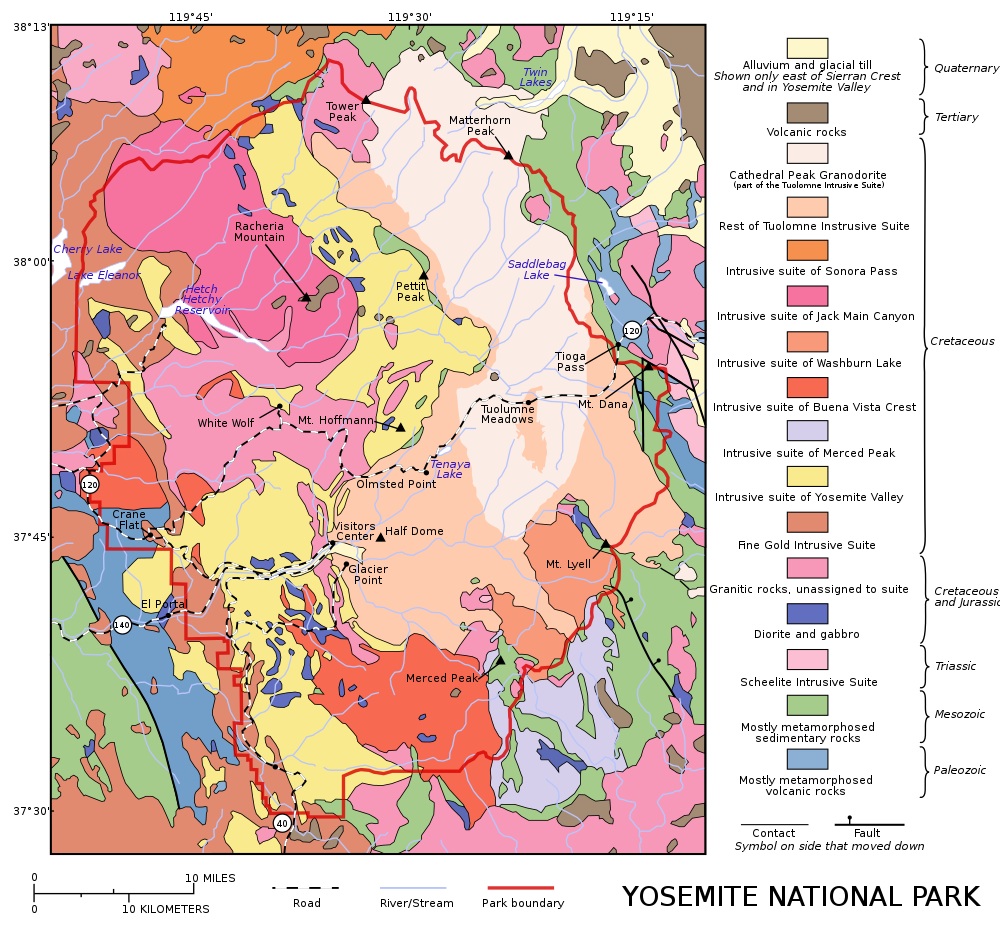
A geological map of Yosemite National Park (full size), showing the Cathedral Peak Granodiorite, the largest unit in the Tuolumne Intrusive Suite, which in turn is the largest granitic suite in the park. Cathedral Peak Granodiorite Rest of the Tuolumne Intrusive Suite
A compass rose, sometimes called a windrose or rose of the winds, is a figure on a compass, map, nautical chart, or monument used to display the orientation of the cardinal directions (north, east, south, and west) and their intermediate points. It is also the term for the graduated markings found on the traditional magnetic compass. Today, a form of compass rose is found on, or featured in, almost all navigation systems, including nautical charts, non-directional beacons, VHF omnidirectional range systems, GPS, and similar equipment.
The General Perspective projection is a map projection used in cartography in which the Earth is depicted as viewed from a finite distance above its surface. If the view precisely faces the center of the Earth, the projection is a vertical perspective projection; otherwise, it is a tilted perspective projection. Here is shown a vertical perspective from an altitude of 35,786 km over (0°, 90°W), corresponding to a view from geostationary orbit. Due to the horizon as seen from the viewpoint position, the projection always shows less than half of the Earth's surface: in this case neither of the North and South Poles is visible.
Photograph: Maull & Fox; restoration: Adam Cuerden
Fanny Bullock Workman (1859–1925) was an American geographer, cartographer, explorer, travel writer, and mountaineer. Together with her husband, William Hunter Workman, she traveled by bicycle through Switzerland, France, Italy, Spain, Algeria and India; after taking up climbing in the Himalayas, she set a women's altitude record on Pinnacle Peak, reaching 23,000 feet (7,000 m). She published eight travel books, with particular focus on the lives of women in the countries she visited, and championed women's rights and women's suffrage.
Antarctica, the continent surrounding the Earth's South Pole, is the coldest place on Earth and is almost entirely covered by ice. Antarctica was discovered in late January 1820. Too cold and dry to support virtually any vascular plants, Antartica's flora presently consists of around 250 lichens, 100 mosses, 25-30 liverworts, and around 700 terrestrial and aquatic algal species.
Caspar David Friedrich (German:[ˌkaspaʁˌdaːvɪtˈfʁiːdʁɪç]i; 5 September 1774 – 7 May 1840) was a German Romantic landscape painter, generally considered the most important German artist of his generation, whose often symbolic, and anti-classical work, conveys a subjective, emotional response to the natural world. Friedrich's paintings often set contemplative human figures silhouetted against night skies, morning mists, barren trees or Gothic ruins. Art historian Christopher John Murray described their presence, in diminished perspective, amid expansive landscapes, as reducing the figures to a scale that directs "the viewer's gaze towards their metaphysical dimension".
Friedrich was born in the town of Greifswald on the Baltic Sea in what was at the time Swedish Pomerania. He studied in Copenhagen from 1794 to 1798, before settling in Dresden. He came of age during a period when, across Europe, a growing disillusionment with materialistic society was giving rise to a new appreciation of spirituality. This shift was often expressed through a reevaluation of the natural world, as artists such as Friedrich, J. M. W. Turner and John Constable sought to depict nature as a "divine creation, to be set against the artifice of human civilization". (Full article...)


.svg)


_Guyot.png)


_(cropped).jpg)


_without_New_Guinea.svg)




.svg)
.svg)


.jpeg)

.jpg)


