This site needs JavaScript to work properly. Please enable it to take advantage of the complete set of features!
Skip to main page content
U.S. flag

An official website of the United States government

Dot gov

The .gov means it’s official.
Federal government websites often end in .gov or .mil. Before sharing sensitive information, make sure you’re on a federal government site.

Https

The site is secure.
The https:// ensures that you are connecting to the official website and that any information you provide is encrypted and transmitted securely.

NIH NLM Logo
Log in
Access keys NCBI Homepage MyNCBI Homepage Main Content Main Navigation
. 2021 Jul 16;7(29):eabf5620.
doi: 10.1126/sciadv.abf5620. Print 2021 Jul.

Circuit mechanisms for the chemical modulation of cortex-wide network interactions and behavioral variability

Affiliations

Circuit mechanisms for the chemical modulation of cortex-wide network interactions and behavioral variability

Thomas Pfeffer et al. Sci Adv. .

Abstract

Influential theories postulate distinct roles of catecholamines and acetylcholine in cognition and behavior. However, previous physiological work reported similar effects of these neuromodulators on the response properties (specifically, the gain) of individual cortical neurons. Here, we show a double dissociation between the effects of catecholamines and acetylcholine at the level of large-scale interactions between cortical areas in humans. A pharmacological boost of catecholamine levels increased cortex-wide interactions during a visual task, but not rest. An acetylcholine boost decreased interactions during rest, but not task. Cortical circuit modeling explained this dissociation by differential changes in two circuit properties: the local excitation-inhibition balance (more strongly increased by catecholamines) and intracortical transmission (more strongly reduced by acetylcholine). The inferred catecholaminergic mechanism also predicted noisier decision-making, which we confirmed for both perceptual and value-based choice behavior. Our work highlights specific circuit mechanisms for shaping cortical network interactions and behavioral variability by key neuromodulatory systems.


Figures

Fig. 1
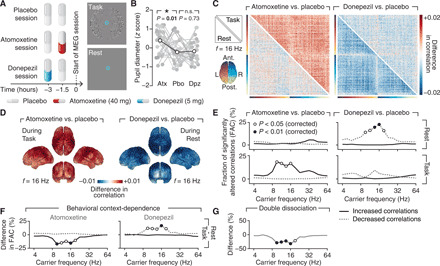
Fig. 1. Dissociated catecholaminergic and cholinergic effects on cortex-wide activity correlations.
(A) Experimental design. Left: Atomoxetine (40 mg), donepezil (5 mg), or a visually indistinguishable placebo was administered before each session. Right: MEG activity was recorded during a visual task (top) or eyes-open rest (bottom). (B) Drug effect on baseline pupil diameter (rest and task collapsed). Atx, atomoxetine; Pbo, placebo; Dpz, donepezil. *P < 0.05, paired two-sided permutation test. n.s., not significant. (C) Drug effects on cortex-wide activity correlations (at 16 Hz), for task (top triangle) and rest (bottom triangle). Left: Atomoxetine- placebo. Right: Donepezil-placebo. (D) Cortical distribution of drug effects on correlations. Left: Atomoxetine-placebo (during task). Right: Donepezil-placebo (during rest). (E) Frequency spectrum of the drug effects on the fraction of significantly (P < 0.05, paired two-sided t test) altered correlations across brain regions, for atomoxetine (left) and donepezil (left) as well as for rest (top) and task (bottom). Fractions of significantly increased (solid black lines) and decreased (dashed gray lines) correlations are shown separately. (F) Effect of behavioral context on correlations [difference between top and bottom rows in (E)]. (G) Spectrum of double dissociation between atomoxetine and donepezil effects, measured as the difference between (E): solid black line (left) and dashed gray line (right). Open circles, P < 0.05; filled circles, P < 0.01 (paired two-sided single threshold permutation test).
Fig. 2
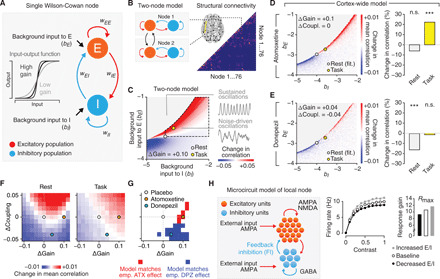
Fig. 2. Circuit mechanisms of context-dependent effects on cortex-wide correlations.
(A) Schematic of a single node (brain region) consisting of an excitatory (E) and an inhibitory population (I), with independent background input to E and I. Inset, input-output function of each population for various gain parameters (slope of the input-output function). (B) Left: Nodes were connected through their excitatory populations. Right: For the cortex-wide model, an estimate of the human structural connectome was used to connect a total of 76 nodes; the model was fitted to the rest-placebo data (Methods). (C) Change in correlation under an increase in gain (+0.1) in the (bE,bI)-plane of the "two-node model." Inset: Sustained and noise-driven oscillations. The area defined by the dashed black line illustrates the range of the assumed shift in the (bE,bI)-plane from rest to task. (D) Effect of gain increase (+0.1) across all 76 ×ばつ 76 node pairs (right; white circle, rest; yellow circle, task). (E) As in (D), but for donepezil with gain increase by +0.04 and decrease in global coupling (−0.04). ***P < 0.001; two sided paired permutation test (N = 100,000). (F) Difference in correlation (averaged across all node pairs) for all changes in gain and changes in global coupling, for simulated rest [left; white circle in (D)] and task [right; yellow circle in (D)]. (G) Mask highlighting parameter combinations where the changes in correlation are qualitatively consistent with the observations for atomoxetine (red) or donepezil (blue). (H) Left: Microcircuit consisting of excitatory and inhibitory leaky integrate-and-fire neurons. Middle: Effect of change in E/I on gain for increases (decreased E/I; black line; filled black circles) and decreases in feedback inhibition (increased E/I; gray line; filled gray circles), with respect to baseline (dashed line; open circles). Right: Fitted response gain parameter (Rmax) of the stimulus-response function for three levels of E/I.
Fig. 3
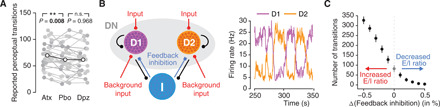
Fig. 3. Catecholamine-induced increase in E/I ratio can increase perceptual variability.
(A) Effect of atomoxetine on rate of transitions in the judgment of continuous input (changes in the apparent direction of rotation of the seemingly rotating sphere). **P < 0.01 (two-sided paired permutation test). (B) Left: Schematic of the decision circuit, endowed with two excitatory decision populations, D1 and D2, and a nonselective population (DN), fully connected to a pool of inhibitory neurons. The two decision populations receive equally strong, noisy Poisson input, reflecting the ambiguous nature of the visual stimulus. Right: The model exhibits spontaneous firing rate fluctuations. Perceptual transitions in the model are defined as changes in the dominance of one population over the other (i.e., one having a higher firing than the other). (C) Effect of E/I increase in circuit model on number of transitions in the judgment of continuous input. E/I increase in the circuit model is implemented via decrease in feedback inhibition (red/blue arrows).
Fig. 4
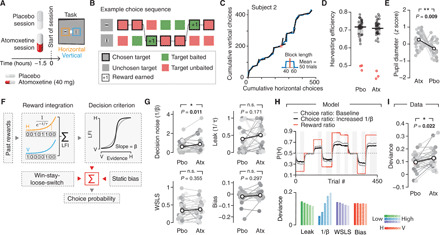
Fig. 4. Catecholamines promote exploratory choice during foraging.
(A and B) Experimental design for value-based choice experiment. (A) Administration protocol for the value-based choice experiment: Atomoxetine or placebo was administered before each session. (B) Reward scheme illustrated for example sequence of rewards and choices across seven trials (see Methods for details). (C) Choice behavior versus reward contingencies for an example participant and session. Continuous blue curve, cumulative choices of horizontal versus vertical targets. Black lines, average ratio of incomes earned from both targets (horizontal:vertical) within each block. (D) Harvesting efficiency (fraction of collected over available rewards) per participant and experimental session. Red circles highlight the excluded participants due to poor performance. (E) Effect of atomoxetine on baseline pupil diameter. **P < 0.01, two-sided paired permutation test (100,000 permutations). (F) Schematic of the algorithmic model for value-based choice task (dynamic foraging). Choice behavior was analyzed with a reward integration model consisting of four parameters: integrator leak, decision noise (1/β of softmax transformation), weight of win-stay, loose-switch (WSLS) heuristic, and overall (static) bias (see Methods). (G) Effect of atomoxetine on model parameters. (H) Top: Example run simulated with the reward integrator model. The model predicts larger deviation of choice fraction from those matching reward ratios (red line) under higher decision noise (black) compared to baseline (gray). Gray shaded areas, temporal intervals used for computing deviance (Methods). Bottom: Deviance as function of all model parameters (see Methods for exact parameter values). (I) Deviance for atomoxetine and placebo. *P < 0.01, two-sided paired permutation test (100,000 permutations).

References

    1. Aston-Jones G., Cohen J. D., An integrative theory of locus coeruleus-norepinephrine function: Adaptive gain and optimal performance. Annu. Rev. Neurosci. 28, 403–450 (2005). - PubMed
    1. Harris K. D., Thiele A., Cortical state and attention. Nat. Rev. Neurosci. 12, 509–523 (2011). - PMC - PubMed
    1. Robbins T. W., Arnsten A. F. T., The neuropsychopharmacology of fronto-executive function: Monoaminergic modulation. Annu. Rev. Neurosci. 32, 267–287 (2009). - PMC - PubMed
    1. Schwarz L. A., Luo L., Organization of the locus coeruleus-norepinephrine system. Curr. Biol. 25, R1051–R1056 (2015). - PubMed
    1. van den Brink R. L., Pfeffer T., Donner T. H., Brainstem modulation of large-scale intrinsic cortical activity correlations. Front. Hum. Neurosci. 13, 340 (2019). - PMC - PubMed
Cite

AltStyle によって変換されたページ (->オリジナル) /