The roles of migratory and resident birds in local avian influenza infection dynamics
- PMID: 30337766
- PMCID: PMC6188652
- DOI: 10.1111/1365-2664.13154
The roles of migratory and resident birds in local avian influenza infection dynamics
Abstract
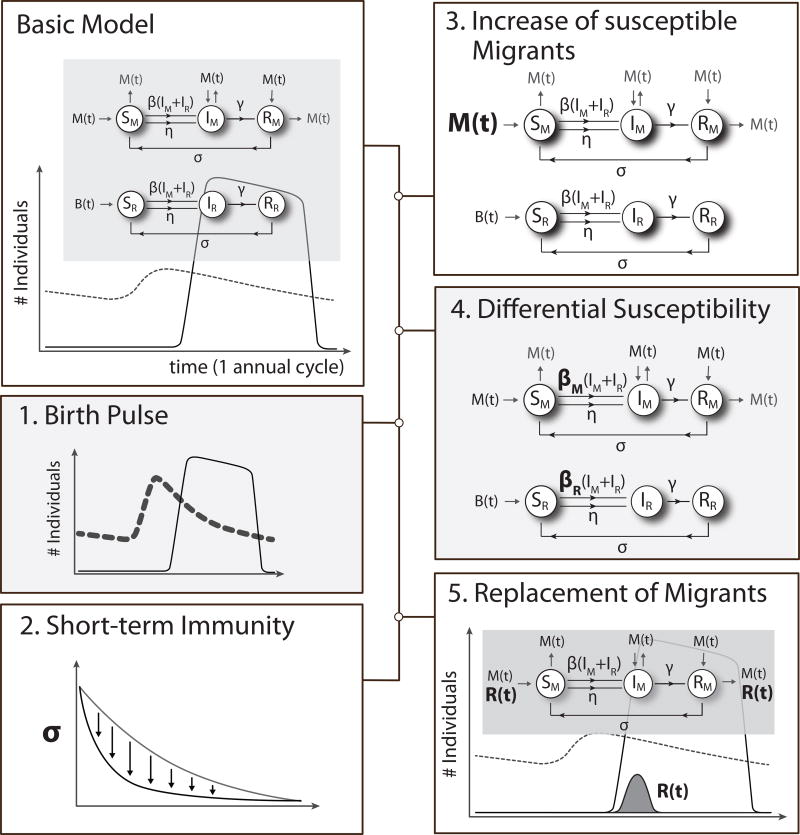
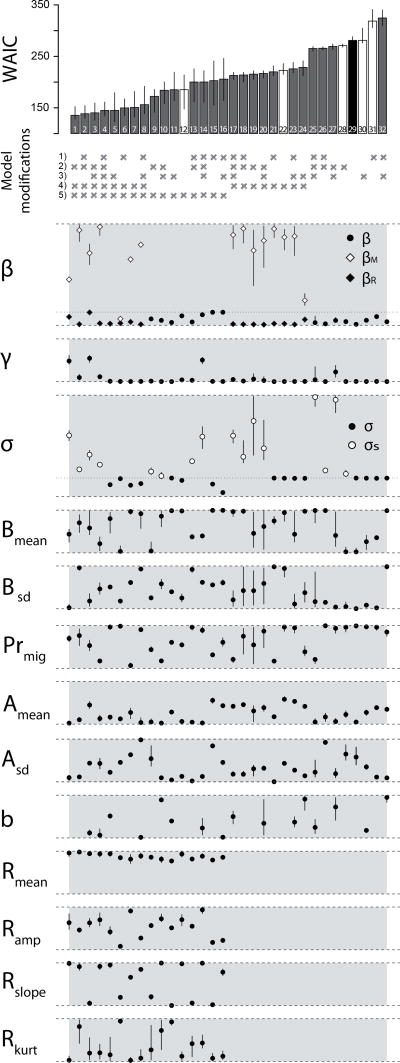
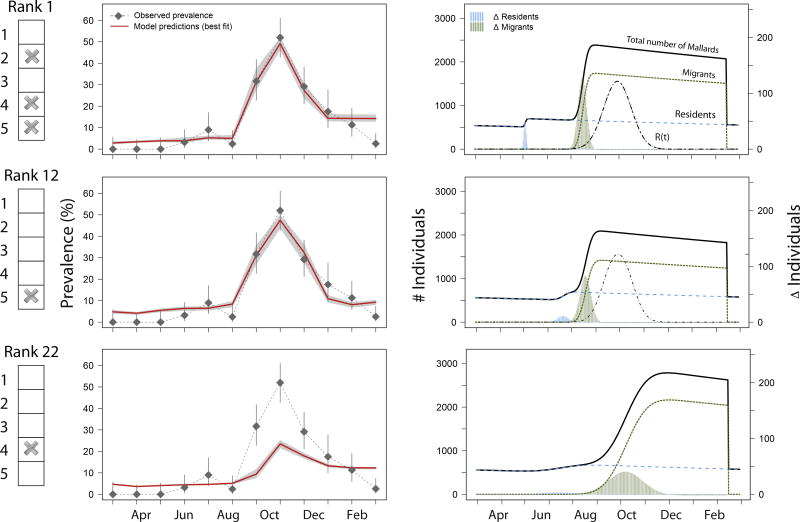
Migratory birds are an increasing focus of interest when it comes to infection dynamics and the spread of avian influenza viruses (AIV). However, we lack detailed understanding migratory birds' contribution to local AIV prevalence levels and their downstream socio-economic costs and threats.To explain the potential differential roles of migratory and resident birds in local AIV infection dynamics, we used a susceptible-infectious-recovered (SIR) model. We investigated five (mutually non- exclusive) mechanisms potentially driving observed prevalence patterns: 1) a pronounced birth pulse (e.g. the synchronised annual influx of immunologically naïve individuals), 2) short-term immunity, 3) increase of susceptible migrants, 4) differential susceptibility to infection (i.e. transmission rate) for migrants and residents, and 5) replacement of migrants during peak migration.SIR models describing all possible combinations of the five mechanisms were fitted to individual AIV infection data from a detailed longitudinal surveillance study in the partially migratory mallard duck (Anas platyrhynchos). During autumn and winter, the local resident mallard community also held migratory mallards that exhibited distinct AIV infection dynamics.Replacement of migratory birds during peak migration in autumn was found to be the most important mechanism driving the variation in local AIV infection patterns. This suggests that a constant influx of migratory birds, likely immunological naïve to locally circulating AIV strains, is required to predict the observed temporal prevalence patterns and the distinct differences in prevalence between residents and migrants.Synthesis and applications. Our analysis reveals a key mechanism that could explain the amplifying role of migratory birds in local avian influenza virus infection dynamics; the constant flow and replacement of migratory birds during peak migration. Aside from monitoring efforts, in order to achieve adequate disease management and control in wildlife - with knock-on effects for livestock and humans, - we conclude that it is crucial, in future surveillance studies, to record host demographical parameters such as population density, timing of birth and turnover of migrants.
Keywords: Avian influenza; Epidemiology; Host-pathogen interactions; Immunity; Mallard; Migratory birds; Migratory connectivity; SIR.
Figures
References
-
- Alexander DJ. An overview of the epidemiology of avian influenza. Vaccine. 2007;25:5637–5644. - PubMed
-
- Altermatt F. Tell me what you eat and I'll tell you when you fly: diet can predict phenological changes in response to climate change. Ecology Letters. 2010;13:1475–1484. - PubMed
-
- Altizer S, Bartel R, Han BA. Animal Migration and Infectious Disease Risk. Science. 2011;331:296–302. - PubMed
-
- Altizer S, Dobson A, Hosseini P, Hudson P, Pascual M, Rohani P. Seasonality and the dynamics of infectious diseases. Ecology Letters. 2006;9:467–484. - PubMed
-
- Avril A, Grosbois V, Latorre-Margalef N, Gaidet N, Tolf C, Olsen B, Waldenstrom J. Capturing individual-level parameters of influenza A virus dynamics in wild ducks using multistate models. Journal of Applied Ecology. 2016;53:1289–1297.
Associated data
Grants and funding
LinkOut - more resources
Full Text Sources