This site needs JavaScript to work properly. Please enable it to take advantage of the complete set of features!
Skip to main page content
U.S. flag

An official website of the United States government

Dot gov

The .gov means it’s official.
Federal government websites often end in .gov or .mil. Before sharing sensitive information, make sure you’re on a federal government site.

Https

The site is secure.
The https:// ensures that you are connecting to the official website and that any information you provide is encrypted and transmitted securely.

NIH NLM Logo
Log in
Access keys NCBI Homepage MyNCBI Homepage Main Content Main Navigation
. 2018 Sep 4;115(36):9026-9031.
doi: 10.1073/pnas.1804420115. Epub 2018 Aug 22.

Convolutional neural networks automate detection for tracking of submicron-scale particles in 2D and 3D

Affiliations

Convolutional neural networks automate detection for tracking of submicron-scale particles in 2D and 3D

Jay M Newby et al. Proc Natl Acad Sci U S A. .

Abstract

Particle tracking is a powerful biophysical tool that requires conversion of large video files into position time series, i.e., traces of the species of interest for data analysis. Current tracking methods, based on a limited set of input parameters to identify bright objects, are ill-equipped to handle the spectrum of spatiotemporal heterogeneity and poor signal-to-noise ratios typically presented by submicron species in complex biological environments. Extensive user involvement is frequently necessary to optimize and execute tracking methods, which is not only inefficient but introduces user bias. To develop a fully automated tracking method, we developed a convolutional neural network for particle localization from image data, comprising over 6,000 parameters, and used machine learning techniques to train the network on a diverse portfolio of video conditions. The neural network tracker provides unprecedented automation and accuracy, with exceptionally low false positive and false negative rates on both 2D and 3D simulated videos and 2D experimental videos of difficult-to-track species.

Keywords: artificial neural network; bioimaging; machine learning; particle tracking; quantitative biology.


Conflict of interest statement

Conflict of interest statement: J.M.N, M.G.F., and S.K.L. are the founders of and maintain a financial interest in AI Tracking Solutions, which is actively seeking to commercialize the neural network tracker technology. The terms of these arrangements are being managed by The University of North Carolina in accordance with its conflict of interest policies. The remaining authors declare no competing financial interests.

Figures
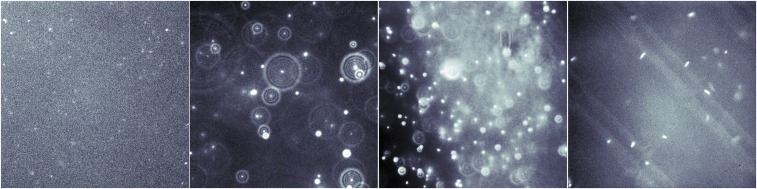
Fig. 1.
Fig. 1.
Sample frames from experimental videos, highlighting some of the challenging conditions for particle tracking. (Left to Right) Fifty-nanometer particles captured at low SNR and 200-nm particles with diffraction disc patterns, variable background intensity, and ellipsoid PSF shapes from 12μm Salmonella.
Fig. 2.
Fig. 2.
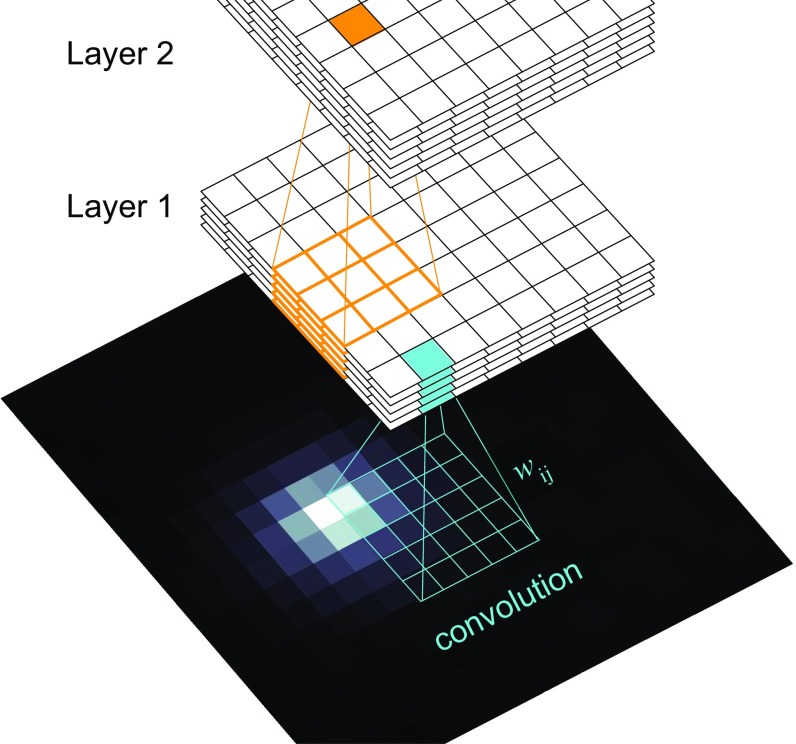
The CNN. Diagram of the layered connectivity of the artificial neural network.
Fig. 3.
Fig. 3.
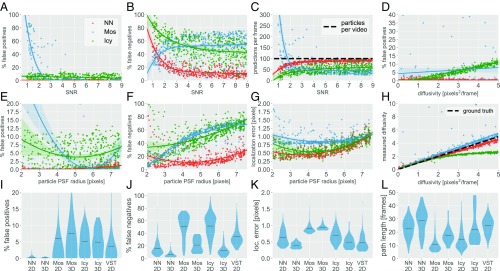
Performance analysis for randomized 2D and 3D synthetic test videos. (AC) Two-dimensional test results showing the (A) percentage of false positives, (B) percentage of false negatives, and (C) predictions per frame vs. SNR. Mosaic shows a sharp rise in false positives for SNR<2 (in A), due to substantially more predictions than actual particles (in C). Conversely, the neural net (NN) and Icy showed no increase in false positives at low SNR. (EG) Results showing the (E) percentage of false positives, (F) percentage of false negatives, and (G) localization error vs. the PSF radius. (D and H) Results showing the (D) percentage of false positives and (H) measured diffusivity vs. the ground truth particle diffusivity. (IL) Violin plots showing the performance on 2D and 3D test videos for each of the four methods: the NN, Mos, Icy, and VST. The solid black lines show the mean, and the thickness of the filled regions shows the shape of the histogram obtained from 500 (50) randomized 2D (3D) test videos. Note that the VST results only included 100 test videos.

References

    1. Wang Y-Y, et al. IgG in cervicovaginal mucus traps HSV and prevents vaginal Herpes infections. Mucosal Immunol. 2014;7:1036–1044. - PMC - PubMed
    1. Wang Y-Y, et al. Influenza-binding antibodies immobilize influenza viruses in fresh human airway mucus. Eur Respir J. 2016;49:1601709. - PMC - PubMed
    1. Lai SK, et al. Rapid transport of large polymeric nanoparticles in fresh undiluted human mucus. Proc Natl Acad Sci USA. 2007;104:1482–1487. - PMC - PubMed
    1. Yang M, et al. Biodegradable nanoparticles composed entirely of safe materials that rapidly penetrate human mucus. Angew Chem Int Ed. 2011;50:2597–2600. - PMC - PubMed
    1. Vasquez PA, et al. Entropy gives rise to topologically associating domains. Nucleic Acids Res. 2016;44:5540–5549. - PMC - PubMed

Publication types

Cite

AltStyle によって変換されたページ (->オリジナル) /