Federated Tensor Factorization for Computational Phenotyping
- PMID: 29071165
- PMCID: PMC5652331
- DOI: 10.1145/3097983.3098118
Federated Tensor Factorization for Computational Phenotyping
Abstract
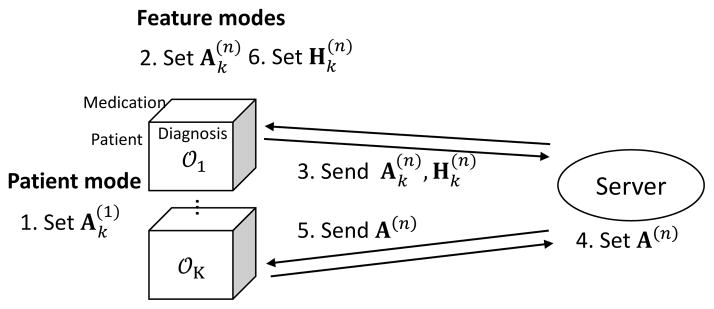
Tensor factorization models offer an effective approach to convert massive electronic health records into meaningful clinical concepts (phenotypes) for data analysis. These models need a large amount of diverse samples to avoid population bias. An open challenge is how to derive phenotypes jointly across multiple hospitals, in which direct patient-level data sharing is not possible (e.g., due to institutional policies). In this paper, we developed a novel solution to enable federated tensor factorization for computational phenotyping without sharing patient-level data. We developed secure data harmonization and federated computation procedures based on alternating direction method of multipliers (ADMM). Using this method, the multiple hospitals iteratively update tensors and transfer secure summarized information to a central server, and the server aggregates the information to generate phenotypes. We demonstrated with real medical datasets that our method resembles the centralized training model (based on combined datasets) in terms of accuracy and phenotypes discovery while respecting privacy.
Keywords: ADMM; Federated approach; Phenotype.
Figures

Comment in
-
Commentary: Methods and Impact for Using Federated Learning to Collaborate on Clinical Research.Bydon M, Nathani KR, Michalopoulos GD. Bydon M, et al. Neurosurgery. 2023 Feb 1;92(2):e19-e20. doi: 10.1227/neu.0000000000002243. Epub 2022 Nov 11. Neurosurgery. 2023. PMID: 36637278 No abstract available.
References
-
- Bennett C, Doub T, Selove R. EHRs connect research and practice: Where predictive modeling, artificial intelligence, and clinical decision support intersect. Health Policy and Technology. 2012 Jun;1(2):105–114.
-
- Boyd S, Parikh N, Chu E, Peleato B, Eckstein J. Distributed optimization and statistical learning via the alternating direction method of multipliers. Foundations and Trends® in Machine Learning. 2011;3(1):1–122.
-
- Carroll JD, Chang J-J. Analysis of individual differences in multidimensional scaling via an n-way generalization of "eckart-young" decomposition. Psychometrika. 1970;35(3):283–319.
-
- Carroll RJ, Thompson WK, Eyler AE, Mandelin AM, Cai T, Zink RM, Pacheco JA, Boomershine CS, Lasko TA, Xu H, Karlson EW, Perez RG, Gainer VS, Murphy SN, Ruderman EM, Pope RM, Plenge RM, Kho AN, Liao KP, Denny JC. Portability of an algorithm to identify rheumatoid arthritis in electronic health records. Journal of the American Medical Informatics Association. 2012 Jun;19(1e):e162–e169. - PMC - PubMed
Grants and funding
LinkOut - more resources
Full Text Sources
Other Literature Sources