This site needs JavaScript to work properly. Please enable it to take advantage of the complete set of features!
Skip to main page content
U.S. flag

An official website of the United States government

Dot gov

The .gov means it’s official.
Federal government websites often end in .gov or .mil. Before sharing sensitive information, make sure you’re on a federal government site.

Https

The site is secure.
The https:// ensures that you are connecting to the official website and that any information you provide is encrypted and transmitted securely.

NIH NLM Logo
Log in
Access keys NCBI Homepage MyNCBI Homepage Main Content Main Navigation
. 2012 Jan;62(1):59-62.
doi: 10.1007/s12576-011-0177-4. Epub 2011 Oct 4.

Interferon-beta, but not tumor necrosis factor-alpha, production in response to poly I:C is maintained despite exhaustive exercise in mice

Affiliations

Interferon-beta, but not tumor necrosis factor-alpha, production in response to poly I:C is maintained despite exhaustive exercise in mice

Masataka Uchida et al. J Physiol Sci. 2012 Jan.

Abstract

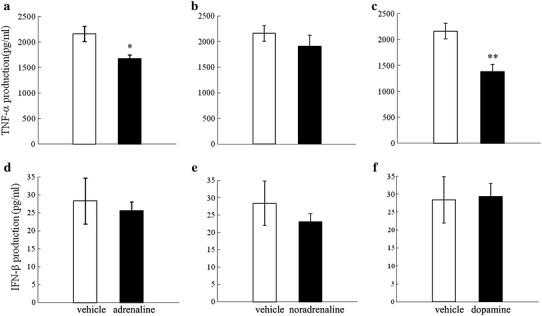
It remains unclear whether immune response to viral infection is inhibited by severe exercise. We determined whether exhaustive exercise inhibits interferon (IFN)-β and tumor necrosis factor (TNF)-α production after injection of synthetic double-stranded (ds) RNAs, a polyriboinosinic polyribocytidylic acid (poly I:C), as viral infection model. Male C3H/HeN mice, which were divided into exhaustive-exercised and non-exercised groups, were injected with poly I:C (5 mg/kg). Although TNF-α in response to poly I:C was significantly inhibited by exhaustive exercise, IFN-β was no different in both groups. In in-vitro experiments, catecholamines inhibited poly I:C-induced TNF-α, but not IFN-β, production in macrophages. These results suggest that anti-virus cytokine IFN-β in response to poly I:C might be maintained despite severe stressful exercise.


Figures

Fig. 1
Fig. 1
Changes in TNF-α (a) and IFN-β (b) concentration in plasma before and after poly I:C injection in exhaustive exercised (EX: filled circles, n = 12) and non-exercised (N-EX: open circles, n = 11) mice. Data are expressed as means ± SEM. The data were analyzed by two-way repeated-measures analysis of variance (ANOVA) and post-hoc Bonferroni’s tests were performed. # p < 0.05 and ## p < 0.01 vs. pre-injection of poly I:C in each group, and **p < 0.01 vs. N-EX at each point
Fig. 2
Fig. 2
Effects of catecholamine on poly I:C-induced TNF-α (ac) and IFN-β (df) production in RAW 264 cells. RAW264 cells (n = 8–11) were treated with epinephrine (1 μM; a, d), norepinephrine (1 μM; b, e), dopamine (1 μM; c, f), or vehicle 30 min before poly I:C (10 μg/ml) stimulation for 6 h. Results are expressed as the means ± SEM. *p < 0.05 and **p < 0.01 vs. vehicle. Statistical analysis was performed with the Student t test

References

    1. Pedersen BK, Ullum H. NK cell response to physical activity: possible mechanisms of action. Med Sci Sports Exerc. 1994;26:140–146. doi: 10.1249/00005768-199402000-00003. - DOI - PubMed
    1. Bagby GJ, Sawaya DE, Crouch LD, Shepherd RE. Prior exercise suppresses the plasma tumor necrosis factor response to bacterial lipopolysaccharide. J Appl Physiol. 1994;77:1542–1547. - PubMed
    1. Kitamura H, Shiva D, Woods JA, Yano H. Beta-adrenergic receptor blockade attenuates the exercise-induced suppression of TNF-alpha in response to lipopolysaccharide in rats. Neuroimmunomodulation. 2007;14:91–96. doi: 10.1159/000107424. - DOI - PubMed
    1. Tanaka Y, Kawanishi N, Shiva D, Tsutsumi N, Uchida M, Kitamura H, Kato Y, Yano H. Exhaustive exercise reduces tumor necrosis factor-alpha production in response to lipopolysaccharide in mice. Neuroimmunomodulation. 2010;17:279–286. doi: 10.1159/000290044. - DOI - PubMed
    1. Kohut ML, Boehm GW, Moynihan JA. Prolonged exercise suppresses antigen-specific cytokine response to upper respiratory infection. J Appl Physiol. 2001;90:678–684. - PubMed

Publication types

Cite

AltStyle によって変換されたページ (->オリジナル) /