This site needs JavaScript to work properly. Please enable it to take advantage of the complete set of features!
Skip to main page content
U.S. flag

An official website of the United States government

Dot gov

The .gov means it’s official.
Federal government websites often end in .gov or .mil. Before sharing sensitive information, make sure you’re on a federal government site.

Https

The site is secure.
The https:// ensures that you are connecting to the official website and that any information you provide is encrypted and transmitted securely.

NIH NLM Logo
Log in
Access keys NCBI Homepage MyNCBI Homepage Main Content Main Navigation
. 2011 Feb 21:5:30.
doi: 10.1186/1752-0509年5月30日.

A simple work flow for biologically inspired model reduction--application to early JAK-STAT signaling

Affiliations

A simple work flow for biologically inspired model reduction--application to early JAK-STAT signaling

Tom Quaiser et al. BMC Syst Biol. .

Abstract

Background: Modeling of biological pathways is a key issue in systems biology. When constructing a model, it is tempting to incorporate all known interactions of pathway species, which results in models with a large number of unknown parameters. Fortunately, unknown parameters need not necessarily be measured directly, but some parameter values can be estimated indirectly by fitting the model to experimental data. However, parameter fitting, or, more precisely, maximum likelihood parameter estimation, only provides valid results, if the complexity of the model is in balance with the amount and quality of the experimental data. If this is the case the model is said to be identifiable for the given data. If a model turns out to be unidentifiable, two steps can be taken. Either additional experiments need to be conducted, or the model has to be simplified.

Results: We propose a systematic procedure for model simplification, which consists of the following steps: estimate the parameters of the model, create an identifiability ranking for the estimated parameters, and simplify the model based on the identifiability analysis results. These steps need to be applied iteratively until the resulting model is identifiable, or equivalently, until parameter variances are small. We choose parameter variances as stopping criterion, since they are concise and easy to interpret. For both, the parameter estimation and the calculation of parameter variances, multi-start parameter estimations are run on a parallel cluster. In contrast to related work in systems biology, we do not suggest simplifying a model by fixing some of its parameters, but change the structure of the model.

Conclusions: We apply the proposed approach to a model of early signaling events in the JAK-STAT pathway. The resulting model is not only identifiable with small parameter variances, but also shows the best trade-off between goodness of fit and model complexity.


Figures
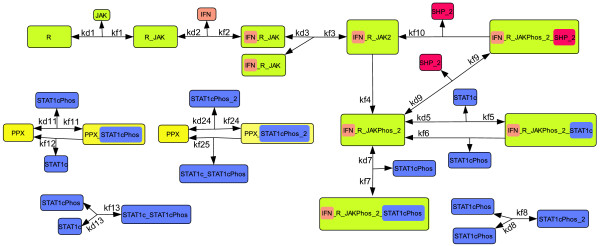
Figure 1
Figure 1
Truncated JAK-STAT model. Protein species are depicted as colored rectangles. Arrows between the protein species describe association or dissociation reactions, which follow mass action kinetics. The names of kinetic parameters are written next to the corresponding reaction arrow. A mathematical representation of the model is given in Additional file 1 table S2a and S2b.
Figure 2
Figure 2
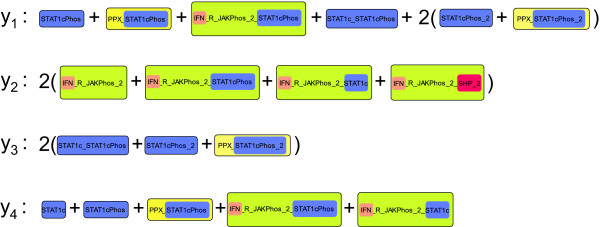
Model outputs.
Figure 3
Figure 3
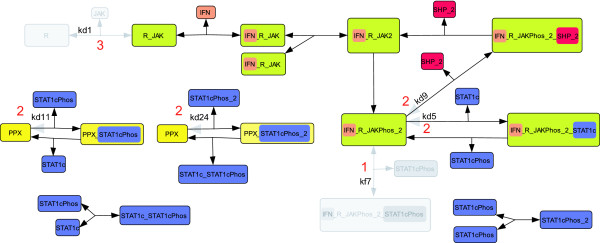
Visualization of the first three model simplifications. Removed components are shown in gray. Red numbers indicate the iteration k of the work flow in which the reaction has been removed. Unidentifiable parameters are stated next to the respective reaction. In the first iteration the reactions containing kf7, kd7 and the species IFN_R_JAKPhos_2_STAT1cPhos have been removed. In the second iteration the dissociation reactions containing the parameters kd5, kd9, kd11, and kd24 have been removed. In the third iteration the model was simplified by deleting the species R and JAK and the corresponding dissociation and association reactions. A mathematical representation of the models created in each iteration is given in Additional file 1.
Figure 4
Figure 4
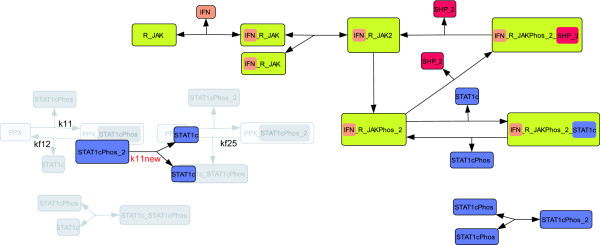
Simplification of the PPX part leads to model M4. The same notation as in Figure 3 is used. Additionally, a red colored parameter name indicates, the introduction of a new parameter. In this simplification step PPX and all corresponding reactions have been removed from the model. In order to still account for STAT1cPhos_2 dissociation and phosphorylation, we added a new dissociation reaction containing the parameter k11new. The mathematical description of model M4 is given in Additional file 1 table S6a and S6b.
Figure 5
Figure 5
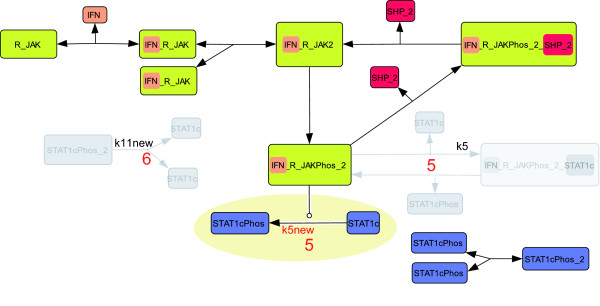
Visualization of simplifications 5 and 6. See Figure 3 and 4 for comments on the notation. In iteration 5 the association and dissociation plus phosphorylation of the active receptor IFN_R_JAKPhos_2_STAT1c and STAT1c are replaced by a simplified reaction (highlighted in yellow). In the simplified reaction with the new parameter k5new, phosphorylation of STAT1c by the active receptor is modeled without considering complex formation of both species. In the last iteration the dissociation and dephosphorylation of STAT1cPhos_y2 is removed from the model. A mathematical description of the models created in steps 5 and 6 are given in Additional file 1.

References

    1. Quaiser T, Marquardt W, Mönnigmann M. Local Identifiability Analysis of Large Signaling Pathway Models. 2nd Conference Foundation of Systems Biology in Engineering, Proceedings Plenary and Contributed Papers. 2007. pp. 465–470.
    1. Quaiser T, Mönnigmann M. Systematic identifiability testing for unambiguous mechanistic modeling-application to JAK-STAT, MAP kinase, and NF-kappaB signaling pathway models. BMC Syst Biol. 2009;3:50. doi: 10.1186/1752-0509-3-50. - DOI - PMC - PubMed
    1. Hengl S, Kreutz C, Timmer J, Maiwald T. Data-Based Identifiability Analysis of Nonlinear Dynamical Models. Bioinformatics. 2007. - PubMed
    1. Vajda S, Rabitz H, Walter E, Lecourtier Y. Qualitative and quantitative identifiability analysis of nonlinear chemical kinetic-models. Chem Eng Commun. 1989;83:191–219. doi: 10.1080/00986448908940662. - DOI
    1. Xia X, Moog CH. Identifiability of nonlinear systems with application to HIV/AIDS models. IEEE T Automat Contr. 2003;48(2):330–336. doi: 10.1109/TAC.2002.808494. - DOI

Publication types

LinkOut - more resources

Cite

AltStyle によって変換されたページ (->オリジナル) /