Eusko-Folklore by José Miguel de Barandiaran. Series 3, Part 4: Traditions and Legends: Lurpeko Eremuetan/Subterranean Regions
Over 100 years ago, in 1921, José Miguel de Barandiaran began publishing a series of articles under the banner of Eusko-Folklore. His work was interrupted by the Spanish Civil War but in 1954 he resumed publishing what he then called his third series of articles. These appeared in the journal Munibre, Natural Sciences Supplement of the Bulletin of the Royal Basque Society of Friends of the Country. While various writings of Barandiaran have been translated to English, I don’t believe these articles have. As I find this topic so fascinating, I have decided to translate them to English (with the help of Google Translate). The original version of this article can be found here.
Traditions and Legends: Lurpeko Eremuetan (In the Subterranean Regions)
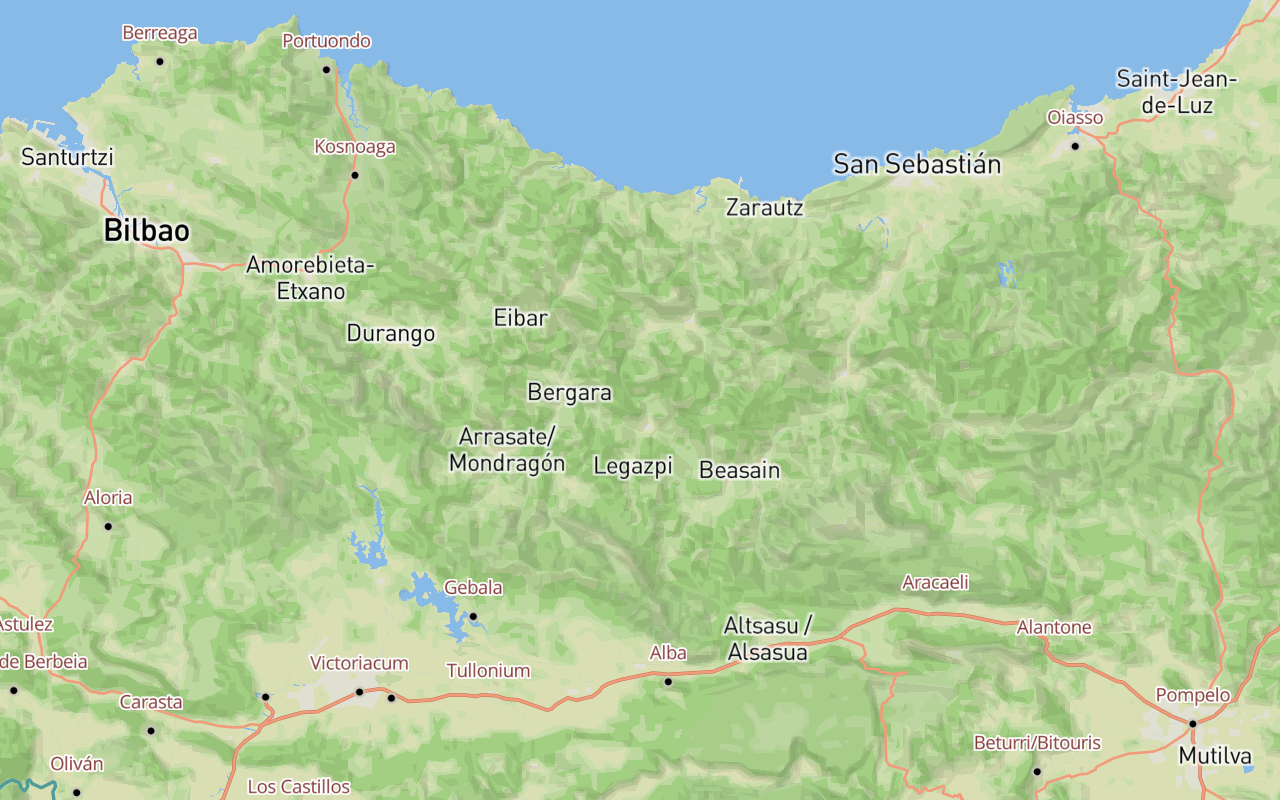
Gerhard Bähr, who visited forty or fifty towns in Guipúzcoa for the purpose of conducting linguistic research, sent me some ethnographic materials from Hanover in February 1936, which were included among his notes. Here are the ones referring to the genius Mari, accompanied by my translation and some comments and additions:
IN ORMAIZTEGUI
The Lady of Murumendi was from the village of Beasain and had ten children, and she was not a churchgoer. Under the pretext of always being ill, she usually refused to enter church. And [it is said] that later her husband, after having the last child, complained, that is, that he would not allow her to miss going to church, and he took her in a cart and took her to church. But at the moment she entered the church, at the door of the church, with fire and flame (wrapped in fire), she disappeared from sight, and from then on she can be seen passing from one mountain to the other.
(Told by the "Blind Man" (Itxue) in Ormaiztegui on 29-III-1926).
IN ASTEASU
When it thundered, the lady of Semeola asked the Lady of Burumendi: “Charge at Izarraitz (mountain above Azpeitia) and unload at Ernio (mountain above Asteasu and Bidania) and protect Alzola, particularly Semeola (hamlet of Aya).”
(April 1926 in Asteasu).
I published variations of this spell in "Mari o el genio de las montañas" (Tribute to Don Carmelo de Echegaray. San Sebastián, 1923).
In the Barranca de Navarra, a spell of the following formula is attributed to a priest from Ergoyena: "Unanoa and Torrano; guard my vineyards and my brother’s garden! The others, kirrisk and marrask."
IN URRESTILLA
Am Tage von Santa Cruz wird die hexe "Moruko damia" von einen Geistlichen beschworen. Ist sie gerade in ihrer Höhle, so kann sie das ganze Jahr nicht wieder heraus, ist sie aber draussen, kann sie nicht mehr hinein.
(mitgeteilt im März 1926 von Josefa Echeverria, 77 Jahr, Urrestilla).
The custom of conjuring Mari in her cave is recognized in beliefs in Ataun, Villafranca, Oñate, Cegama, Aya, Muguiro, Gorriti, and Udabe, as can be seen in "Mari o el genio de las montañas and in issues of the 1st Series of EUSKO FOLKLORE.
IN LEGAZPIA
Auf dem Aizkorri ist eine Höhle, wenn die Sonne darauf scheint, so komme starker Dampf heraus. Sie heisst Gaiztozulo. Von einer anderen wird erzählt, dass manchmal "labasue" herauskäme. In der Näbe gibt es Eiben (agiñek).
The fog that sometimes forms at the entrance to certain caves is the smoke rising from the oven where Mari bakes her bread (labasu = oven fire), according to the beliefs of Cegama and Ispaster. “Marie Labakok labakoa dauko da euria eingo du laister” (Mari, of the oven, bakes bread in the oven and then it must rain), they say in Ispaster, when they see the summit of Mount Otoyo crowned with clouds.
IN OÑATE
The Lady of Amboto was born in Aramayona. Her mother (or father) told her in their anger that the devil should take her to the air. That’s why she was given the name of the Lady of Amboto. We hadn’t heard that before, but now we have.
(erzählt von Ambrosio Errasti, wohnaft in Zubillaga. Oñate, 3.8.1930).
IN ABALCISQUETA
Irari’s daughter was herding the cows and then returned missing one cow, and her mother cursed her, telling her that she would never enter the house again without the cow. Later, at dusk, she went to look for the cow and found the figure of her cow and grabbed its tail; then she entered the cave with it.
Afterward, the girl didn’t appear for some time, and the shepherds saw her in front of that cave combing her hair, and then they told her parents where she was. Her parents told her to come out, and (the girl, in turn, told them) that a little red dog was there. If it woke up, she would lose them... She told them to move away.
Afterward, they inquired carefully and were, apparently, prepared to get her out of the cave. But they lacked the missal stand to celebrate Mass... And the girl remained right there.
They say that from then on, there will always be a lame or a one-handed person in that house.
(erzählt von José Prantzisko Ipentza, Sasiain, Abalzisketa. Irari ist ein Bauernhaus in der Nähe).
Dieselbe Geschichte wurde ähnlich von Ramona Sagastume (75 Jahre alt) in Irari selbst erzählt. Aber die "Stiefmutter fluchte der Tochter, und diese ritt fort auf einem weissen Pferde (zaldi zuriren gaiñeen)". (Ebenfalls 1923-24). Siehe RIEV 1931, Seite 121.
In 1923, this same legend was told to me in Igaratza (Aralar) by the shepherd José Francisco Ipentza, the same man who told it to Bähr, as can be seen in my “Mari o el genio de las montañas,” which also includes other variations of this story.
IN ATAUN
In Ataun, there are three caverns where the deity Mari is supposed to spend time. These are: Gutzeberri on the rock above the Artzate gorge; Sagaarzulo on the Agerre rock above the Arrateta gorge; and Agamunda above the Ergoone neighborhood.
A young woman disappeared in Agamunda’s cavern, according to the following popular Ataun legend:
In a house in Aia (1), a young woman from Saint Gregory (2) was serving.
(1) Aya is a neighborhood of Ataun.
(2) San Gregorio is a neighborhood of Ataun.
Every feast day, she would go down to her parents’ house, and then, at dusk on the feast day, she would be lazy, very lazy, in returning to Aia. She, too, preferred her home to the house where she was serving. Because of this, she often bothered her mother.
Once, on a feast day evening, her mother cursed her because she was late, as usual, returning to Aia. Then the girl went out, weeping, and headed up the slope of Agamunda (3) to Aia.
(3) Agamunda is a mountain in the Aya neighborhood, located to the east of the Ergoone neighborhood, part of the parish of San Gregorio.
When she approached the Agamunda chasm, she saw hazelnuts in a hazelnut tree that was there at the mouth of the chasm, and, trying to reach them, she climbed up the hazelnut tree. But unfortunately, her foot slipped from the branch of the hazel tree and she fell to the bottom of the chasm. For days, her relatives and neighbors searched for her; but in vain: they found no trace of her footprints.
Later, a finger of the girl appeared under the Arbeldi Bridge (4) with her ring.
(4) Arbeldi is an old house located in the Ergoone neighborhood of Ataun.
(Recounted in 1925 by Juan Miguel de Aguirre, 63, from the Mendiurkullu baserri, Ataun).
I published a variant of this legend, told by my late mother, in EUSKO-FOLKLORE in 1921.
The last theme of the preceding legend also appears in the following story from Cegama.
Inside the Santatri (San Adrián) cave, next to the natural tunnel of the same name, located in Aizkorri, there is a spring of fresh water and a small well. A woman was cleaning her clothes in this well when, according to legend in Cegama, she slipped on the edge and fell into the water. However, no news of her was heard until, much later, one of her arms appeared in the Iturrutxaran spring, near Araya (5).
(5) Two Roman altars dedicated to the Nymphs were discovered 40 years ago next to the Iturtxarán fountain.
IN VERGARA
A blacksmith’s foundry stopped working in Zubillaga (Oñate). And he thought of presenting himself to the lady of Amboto, because he didn’t know what was happening. A friar blessed him and taught him how to behave, and the blacksmith went and entered the cave.
The lady was combing her hair in a beautiful room.
The blacksmith told her that the forge was stopped; that he didn’t know the remedy. He also asked to see where the owner of the cave was.
The lady returned saying that the master was in Zubillaga, distributing what he hadn’t received (unloading the hail). She told him to force a friar to bless the forge [which was at a standstill] because it had a small snake. The blacksmith left without following the lady’s other advice (6) and went to Zubillaga. That afternoon, the hail fell in Zubillaga (7). The blacksmith carried out the lady’s order, and the forge began to work.
(6) This refers to the advice to sit in the cave and to leave the cave facing forward.
(7) Hail is also called “esartuak” (those not received) in this legend, undoubtedly alluding to the undeclared goods that in other legends are called ezari_emanak (those given to no), whose counterpart is hail, which represents what was not received or the response of the Lady of Amboto.
Many men have seen that lady in the air with fire in the form of a pile of straw. And when she entered the Amboto cave, she left a cloud and produced a dull thunderclap. That cave is on the Elorrio side and is as large as the door of a house.
That woman was very wicked: her mother announced to her, in the form of a curse, what would happen to her.
(Written by a resident of Vergara at the request of Don Fermín Garbayo, who passed it on to me in 1927.)
The master of the cave referred to in this legend must be Mari’s husband, who, in certain tales from Azkoitia, is called Maju, sometimes represented in the form of a serpent or a dragon. This Maju visits Mari every Friday to “comb her hair” (orraztu), according to a legend from Zumaya. (EUSKO-FOLKLORE, third series, page 15).
IN ALOÑA
In Oñate, among the indigenous shepherds, there is a custom of taking a lamb to the Virgin Mother of Aránzazu every year in spring. And on their return, the friars give them a banquet.
According to custom, a shepherd who had his flock on Mount Aloña was carrying his lamb on his shoulder, and as he passed by Geiztozulo, the lamb was snatched from his shoulder, without him realizing who. Frightened, he looked around to see who had taken it, and where he saw the Lady of Amboto, lamb and all, hiding in Geiztozulo! The poor shepherd, almost in tears, went to Aránzazu and told the friars what had happened to him. And they, assuming he was up to tricks, said to him jokingly: “Ah! Ah! What you want is to eat the banquet without bringing the lamb.” “No, sir; if you don’t want to, don’t believe me; but what I told you is truly true.”
Seeing that this shepherd was so steadfast in his pursuit, those friars said: “Is there anyone here who has the courage to enter the chasm and see if this one is telling the truth or not?”
“Yes,” one replied, “if you go to a village and bring from there a good cart rope of the kind they usually keep in the villages; I will go in, dressed in a rochet and stole, holding the hyssop in my hand, if they tie me tightly around the waist and armpits.”
No sooner said than done: they bring some strong, thick cart ropes, and off they go, half-joking, those friars and those villagers, to Geiztozulo.
That friar dresses in a rochet and stole, takes the hyssop well soaked in holy water, ties himself tightly, as previously mentioned, and then slowly goes down the chasm.
At this point, those above hear: “Stop! Don’t let out the rope any further,” and upon hearing this, they feel a gust of wind coming from the chasm. “Up!” says the one below, and little by little they bring that friar back to him. They are amazed to see that he is carrying the lamb under his arm. And they say to him: “So what this man told us is true?”
“Yes,” said the other, “when I descended below, I found the Lady, astride the lamb and combing her hair with a golden comb. Seeing this, I sprinkled every corner with holy water, and there she goes, that lady, caught by lightning, fleeing! Didn’t you see her when she left?”
“We didn’t see her; but yes, when you said ‘Stop!’ we felt a strong gust of wind.”
“Indeed, that’s when she left, and the proof that this shepherd has told the truth I bring here, and now he is owed food.”
(Communicated in 1955 by Don Félix Arrazola, who picked it up in Oñate).
In the time of our ancient grandparents, this Lady of Amboto stayed for a while in Amboto and for another time in Gaisto-sulo de Aloña.
On one occasion, she stole a sheep from a shepherd from Urbía and took it to Gaisto-sulo de Aloña. The shepherd thought that this Lady had stolen it, and armed with a stick, he went to Gaisto-sulo. No sooner said than done, there he found this Lady, spinning while mounted on the sheep. The shepherd kicked her in the rear and sent her somersaulting. Then the shepherd grabbed the ram by the horn and led it outside.
From further inside, that Lady’s maid shouted to him, “Grab it, then, if you can.”
“Yes, if I didn’t have rue and celery,” the Lady replied. She also said: “If those who are in Zubillaga collecting undeclared tithes had been here, I wouldn’t have taken it.”
And the shepherd took the ram.
That Lady traveled from Koroso Mountain to Amboto and from Amboto to Aloña. And one of the times she passed by, she broke her wrist while running and jumping. At that time, on that Koroso Mountain, there was an old man who mended broken sheep legs with straps and cheesecloth, and that Lady knew this, and that old man mended her wrist. There is no news of this lady since then.
(Reported by Rufino de Elortondo, from the Arriaga farmhouse, and reported in 1928 by Father Benito Juan de Larrakoetxea.)
José Miguel de Barandiaran