One of the themes in the Democratic primaries this year has been DSA candidates vs. more centrist candidates. However, another theme, somewhat, but not entirely related, is youth vs. age. In some cases they overlap, when a younger DSA candidate challenges an older centrist. If the younger candidate wins, was it due to age or ideology? In NY-13, Darializa Chevalier beat Rep. Adriano Espaillat (D-NY). She is 32. He is 71. Did she win because she is a lefty or because he is too old? Hard to say.
An interesting test would be a young centrist vs. an old progressive. Then we would know which factor is dominant. Fortunately, Massachusetts has arranged this experiment for us tomorrow. A young (47) centrist representative, Seth Moulton (D-MA). is challenging the elderly (80) but very progressive Sen. Ed Markey (D-MA). Markey co-authored the Green New Deal with Rep. Alexandria Ocasio-Cortez (D-NY). Markey often works closely with the very progressive Sen. Elizabeth Warren (D-MA) and also with Sen. Bernie Sanders (I-VT). All three of them have endorsed Markey. This is the test we were looking for. Wednesday we will have an answer.
Markey isn't just old, he is already the oldest senator Massachusetts has ever had in its long history. He was in Congress before Moulton was even born. He's probably going to die in Congress. Markey makes no apologies. He doesn't create photo-ops with him doing pushups, lifting weights or doing the 100-yard dash. His argument is that he is a battle-hardened veteran who can get things done. He also notes that if the Democrats capture the Senate, he will be chairman of the HELP subcommittee that deals with retirement security, something the old folks will appreciate.
Moulton has been endorsed by the Boston Globe. The campaign said: "The Globe made clear that Seth brings the proven leadership and progressive vision needed to tackle the affordability crisis, concluding that the future must be now.' Proven leadership? Against a guy who has been in Congress since before Moulton was born? Hardly. The Globe simply said although Markey looks sharp and sounds sharp, it is time for a new generation of leaders. Nothing wrong with him. He's just too old. Polls indicate that the Globe is wrong. In a new University of Massachusetts Amherst poll, Markey is leading 60% to 32%. But after the polling mishaps in Michigan and Wisconsin, you never know (although both of those races may have changed a lot in the final days due to external factors that moved public opinion, something not present here).
There is no Senate primary on the Republican side. Attorney, author and Marine Corps veteran John Deaton was the only person who filed. He will "win" the primary handily and then lose the general election almost as handily.
In all the House districts but one, the Democratic incumbent is running and will get the nomination and be reelected. The one exception is MA-06, which is open due to Moulton running for the Senate. Six Democrats have filed for the D+11 district covering Lynn and Salem. Whoever wins the primary will trounce Micah Jones, the only Republican who filed, in November.
In the gubernatorial race, Gov. Maura Healey (D-MA) wants another term and will probably get it. She has no primary challengers. The Republican primary has two entrants: Army veteran and businessman Michael Minogue and Marine Corps veteran and businessman Brian Shortsleeve. Army guys will go for Minogue and Marine Corps guys will go for Shortsleeve. Running for governor of Massachusetts as a Republican is not pointless, despite the blueness of the state. Republicans were elected governor in 2018, 2014, 2002, 1998, 1994, and 1990. This probably isn't the year for a Republican, though, and running against an incumbent doesn't make it any easier. (V)
During the 19th century, the European powers carved up much of the world into colonies for the purpose of extracting their natural resources and sometimes enslaving the local population to produce agricultural products. In the 20th century, the colonies got wise and most of them rebelled and became independent nations. Donald Trump seems to enamored with the idea of making colonialism great again and has claimed Venezuela's oil as America's. He thinks its large supply of oil will lower gas prices.
Guess what? It won't and, even if it did, it would take many years and many many tens of billions of dollars of investment. There are multiple things wrong with this plan. But before explaining why it won't work, let's take a look at the question of whether it even matters if the plan might work. Trump's problem is that gas prices are too high now and he wants them down before Nov. 3. Actually he wants them down earlier, since early voting begins in September in 10 states. Voters in those states are probably not going to say "Problem solved" with a promise that will be impossible to fulfill for years at best and never at worst. Trump is hoping that enough voters are gullible enough to believe him. After all, he won the 2024 election by promising to lower prices on Day 1. There is no promise so absurd that 30% of the country won't swallow it whole, it seems. He could promise "a chicken in every garage and a car in every pot" and his supporters would cheer him on.
The proposed deal would give the U.S. control of 65 billion barrels of Venezuela's 303-billion barrel proven reserves. However, it is important to note that "proven reserves" is an industry term for the amount of oil in the ground that can be economically extracted at current prices. If oil prices go up, proven reserves usually go up, too. If oil prices go down, some of the oil won't be profitable to extract, so the proven reserves go down. The industry term for how much oil is actually in the ground is OIP.
The deal would create a private joint venture of the U.S. government and a private Venezuelan company. The U.S. government will own 55% of the company. Donald Trump is the greatest socialist in American history—you know, the bit about government ownership of the means of production. Karl Marx is smiling somewhere.
Sorry, President Marx, but this (white) elephant won't fly for so many reasons. Let's take a look:
We have been surprised by how most media outlets have simply parroted Trump's description of what a great project this is and how America will profit greatly from it. We have seen remarkably few comments from major outlets pointing out all the potential pitfalls, as described above. Maybe we are seeing monsters when there is in fact only smooth sailing ahead. But we doubt it. And see our fourth item today as a possible explanation.
All in all, it is by no means certain that anything will come of Trump's plans, but for some voters, all they hear is: "Trump is going to lower gas prices." They couldn't tell high-sulfur Venezuelan heavy crude from West Texas light sweet oil if you gave them a barrel of each, but they "know" that gas will soon be 2ドル.50/Gal. again. That's all they need to "know." (V)
On the same beat, somebody apparently told Donald Trump that the peasants are coming with their pitchforks and he'd better get on the stick on affordability. The price of gas is one area he is "working" on (see above). The price of meat is another target.
Trump has done two things in the meat space. First, he has waived the 26.4% tariff on 300,000 metric tons of beef. Cattle ranchers in Texas and other states did not wave back. They are furious with him because: (1) they have to compete with the cheaper imported beef and (2) more beef on the market drives beef prices down. Ranchers and farmers skew heavily Republican and are an important element of Trump's coalition.
Senators from beef-producing states are not happy. Senate Majority Whip John Barrasso (R-WY) said: "Americans want U.S. beef on the table—not foreign imports." You didn't know that Wyoming has cows? Surely you knew that the Cowboy State has cowboys, and where there are cowboys, there are cows. Trump's problem here is that he needs both consumers and cattle ranchers and it is hard to get both on this issue. Also, the 26.4% reduction will not cut beef prices 26.4% in stores because the cost of ground beef in the supermarket is made up of many factors besides the beef (e.g., transportation, packaging, retailers' margins, etc.). Also, most imported beef goes to fast-food restaurants, not supermarket shelves. So with one move, Trump has enraged ranchers without actually helping consumers much.
Second, Trump has another plan to get prices down. He wants to allow ranchers to process their own meat. Again, this may sound good, but it is not. Here are some caveats:
So once again, a big presidential pronouncement about meat prices probably won't overcome market forces. Meat prices have gone up because all of the inputs have gone up. But for Trump, what matters is the photo-op for the announcement, not the reality that comes after it. If this comes to pass eventually, and meat that is not USDA approved gets on the market, there is a fair chance that someone will get seriously sick from uninspected meat. That will likely get a lot of publicity and make consumers very leery of uninspected meat for health reasons. Then the whole project will collapse when people decide they prefer healthy (but more expensive) meat to unhealthy (but cheaper) meat. (V)
NBC's Meet the Press host, Kristen Welker, recently said that Donald Trump will loom large over the midterms (we agree; see next item). She also said he had "some mixed results" in the primaries, pointing out that his endorsees Ken Paxton and Julia Letlow won their races but Burt Jones and Randy Feenstra did not. Those are simple statements of fact, but Trump didn't like them, so he bleated on his social media site for the Sons of Mussolini: "Because of this purposeful inaccuracy, she will be reported to the FCC for rebuke or punishment." He also noted that he hoped that FCC Chairman Brendan Carr "will take this Threat to our Country very seriously." Why is he capitalizing nouns? Which Country? We can think of only one country where the people there capitalize all nouns.
NBC did respond by saying: "Kristen is one of the best in the business and we stand by her." Is Trump merely trying to intimidate the media or does he have Uncle Scrooge-type dollar signs in his eyes?
Carr has been Trump's media enforcer. He has said he would revoke broadcast licenses if a company runs fake news. Under the Communications Act of 1934, the FCC has the authority to monitor licensed stations to see that they serve the public interest. It has not revoked a license for 40 years. No court would agree to a revocation because a journalist said something the administration didn't like. And certainly not if the statement was provably true.
A journalist making a statement of fact was previously covered by the First Amendment, but the only amendments Trump seems to know about are the Second and Fifth. Definitely not the 14th and 25th. Maybe NBC will stand tall and stare Trump down, but previous encounters between media companies and Trump have not been encouraging. (V)
After much pleading, Donald Trump is doing something Democrats want. He is trying to make the midterms about himself. Democrats couldn't be more pleased.
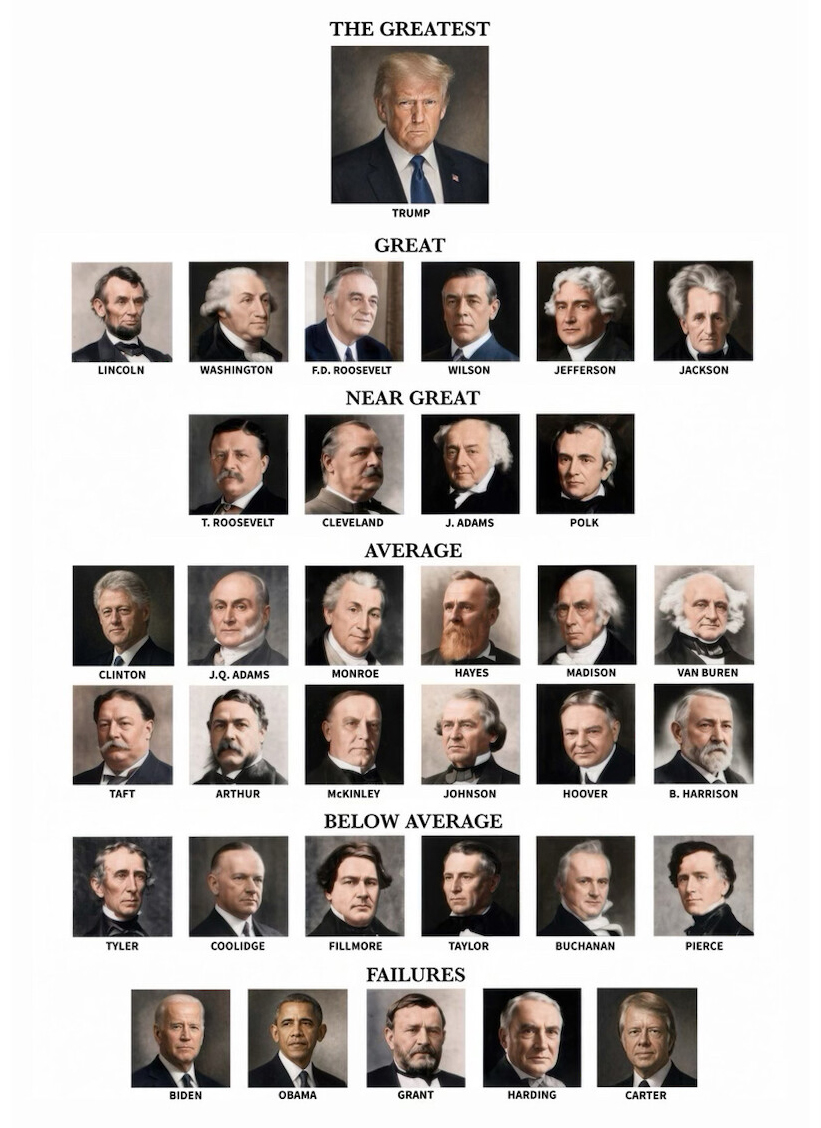
Trump is thinking about his legacy, not about holding the House and Senate, much to the dismay of congressional Republicans. To help burnish his legacy, he just sent out this AI-generated bleat:
[画像:Trump's AI-generated chart of presidents]There are a couple of problems here. We seem to be having some problems locating the beloved John F. Kennedy here, and also the less-beloved Lyndon B. Johnson. And what about Ike? Wasn't he the guy who was president back in the 1950s, the era MAGA wants to return to? Doesn't he rate even being on the chart? Not to mention St. Ronnie of Reagan?
We don't entirely get why Woodrow Wilson is among the greats. Maybe because he was a racist and white supremacist? The list of failures at the bottom has a surprise, though. Why is Warren Harding in the bottom row? His administration was so corrupt that 100 years later the only thing anyone remembers about it is the Teapot Dome scandal. What's not to like here?
There have been many ratings contests conducted by historians, political scientists, pollsters, and others. Here are 25 rankings since 1948. In the most recent one, from the American Political Science Association, Trump beat out Andrew Johnson and James Buchanan for the bottom spot. He was dead last. We were half-tempted to rotate the above image by 180°, but we managed to resist. In the 2024 APSA ranking (the most recent), The top three are Lincoln, F. Roosevelt, and George Washington. In nearly all rankings, these are the top three, but the order varies.
Trump has never been #1 in any ranking. However, in a 2018 Siena College Research Institute ranking, he did manage to beat out Buchanan and Andrew Johnson and was only third-worst president.
Now that we've had time for a little snark, we'll say that the image Trump sent out clearly comes from the 1948 Life magazine article reporting on the first major scholarly poll of presidents. Some Trumper used AI to add Trump at the top, put Joe Biden, Jimmy Carter and Barack Obama at the bottom, and then they called it a day. That Trumper, along with Trump himself, are counting on two things: (1) that people won't question the absurdity of Trump as the greatest ever and (2) that people won't notice that the presidents from 1948-2026, other than Trump and the three "failure" Democrats are missing. It's a way to put Trump front and center, and to try to create an impression he's a wild success.
A new report from The Atlantic says that Trump will spend some of the 400ドル million from one of his piggy banks to buy ads touting how great he is, rather than helping the beleagured Ken Paxton or Jon Husted.
Republican candidates DO NOT WANT to have Trump's face all over the media since this will allow Democrats to tie them to an unpopular president. They would prefer he just stay inside the White House until Nov. 3 and watch Fox News and not do anything visible outside the building. His overall approval is in the mid-30s, but on combating inflation, the most recent poll has him at 22% approve and 72% disapprove. Democrats are hammering him on this. His approval on the war in Iran is only marginally better, at 29/64.
Maybe Trump thinks he can improve his numbers by running ads praising the tax cut he gave to billionaires, but we suspect not. Also, it is not clear whether a Trump-centric midterm will turn out more Democrats or more Republicans. But Trump doesn't seem to care. He is definitely fighting against Democrats, just not James Talarico and Troy Jackson. His enemies are Andrew Johnson and James Buchanan and the goal is to get out of last place. But a big campaign that makes the midterms all about himself might actually have the reverse result. However, it will make Democratic candidates very happy. (V)
No, this is not an item about Sen. John Fetterman (D?-PA). It is about a number of (former) registered Republicans who have turned on Donald Trump and are running for office as Democrats. Some have even held public office as Republicans. Switching parties is not something new, but in the past it was rarely successful. It didn't work for Arlen Specter or Charlie Crist, but times are different now.
One of the arguments the party switchers are making is that they understand what Republicans want and how they think and that is valuable knowledge, The highest profile switcher is David Jolly, a former Republican congressman who is the Democratic nominee for governor of Florida. He is running against Rep. Byron Donalds (R-FL), who is extremely Trumpy. Donalds is also Black, which always plays a role in the South. Jolly is white.
Jolly has said that he believes 30% of the state consists of hard-core MAGA types and they are out of reach. He is therefore focusing on winning over traditional Republicans who have soured on Trump, along with independents. Most Democrats will probably vote for him even though he used to be a Republican because the alternative is so much worse.
Another former registered Republican in a high-profile race is vice admiral Nancy Lacore (ret.) who is running as a Democrat for the House seat Rep. Nancy Mace (R-SC) will retire from in January. Lacore was fired by Defense Secretary Pete Hegeth, mostly because she was a high-ranking woman and he doesn't like them. Lacore said: "It's a big tent, right?" She may have a point that South Carolina voters don't elect Democrats anymore, but if she isn't viewed as "one of those" Democrats, she might have a chance. The district, SC-01, which covers Charleston and the Low Country, is only R+6 and the current House generic poll is D+6.6, so maybe she has a chance, especially given her 35-year career in the Navy. Her opponent is attorney Jenny Honeycutt (R).
Still another former registered Republican running for the House is former TV anchor Janelle Stelson, who is challenging Rep. Scott Perry (R-PA) in PA-10, which includes Harrisburg. The district is R+3, even though it is in the Alabama/Kentucky part of Pennsylvania. There, being a former Republican is probably more of a help than a hindrance.
Yet another switcher is Rebecca Bennett, who is running against the occasionally present but mostly absent Rep. Tom Kean (R-NJ) in the EVEN NJ-07 district. Like the governor, Rebecca "Mikie" Sherrill, with whom she shares a first name, she was also a Navy helicopter pilot for 15 years. Bennett said that while in the military, she didn't serve Democrats or Republicans; she served Americans. In an EVEN district against a frequently absent incumbent in a blue state, Bennett has an excellent chance, even as a party switcher. (V)
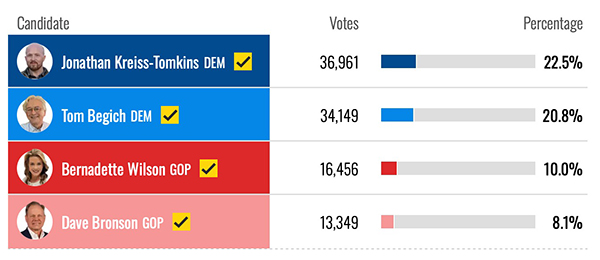
The race for governor of Alaska has gotten simpler—at least compared to what is was. There was an all-party jungle primary, with the top four finishers moving on to a ranked choice general election on Nov. 3. Here are the top four from the primary:
[画像:Top four finishers in Alaska gubernatorial primary]Now the top four has become a top three, because former State Senate Minority Leader Tom Begich (D) has dropped out. He ran out of money. That is usually why candidates for office drop out. On his way out the door, he endorsed former state Rep. Jonathan Kreiss-Tomkins (D).
In a ranked-choice election, if Begich had stayed in and been eliminated on the second round, many of his votes might have gone to Kreiss-Tomkins anyway, but not all. Some people don't mark a second choice on the ballot, which results in exhaustion (the ballot's, not the voter's). But there is a more important reason Begich dropped out. Instead of competing for the same donors and same resources, Kreiss-Tomkins and Begich can work together. Possibly Kreiss-Tomkins offered Begich a post in his administration if he wins, like secretary of sled dogs, a very important job in snowy Alaska.
It is also possible that the Democratic Governors' Association will now jump in since there is only one Democrat left. With two candidates, they probably didn't want to take sides. Now that is not a problem.
The result of Begich's decision to take one for the team means that JKT might actually have a chance. Dave Bronson is somewhat normal Republican and the former mayor of Anchorage. Bernadette Wilson is a sub-zero version of Marjorie Taylor Greene. She is the garbage candidate—she owns a waste management company. Correctly disposing of frozen moose poop requires special skills and equipment.
A lot is riding on who is eliminated on the first round. If Wilson just edges out Bronson again (which could happen if Donald Trump endorses her), then round two will be JKT against Wilson. Alaska is red, but it is not that red (R+6). Alaskans tend to be more libertarian than MAGA, and some Bronson supporters might prefer the somewhat bland JKT over the loony Wilson and might mark him as their second choice. If there are enough of them, in a blue wave, that might be enough to push JKT over the top. Alaskans do occasionally pick governors who are not Republicans, like Wally Hickel (I) in 1990, Tony Knowles (D) in 1994 and Bill Walker (I) in 2014.
Of course, Trump could pull a surprise that would upend the election by giving Alaska back to Russia in exchange for permission to build Trump Tower Moscow. (V)
Chinese government-sponsored hackers, known as QTFY, have penetrated many U.S. government computers, including those at the Dept. of Energy (which manages the U.S. nuclear arsenal), HHS, the DoJ, and many other departments. The hackers have also penetrated civilian networks and computers, including those of telecomm providers, hospitals, power and water companies, and more. There were also attempts to penetrate the Senate, NASA, the DoJ, the Fed, and more. Taking the government's word for which attempts were successful and which were not would be rather naive.
Why is this important? Well, suppose China wants to finally "reunite" Taiwan with the mother country—by invading it. A few hours before the invasion starts it disables many U.S. government computers as well as turning off the power, water, telephone, and cellular service in a dozen large U.S. cities, including all traffic lights (which would cause total gridlock everywhere). Then while the president is dealing with this five-alarm fire (for example, during morning rush hour), China invades Taiwan. Would a deeply distracted president be able to respond? Would the president even prioritize savng Taiwan over dealing with the massive civilian disruption? China is making a bet here.
Is the U.S. doing anything about this? For example, does it have an agency to defend against this kind of hostile attacks? Fortunately, yes (but hold on for a second). In 2007, George W. Bush, to his credit, recognized the the threat of a Cyber attack and created an agency, the NPPD, to defend against attacks. In 2018, Donald Trump 1.0 signed a bill promoting the NPPD to a full-blown federal agency called the Cybersecurity and Infrastructure Security Agency (CISA). The initial director was Chris Krebs, a respected professional in the area of cybersecurity and risk management.
On Nov. 17, 2020, two weeks after the 2020 election, Trump fired Krebs for openly stating that 59 election security experts agreed that the 2020 election was not hacked and Trump's claims that it was were false. But this was only the first round of Trump's attacks on CISA and other cybersecurity agencies. On April 3, 2025, Trump 2.0 fired the well-respected head of the U.S. Cyber Command, four-star Gen. Timothy Haugh, because Laura Loomer didn't think he was loyal enough to Trump. Trump followed that up by slashing CISA's budget, requiring the agency to fire 1,000 employees. Now people are asking "how did the Chinese attacks happen?" Beats us. (V)
A number of young influencers on social media have acquired large followings for various reasons. Some are into sports, others are into lifestyle topics like beauty, food, wellness, finance, or technology. Some are into politics. Politicians have noticed, and are now paying influencers to make pitches for them.
This is much more insidious than paid television commercials, because commercials are labeled as such and everyone knows the people in them are actors who don't especially care about the products they are pitching and are just spouting a memorized script the director gave them in return for money. Social media influencers act like they are your friend who is trying to help you because they are kind people. If followers discovered that they were endorsing some candidate because the candidate was paying them to do so, that changes the picture entirely, so very few influencers admit to being paid shills.
A study by The New York Times uncovered some of this by combing through candidates' finance reports. For example, Josh Greene, a left-wing social-media star with 800,000 followers to his podcast, has taken money from at least seven politicians. When Tom Steyer was running for governor of California, Steyer paid Greene 21,500ドル for plugs. This comes out to 2.69¢ per follower. Influencer Carlos Eduardo Espina, who has 14 million followers, got Steyer to pay him 400,000ドル. Michigan U.S. Senate candidate Abdul El-Sayed's (D) super PAC has also paid Greene. Many other influencers also put their mouths where the money is.
Katie Porter, another former California gubernatorial candidate, paid 12 influencers a total of 139,500ドル. The biggest payment, 25,000,ドル went to Avery Cyrus, who has 9.5 million TikTok followers. At that rate, a follower costs 0.26,ドル about a quarter of a penny per follower. Because the whole business is ad hoc and secretive, Cyrus probably didn't know that Greene was charging 10x more than she was. Since candidates know that most influencers aren't aware of what they are worth, Porter could buy off Cyrus for 25,000,ドル when Cyrus might have been able to demand and get 250,000ドル.
From the candidates' viewpoint, paying influencers is a cheap way to reach a large audience. It is also completely unregulated. Best of all, the viewers think they are getting unbiased advice, not a paid political ad, so the ads are likely more effective than spots that are labeled as paid ads. The only way a viewer would know their influencer "friend" is a paid pitchman or pitchwoman is by searching though candidates financial statements, and even then, not always, since payments are often routed through intermediaries.
There are now also companies that facilitate buying influencers. In the past they would have called themselves advertising agencies, but they are more discreet now. A company called SideShift claims to have a million creators who are willing to pitch products and candidates on Instagram, TikTok, YouTube and Facebook for (modest) payment. It is not exactly child labor, since most of the influencers are over 18, but many are happy to get paid at all, and are not driving a hard bargain. The way SideShift apparently works is that the advertiser posts what he or she wants, then creators pitch themselves and advertiser chooses one or more. SideShift gets 299ドル/mo. from the advertisers and 3% of the payment.
The whole business of undisclosed paid ads is ethically challenging and legally murky. TikTok's terms of service ban all paid political advertising. How does paying an influencer money to promote a candidate differ from hiring a professional actor to recite a script promoting a candidate on camera? Some day John Roberts will have to decide, but not yet.
While we are on the subject of paid influencers, it is worth noting that candidates are not the only ones buying influencers. Secretary of Defense Pete Hegseth has been actively hiring conservative military veterans with large online followings to promote his policies in a stealthy way. These include Air Force Col. Rob Maness (ret.) with 135,000 followers on eX-Twitter, Army Col. Kurt Schlichter (ret.), who has 620,000, and Army Col. Thomas Anderson (ret.), who has 323,000. Also working on this project is "DataRepublican," the nom de web of Jennica Pounds, a special DoD employee who has refused to explain what her job there entails, but it seems to relate to a lot of posting on social media. None of this was known until The Bulwark broke the story 4 days ago. It is entirely possible that Hegseth has committed a federal felony by using public money for political purposes, a violation of the Hatch Act. Given the secret nature of this work, these news fragments are likely to be only the tip of the iceberg. (V)
Looks like Iowa is going to be a real barnburner. We wonder if Democratic gubernatorial candidate Rob Sand, who is polling well, might have coattails. (V)
| State | Democrat | D % | Republican | R % | Start | End | Pollster |
| Iowa | Josh Turek | 48% | Ashley Hinson | 50% | Aug 27 | Aug 29 | Wedgewood Polls |
To download a poster about the site to hang up, please click here.